

Maddy summaryHF 2960 appropriates $25,000 from Minnesota’s arts and cultural heritage fund for fiscal year 2026 and $25,000 for fiscal year 2027 to provide a grant to "Fishing with Vets," a 501(c)(3) nonprofit organization. The funding will support the organization in organizing and conducting guided fishing trips for veterans across Minnesota. This bill directly affects veterans by enabling access to recreational fishing programs through an existing nonprofit, with no new policy requirements or program changes. The appropriation is limited to the specified amounts and timeframes outlined in the bill.
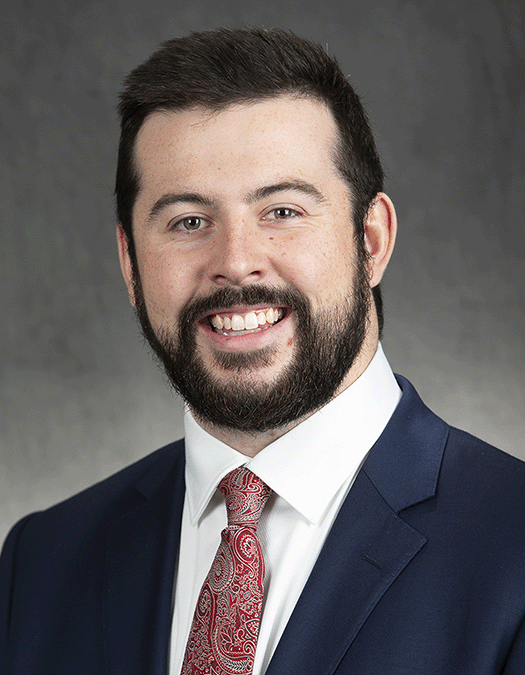
Rep. Spencer Igo
Sponsored bills
Maddy summaryHF 2013 limits certain local regulations on residential development in Minnesota. It prohibits municipalities from requiring specific building materials, designs, or aesthetic features beyond the State Building Code (chapter 326B), and bans minimum square footage requirements for residential projects. The bill directly affects developers and homeowners seeking building permits, as local governments can no longer impose these specific restrictions. It includes an exception for developments built by the municipality itself. The law takes effect the day after final enactment.
Maddy summaryHF 1309 prohibits Minnesota local governments (cities and counties) from requiring minimum parking spaces for new residential, commercial, or industrial buildings. The bill directly affects developers and property owners by removing a common zoning requirement that previously mandated a set number of parking spots. Key provisions state that political subdivisions cannot impose these minimums, though they may still require ADA-compliant disability parking or make non-binding parking space recommendations. This change aims to increase flexibility for development projects, potentially allowing more housing or commercial space without dedicated parking.
Maddy summaryHF 1340 amends Minnesota law to allow housing infrastructure bonds to fund adaptive reuse projects (converting existing buildings like offices or stores into housing) for permanent and supportive housing. It directly affects low-income households earning 50% or less of the area median income (AMI) and housing developers seeking bond financing. The bill expands existing bond program uses to specifically include adaptive reuse for these affordable housing projects, requiring new construction to meet accessibility standards (e.g., roll-in showers, sensory-accessible units). This change to Minnesota Statutes 462A.37, section 2, broadens the program’s scope without creating new funding.
Maddy summaryHF 3030 provides additional unemployment benefits for workers laid off in the iron ore mining industry (or supporting industries) due to a 50% or greater workforce reduction between March 15 and June 15, 2025, with benefits capped at 26 weeks. Eligibility requires exhausting regular unemployment benefits from qualifying employers and meeting standard eligibility rules. The bill also establishes new requirements for the safe storage of reactive mine waste (defined as waste causing a sustained pH drop of 0.5+ in water) to prevent environmental harm. A procedural provision allows temporary sulfate water quality standard modifications during pending rulemaking, but does not detail implementation.
Maddy summaryHF 3050 modifies Minnesota's requirements for safely storing reactive mine waste, directly affecting nonferrous metallic mining operations. The bill requires mining companies to conduct chemical and physical waste characterization before and during mining, and mandates that waste storage facilities be designed by Minnesota-registered engineers to meet water quality standards. Key provisions include designing facilities to either modify waste characteristics or collect and treat drainage water to prevent harmful pH changes in water sources. The bill repeals an outdated rule (Minnesota Rules 6132.2200) and updates engineering standards for waste storage. These changes aim to prevent environmental harm from mine waste by ensuring facilities meet current water quality protections.
Maddy summaryThis bill provides $12.189 million in state funding for clean water and wastewater infrastructure upgrades in Palisade, Minnesota. It appropriates bond proceeds to the city for specific projects including a new water treatment plant, well rehabilitation, pipe replacements, and wastewater facility improvements. The state will issue bonds up to this amount to cover the costs, administered through the Public Facilities Authority. The funding directly supports Palisade's municipal infrastructure systems serving its residents.
Maddy summaryHF 1332 appropriates $18 million from state bonds to fund forest management on Minnesota's state forest lands. The funds cover reforestation activities (like planting native seeds and trees), site preparation, and forest stand improvement, including treatment for pests like emerald ash borer and spruce budworm. The state will issue bonds up to $18 million to finance these projects, administered by the commissioner of natural resources under Minnesota Statutes. This bill directly affects state forest management operations and the use of public funds for forestry capital projects.
Maddy summaryHF 856 creates a new position for a Common Interest Community Ombudsperson within Minnesota’s Department of Commerce to help resolve disputes between unit owners (like condo or HOA residents) and community associations. The ombudsperson will provide free dispute resolution services, maintain a public website with resources about rights and rules, and compile complaints - without making legal rulings or decisions. The bill classifies all personal data collected by the office as "private" or "nonpublic," requiring individual consent or court order for release. It appropriates funding for the office starting in fiscal year 2026, with the position effective July 1, 2025.
Maddy summaryThis bill appropriates $6.4 million for fiscal years 2026 and 2027 to fund Minnesota's Small Business Assistance Partnerships Program under Minnesota Statutes §116J.682. It directly supports small businesses by providing two-year grants through local partnerships, with funding administered by the Department of Employment and Economic Development. The bill specifies that all grants must be awarded in the first year of funding, and up to 5% of the appropriation may cover administrative costs. This is a one-time funding measure, not an ongoing program.