

Maddy summaryHF 278 increases fees for all-terrain vehicle (ATV) registrations and nonresident trail passes in Minnesota. It adds a $45 surcharge to all ATV registration fees (raising public-use fees from $6 to $20 annually) and increases the nonresident trail pass fee from $30 to $45 per year. The surcharge and higher pass fees fund grant-in-aid programs under Minnesota Statutes 84.927, specifically for constructing and maintaining ATV trails and use areas in counties and municipalities. This directly affects ATV owners (residents and nonresidents) who must pay these updated fees to operate on state or grant-in-aid trails.
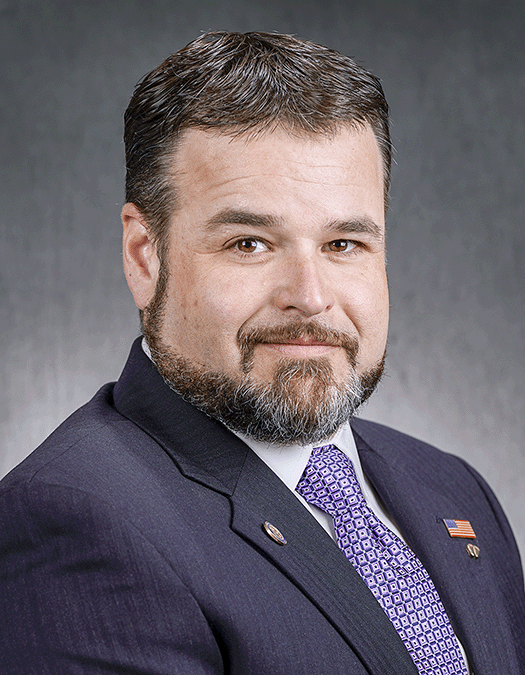
Rep. Josh Heintzeman
Sponsored bills
Maddy summaryHF 1382 removes outdated legal language from Minnesota law by repealing two specific statute sections: Minnesota Statutes 116C.04, subdivision 11 (which required the Environmental Quality Board to coordinate lead regulation compliance and report to the legislature by January 31, 1992) and 116C.991 (which detailed environmental review requirements for silica sand projects). These provisions are obsolete, as they reference outdated deadlines and regulatory frameworks. The bill makes no changes to current environmental regulations or requirements. It is a technical cleanup to remove redundant or outdated legal text.
Maddy summaryHF 1218 appropriates $22.1 million from Minnesota's Environment and Natural Resources Trust Fund for specific research projects during fiscal years 2026-2027. The bill funds university and state agency studies on wildlife management, including deer population monitoring, walleye strain research, wolf-deer interactions, and wood turtle conservation. These one-time appropriations establish grant programs requiring final reports, directly affecting research institutions like the University of Minnesota and the Science Museum of Minnesota. The funding modifies prior allocations but does not create new laws or regulations.
Maddy summaryHF 1845 expands Minnesota's definition of "veteran" to include two specific groups: (1) Hmong veterans naturalized under the federal Hmong Veterans' Naturalization Act of 2000, and (2) individuals who served honorably with secret guerrilla units or irregular forces operating from Laos in support of U.S. forces between February 28, 1961, and May 14, 1975. The bill amends Minnesota Statutes section 197.447 to add these categories to the existing definition, ensuring these veterans qualify for state benefits. It also creates an advisory task force of veterans, experts, and community members to help determine eligibility under the new definition. This change directly affects Hmong veterans and Laotian-based veterans who previously may not have met Minnesota's veteran criteria.
Maddy summaryMinnesota's legislature has passed a resolution requesting Congress to call a constitutional convention under Article V of the U.S. Constitution. The resolution asks for proposed amendments to impose budget rules on federal spending, reduce federal government authority over states, and limit terms for federal officials and members of Congress. This is a procedural step - Minnesota is formally petitioning Congress, not creating new laws. The resolution serves as Minnesota's ongoing application for such a convention, pending similar actions by two-thirds of states.
Maddy summaryHF 1362 repeals a Minnesota law requiring state environmental agencies to submit biennial reports to the governor and legislative committees about mandatory environmental review categories. The repealed provision (Minnesota Statutes § 116D.04, subd. 5b) mandated agencies to document the historical purpose of each review category, assess overlaps with other permits, and recommend changes. This bill directly affects agencies like the Pollution Control Agency, Department of Natural Resources, and Department of Transportation, which previously had to comply with these reporting requirements. The change eliminates a specific administrative obligation without altering environmental review processes or standards.
Maddy summaryHF 281 appropriates $380,000 for the Voyageur Country ATV Trail system and $175,000 for the Prospectors Loop Trail system in St. Louis County. The funds, from the natural resources fund, are for one-time use on trail design, right-of-way acquisition, permitting, and construction through June 2028. This bill directly affects St. Louis County by providing targeted funding for specific ATV trail projects.
Maddy summaryHF 1425 prohibits the commissioner of natural resources from selling any state-owned land located wholly or partially within the Boundary Waters Canoe Area Wilderness. This directly affects the commissioner’s authority over state lands and prevents potential private sales in this protected wilderness area. The bill repeals Minnesota Statutes section 92.82, which previously allowed such sales, while permitting land exchanges. It applies to all state lands managed by the commissioner, including those acquired through legal processes like condemnation or congressional grants.
Maddy summaryHF 2220 prohibits Minnesota state agencies from charging parking fees to state employees at facilities owned or operated by the state. It directly affects all state employees who park on state property, whether working or with manager approval for personal use. The bill amends Minnesota Statutes (sections 16B.04 and 16B.58) to require free parking, removing all fees, fines, or penalties for eligible employees. This change applies to all state parking lots managed under the Department of Administration, ensuring employees receive a free parking permit.
Maddy summaryHF 1676 modifies Minnesota's rules for farmed deer (Cervidae) to strengthen chronic wasting disease (CWD) management. It requires annual herd inventory verification by veterinarians, 14-day reporting of deer movements, and mandatory CWD testing for deer over six months that die or are slaughtered. If CWD is detected, owners must depopulate herds within 30 days, maintain fencing for ten years, post biohazard signs, and disclose CWD history to future property buyers. The bill directly affects deer farmers and landowners in CWD-affected areas, adding specific reporting, testing, and long-term land-use restrictions. These changes aim to prevent CWD spread through stricter monitoring and response protocols.