

Maddy summaryHF 3793 requires large groundwater users (those exceeding 100 million gallons annually or 50% of a municipality's current water allocation) to apply for their own water-use permits instead of modifying existing municipal permits. This affects industrial and commercial entities, including data centers, whose water use meets these thresholds. Key provisions include mandatory public comment periods for new permits, potential aquifer testing, and monthly reporting for threshold users - compared to annual reporting for smaller users. The bill aims to strengthen oversight of significant groundwater withdrawals while ensuring public input and watershed protection.
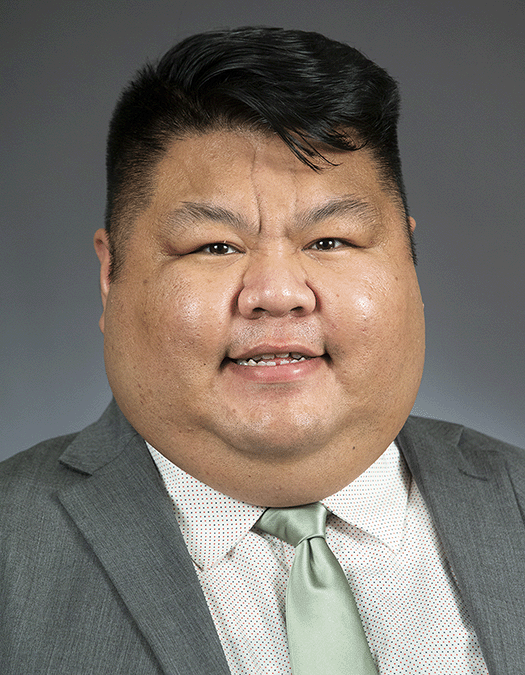
Rep. Jay Xiong
Sponsored bills
Maddy summaryHF 2380 prohibits discrimination against individuals with disabilities in services, programs, or activities receiving state funding in Minnesota. It directly affects public and private entities (like schools, hospitals, and businesses) that receive state money. The bill requires these entities to provide reasonable accommodations and bans exclusion or denial of benefits due to disability. It also specifically prohibits businesses from banning service animals or charging extra fees for them, defining "disability" broadly to include conditions substantially limiting major life activities.
Maddy summaryThis bill creates a new Greenhouse Gas Pollution Superfund in Minnesota to address climate change impacts. It establishes a program that requires fossil fuel companies responsible for over one billion metric tons of emissions between 1995 and 2026 to pay into a dedicated account. The collected funds will be used to finance climate change adaptation projects for state, local, and Tribal governments, as well as for disadvantaged communities. The bill defines specific terms like "responsible party" and "covered greenhouse gas emissions" to determine which companies must contribute and what types of projects can receive funding.
Maddy summaryThis bill designates thermal energy networks as public improvements and waterworks, allowing municipalities in Minnesota to acquire, construct, and maintain these systems alongside existing utilities like water and sewer infrastructure. The legislation amends state statutes to explicitly include thermal energy networks in the list of authorized municipal projects, enabling local governments to build and operate district heating systems as part of their public works responsibilities. By reclassifying these networks under existing legal frameworks for waterworks and public improvements, the bill provides municipalities with the authority to plan, fund, and manage thermal energy distribution without requiring new legislative approvals for each project.
Maddy summaryThis bill updates terminology and adjusts certain positions within Ramsey County's human resources personnel structure to align with other similar roles. It changes the title of the human resources director to "chief human resources officer" and moves this position from classified to unclassified service, while also updating the county manager's role in labor negotiations. The legislation repeals outdated language and makes technical corrections to state statutes governing county personnel systems, ensuring consistency across the county's administrative framework. These changes affect how county employees are classified, how personnel rules are created, and how collective bargaining agreements are managed within the county government.
Maddy summaryThis bill prohibits Minnesota municipalities from signing nondisclosure agreements that prevent them from sharing information about projects funded with public money. It directly affects local governments, including cities, counties, school districts, and other political subdivisions that manage public funds. The law makes any such restrictive contracts automatically unenforceable and requires municipalities to publicly disclose any agreements that violate this rule. The provision specifically covers projects involving land development, economic initiatives, tax revenues, bonds, and other debt obligations.
Maddy summaryHF 3624 appropriates $5,392,000 from the general fund for Minnesota's food shelf programs in fiscal year 2027. The funding, added to the base allocation, supports existing food shelf operations under Minnesota Statutes section 142F.14, administered by the state agency for children, youth, and families. This bill directly affects community food shelves that provide emergency food assistance to Minnesotans in need, without changing program eligibility or creating new requirements. The measure focuses solely on providing dedicated state funding for current food shelf services.
Maddy summaryHF 3586 establishes a $10 million annual grant program for regional food banks and Minnesota Tribal governments in Minnesota, funded through the general fund for fiscal years 2027-2029. The program distributes funds based on poverty and unemployment data in each area, requiring grantees to use money for purchasing, transporting, and distributing food and hygiene products (like diapers) at no cost to recipients. Funds cannot cover staff salaries or other ineligible expenses, and grantees must report spending and maintain records for oversight. This bill directly supports food banks serving low-income individuals and families by expanding access to essential food and hygiene supplies.
Maddy summaryHF 82 clarifies the scope of practice for licensed athletic trainers in Minnesota. The bill defines "athletic training" to include specific activities like injury prevention, emergency care, assessment, rehabilitation, and clinical decision-making within the trainer's expertise. It requires athletic trainers to work under a primary physician's direction, with documented protocols updated yearly, and limits initial treatment of undiagnosed injuries to 30 days (or less as specified by the physician). This directly affects athletic trainers, primary physicians, and healthcare facilities employing them, ensuring clear boundaries for their practice while preventing overlap with other licensed professions like physical therapy or medicine.
Maddy summaryThis bill establishes a one-year moratorium on issuing permits for new data centers in Minnesota, preventing their construction until a comprehensive report is completed. The Public Utility Commission is required to submit this report by July 1, 2027, or January 1, 2028, if an extension is granted, to state legislative committees. The report must analyze energy, water, and materials usage; environmental and cultural impacts on Tribal Nations; local and state economic effects; and suitable locations that minimize disruption to communities and infrastructure. Additionally, the commission must consult with Tribal governments and hire a third-party contractor who has no financial ties to data center developers to ensure the report's objectivity.