

Maddy summaryHF 3263 appropriates $1.2 million from Minnesota's workforce development fund for the Asian Economic Development Association (AEDA) in fiscal year 2026. The funds will support AEDA, in partnership with the Minnesota Asian Building Trades Entrepreneurs (MABTE) coalition and related businesses, to grow member companies through training, hiring, and capacity-building programs. This is a one-time appropriation available until June 30, 2027, directly benefiting Asian-owned small businesses and entrepreneurs in Minnesota's building trades sector. The bill provides concrete funding for existing workforce development efforts without creating new regulations.
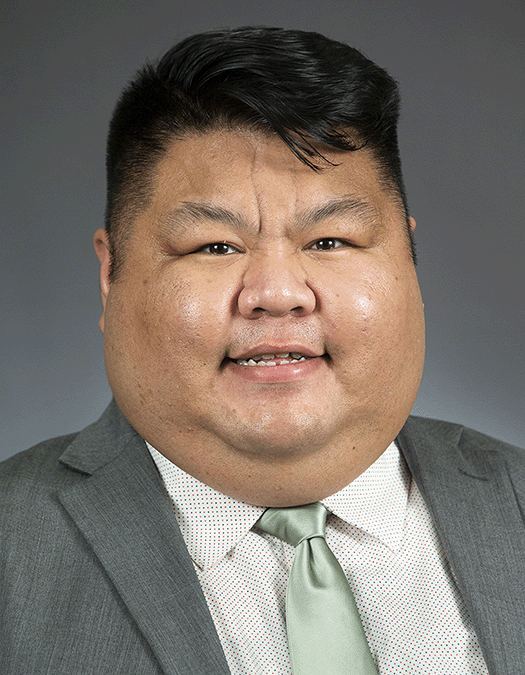
Rep. Jay Xiong
Sponsored bills
Maddy summaryThis bill appropriates $20 million ($10 million for each of fiscal years 2026 and 2027) to create regional food bank grants. It directs the commissioner of Children, Youth, and Families to distribute funds to regional food banks and federally recognized Minnesota tribes to purchase, transport, and distribute food through federal programs, with optional use for hygiene products like diapers. Recipients must comply with federal food assistance guidelines and report spending to the commissioner. The program aims to increase food availability for individuals and families in need across Minnesota.
Maddy summaryHF 3164 establishes a Minnesota state program providing $10,000 relocation grants to veterans who were involuntarily terminated from federal jobs on or after January 20, 2025, and establish Minnesota residency before January 1, 2027, while beginning at least 20 hours/week of work in the state before that date. The program, funded by a $6 million appropriation from the workforce development fund for fiscal year 2026 (including $50,000 for outreach), requires applicants to apply through the commissioner of employment and economic development. The commissioner must report on the program’s implementation to legislative committees by March 1, 2027. This policy directly supports eligible veterans transitioning to Minnesota employment and aims to strengthen the state’s workforce.
Maddy summaryHF 1644 creates a grant program to fund family permanent supportive housing in Minnesota. It appropriates $1.5 million for fiscal year 2026 to provide $15,000 per family served to nonprofit organizations or Tribal governments operating housing for families facing barriers like homelessness, mental health challenges, or child protection referrals. The program requires grantees to offer specific services - including child-centered education, job training, counseling referrals, and 24/7 on-site staffing - to help families maintain stable housing and support children's well-being. Funding must serve 60% of families in the metro area, 40% outside it, and at least 10% from Minnesota Tribal Nations.
Maddy summaryHF 2764 requires Minnesota public schools (including charter schools participating in the National School Lunch Program) to offer at least one plant-based meal option daily starting with the 2026-2027 school year. A "plant-based meal" is defined as one without any animal products (meat, dairy, eggs, fish), and schools must provide this option within four weeks of a student's written request. Schools must also make the request process clear to students and parents, comply with federal nutrition standards, and report annually on implementation to the Department of Education. The bill applies to all public schools serving lunches through the National School Lunch Program.
Maddy summaryHF 2444 is a Minnesota state budget bill that allocates funding for military and veterans services. It provides $30 million for Military Affairs (2026) and $33.5 million (2027), plus $141.9 million for Veterans Affairs (2026) and $146.7 million (2027), including $111.3 million for veterans health care. The bill requires new reporting on federal Medicare reimbursements for veterans homes, allocates $550,000 annually for suicide prevention programs, and mandates a memorial plaque for Gold Star and Blue Star families at the State Capitol. These provisions directly affect Minnesota veterans, military families, and state agencies managing veterans' benefits and facilities.
Maddy summaryThis bill modifies Minnesota's definition of a "debt buyer" to clarify that businesses purchasing charged-off medical debts for collection purposes are considered debt buyers, while excluding nonprofits buying for charitable reasons. It appropriates $5 million from the general fund for a one-time grant to the nonprofit Undue Medical Debt to relieve medical debt for eligible residents who couldn't pay after hospitals completed reasonable collection efforts. The grant must be used by June 30, 2028, and Undue Medical Debt must report recipient demographics to state agencies. The bill directly affects low-income Minnesotans with unpaid medical bills and hospitals that previously pursued collections.
Maddy summaryHF 2355 modifies Minnesota school district requirements for sexually transmitted infection (STI) prevention programs. It mandates that all public school districts develop programs including medically accurate curriculum covering abstinence until marriage, updated prevention materials, coordination with health agencies, and parent/community involvement. The bill requires districts to collaborate with health departments and community organizations to target high-risk adolescents. These programs must align with existing health curriculum standards and be implemented by school districts across Minnesota.
Maddy summaryHF 3158 proposes a constitutional amendment requiring a two-thirds vote in both the Minnesota House and Senate to authorize public funding for the design, construction, or renovation of a professional sports facility. Currently, a simple majority vote suffices for such funding. The amendment must be submitted to voters in the 2026 general election, where they will decide whether to adopt the two-thirds requirement. If approved by voters, this change would become part of the Minnesota Constitution, affecting future legislative decisions on sports facility funding.
Maddy summaryHF 3008 appropriates $250,000 from Minnesota's arts and cultural heritage fund for fiscal year 2026 and another $250,000 for fiscal year 2027. The funds will be provided as a grant to Hometown Hero Outdoors, a Stillwater-based nonprofit, to support outdoor recreational activities and mental health services. These services are directly intended for currently serving military personnel and veterans in Minnesota. The bill aims to improve mental health outcomes and quality of life through structured outdoor engagement and access to mental health professionals.