

Maddy summaryHF 265, also known as "Brent's Law," requires Minnesota 911 call centers to identify mental health crisis calls and prioritize mental health crisis teams as primary responders when available. It mandates that 911 telecommunicators receive specific training or mental health staff screen calls to recognize crises, and establishes protocols for public safety answering points to comply. The bill also creates a civil lawsuit option for individuals or families harmed by violations, allowing claims for damages, attorney fees, and up to $15,000 in punitive damages for willful violations. This directly affects all Minnesota public safety answering points and the government entities operating them.
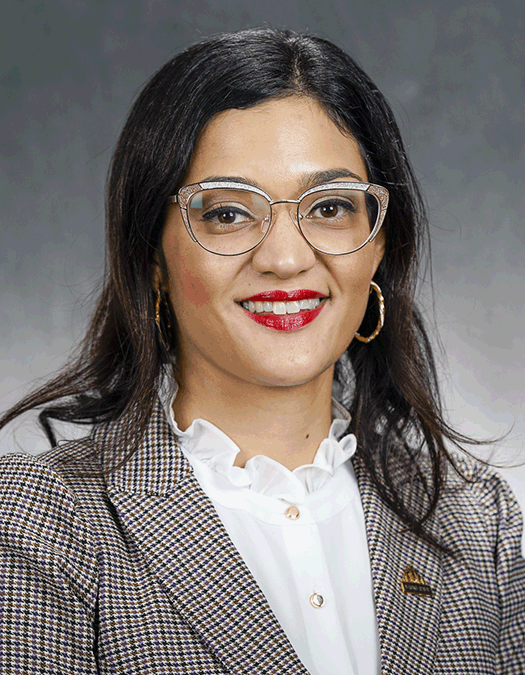
Rep. María Isa Pérez-Vega
Sponsored bills
Maddy summaryHF 196 appropriates $4 million from state bond proceeds to Dakota County for specific improvements at Thompson County Park in Dakota County. The funds will finance accessible outdoor recreation features including a nature play area, picnic spaces, park entrance safety upgrades, ravine overlooks, and accessible trail enhancements. The state will issue up to $4 million in bonds under Minnesota law to cover this appropriation. The bill becomes effective the day after final enactment.
Maddy summaryHF 218 appropriates $3 million from state bonds to fund specific improvements at West St. Paul's 150 Thompson Community Square. The funds will finance an enclosed pavilion for public/private events, an outdoor performance stage, and a convertible turf area that can be used as an ice rink. The city of West St. Paul will receive the grant through the commissioner of employment and economic development. This bill directly affects West St. Paul residents by enhancing community space infrastructure through state-funded construction.
Maddy summaryHF 141 modifies Minnesota's sustainable building guidelines to require state agencies to comply with these standards during the predesign phase for all new state buildings and major renovations. It directly affects state agencies planning construction or major renovations (defined as projects over 10,000 sq. ft. or involving mechanical system replacement). The bill adds specific requirements for reducing greenhouse gas emissions, improving indoor air quality, conserving water, and enhancing climate resilience into the guidelines, while mandating a report and appropriating funds for implementation. These changes apply to all state-funded projects after specified dates, ensuring sustainability is integrated early in the planning process.
Maddy summaryHF 501 proposes a constitutional amendment to guarantee equal rights under Minnesota law and prohibit state discrimination based on race, color, national origin, ancestry, disability, or sex - including pregnancy decisions, gender identity, and sexual orientation. If approved by voters in 2026, it would add a new section to the Minnesota Constitution requiring state actions to use the least restrictive means to achieve compelling government interests. The amendment would directly apply to all Minnesotans and state agencies, ensuring equal protection in all state laws and programs. It requires voter approval at the 2026 general election, with the question asking whether the state constitution should include these equal rights protections.
Maddy summaryHF 116 appropriates $250,000 for fiscal year 2026 and $250,000 for fiscal year 2027 from Minnesota's arts and cultural heritage fund to (Neo)Muralismos de Mexico. The funds will directly support expanding arts programming that celebrates Latino cultural heritage through workshops, artist support, and capacity building. Key provisions include providing professional development, networking opportunities, and presentation platforms for Latino artists and cultural organizations. This bill specifically targets funding for a single organization to strengthen community arts initiatives focused on Latino cultural expression.
Maddy summaryHF 262 prohibits employers from paying people with disabilities less than the state minimum wage, effective August 1, 2025 for new hires and August 1, 2027 for all current employees, ending the use of federal or state special certificates that allow subminimum wages. It requires providers of home and community-based services to report data on individuals currently paid subminimum wages by August 1, 2027, including personal details and employment metrics. The bill appropriates $38,000 in fiscal year 2026 and $75,000 in fiscal year 2027 to enhance the MnCHOICES system with employment-related resources. These changes directly affect employers, service providers, and people with disabilities working in supported employment programs across Minnesota.
Maddy summaryThis bill appropriates $500,000 from the workforce development fund for fiscal year 2026, and $500,000 from that fund plus $500,000 from the general fund for fiscal year 2027 - totaling $1.5 million in one-time funding - to the Hmong American Partnership. The funds are designated for job training, employment services, business development, technology support, financial services, and empowerment programs. The bill directly affects the Hmong American Partnership organization in Minnesota, which will use the grant to support economic opportunities for Hmong American communities.
Maddy summaryHF 117 appropriates $300,000 from Minnesota's arts and cultural heritage fund to the Walker West Music Academy for specific programs. The funding supports 12 free concerts, youth and adult music education classes, professional development for music educators, and community choir initiatives. This direct allocation affects the Walker West Music Academy and the local community it serves through these arts and education programs. The bill establishes a concrete funding mechanism for these services in fiscal year 2026.
Maddy summaryHF 109 allocates $2 million for fiscal year 2026 and $2 million for fiscal year 2027 from the state general fund to Propel Nonprofits. The funds will support grants for community-based organizations in Minnesota, specifically for capacity building, technical assistance, training, and strategic consulting. Up to 10% of the total amount may cover Propel Nonprofits' administrative costs. This is a one-time appropriation, not an ongoing funding source, directly benefiting local community organizations through Propel's grant program.