

Maddy summaryHF 2764 requires Minnesota public schools (including charter schools participating in the National School Lunch Program) to offer at least one plant-based meal option daily starting with the 2026-2027 school year. A "plant-based meal" is defined as one without any animal products (meat, dairy, eggs, fish), and schools must provide this option within four weeks of a student's written request. Schools must also make the request process clear to students and parents, comply with federal nutrition standards, and report annually on implementation to the Department of Education. The bill applies to all public schools serving lunches through the National School Lunch Program.
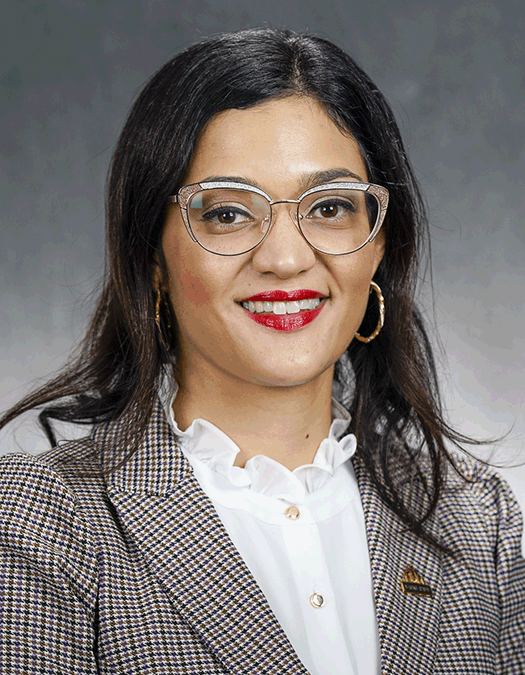
Rep. María Isa Pérez-Vega
Sponsored bills
Maddy summaryHF 3185 provides Minnesota state funding to replace St. Paul's Robert Street viaduct if the federal government rescinds a $25 million RAISE grant. Specifically, it appropriates $21.2 million from the trunk highway fund and $3.8 million from the general fund - totaling $25 million - to cover the project if the federal grant is withdrawn. The funding covers the viaduct replacement and related improvements like pedestrian crossings, sidewalk upgrades, transit access, and community amenities. This bill directly affects the St. Paul city project and ensures funding continuity should federal support be lost. It is a contingent appropriation triggered solely by a USDOT decision to rescind the existing grant.
Maddy summaryHF 1383 establishes the "Great Start Affordability Scholarship" program to help low-to-moderate income families pay for child care. It directly affects families with children from birth to kindergarten entry who earn under 150% of Minnesota's median income. The bill requires the program to limit child care costs to no more than 7% of a family's annual income, transitions existing child care assistance into this new system by July 2028, and mandates participating child care providers to meet quality standards through Minnesota's rating system. Families must renew scholarships annually, and providers must use scholarship funds to supplement, not replace, existing federal funding.
Maddy summaryHF 847 appropriates $2.7 million for each of fiscal years 2026 and 2027 from the general fund to provide community action grants under Minnesota Statutes sections 142F.30 to 142F.302. The funding directly supports community action agencies that serve low-income residents with services like housing assistance, job training, and nutrition programs. This bill allocates specific state funds to maintain ongoing grant programs without changing existing eligibility rules or creating new requirements. The appropriation is a routine funding measure for established community-based services.
Maddy summaryHF 1471 requires local governments in Minnesota (such as cities or towns) to provide renters with a copy of the Attorney General's existing landlord-tenant guide whenever they issue or renew a rental license. This applies whether the license is issued in person (requiring a physical copy) or electronically (requiring a link to the guide online). The bill directly affects landlords who obtain rental licenses and local governments that administer the licensing process. It ensures renters have immediate access to clear information about their rights and responsibilities under Minnesota law.
Maddy summaryHF 1002 appropriates $15 million for the Head Start program in fiscal year 2026 and $15 million for fiscal year 2027 from the state general fund. This funding directly supports Minnesota's Head Start program, which provides early childhood education and family services to low-income preschool children. The bill directs these funds to the commissioner of children, youth, and families for implementation under Minnesota Statutes section 142D.12. The legislation makes no changes to program eligibility or structure, solely providing dedicated state funding for existing Head Start services.
Maddy summaryThis bill modifies Minnesota's definition of a "debt buyer" to clarify that businesses purchasing charged-off medical debts for collection purposes are considered debt buyers, while excluding nonprofits buying for charitable reasons. It appropriates $5 million from the general fund for a one-time grant to the nonprofit Undue Medical Debt to relieve medical debt for eligible residents who couldn't pay after hospitals completed reasonable collection efforts. The grant must be used by June 30, 2028, and Undue Medical Debt must report recipient demographics to state agencies. The bill directly affects low-income Minnesotans with unpaid medical bills and hospitals that previously pursued collections.
Maddy summaryHF 2147 exempts hot tubs or whirlpools on houseboats and single-unit rental properties from most public pool safety requirements in Minnesota. It requires property owners to ensure water temperature stays below 106°F, test chlorine/bromine, pH, and alkalinity before each rental, and provide renters with a specific notice about the exemption. The bill mandates a posted warning: "NOTICE: This spa is exempt from certain state and local sanitary requirements... USE AT YOUR OWN RISK." It directly affects rental property owners, resorts, and renters of these properties, while prohibiting local governments from adding extra requirements for qualifying hot water pools.
Maddy summaryHF 361 extends the deadline for using funds to implement the Capitol Mall Design Framework until June 30, 2025. It appropriates $4.5 million for the city of St. Paul to improve livability, economic health, and safety in the Capitol Area, including $500,000 specifically for technical assistance through the Capitol Area Architectural and Planning Board to help residents and businesses apply for community grants. The bill repeals and cancels the previous Capitol Area community vitality account established in 2023, transferring any remaining funds to the general fund. This legislation directly affects the city of St. Paul, the Capitol Area Architectural and Planning Board, and local businesses and residents in the Capitol Area.
Maddy summaryHF 2565 extends a one-time $1 million grant from the workforce development fund to Ramsey County (in partnership with St. Paul) for workforce development programs. It directly supports youth and young adults aged 18-30 through initiatives like the "Learn and Earn" program, which includes technology training and a driver's license academy. The funding, available until June 30, 2028, is specifically for these targeted training pathways and is not an ongoing appropriation. This bill modifies the existing grant authorization to extend its availability through the specified deadline.