

Maddy summaryHF 1812 establishes a state-run Minnesota Health Plan to guarantee comprehensive, affordable health care for every Minnesota resident. The plan covers all necessary medical, dental, vision, mental health, and long-term care services without co-pays, with premiums based on income. It creates new state entities including the Minnesota Health Board, Health Fund, Office of Health Quality and Planning, a patient advocacy ombudsman, and an auditor for the plan. The bill also requests a federal waiver under the Affordable Care Act to modify certain health insurance requirements and appropriates funding for implementation.
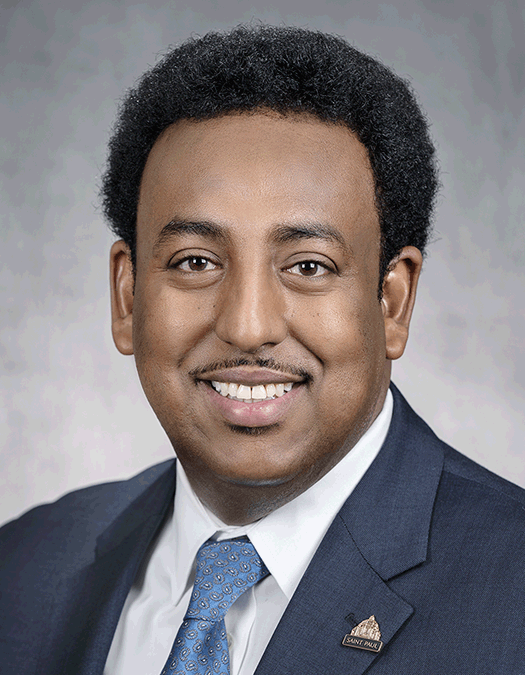
Rep. Samakab Hussein
Sponsored bills
Maddy summaryHF 1813 appropriates $2 million from the general fund for fiscal year 2026 to 30,000 Feet, a nonprofit organization, to design, construct, and equip a Black Arts and Tech Center in St. Paul. The center will include an outdoor performance space, art room, and dance space to provide tech training and programming specifically for youth living in poverty. This funding is in addition to prior appropriations and remains available until the project is completed. The bill directly affects 30,000 Feet as the grant recipient and youth in St. Paul experiencing poverty through expanded access to arts and tech resources.
Maddy summaryHF 1160 appropriates funds from the general fund for a one-time grant to Union Gospel Mission Twin Cities, a 501(c)(3) nonprofit organization. The grant will support the design and construction of a new women and children's family shelter and transitional housing at 376 Western Avenue in St. Paul, as well as capital improvements at the men's campus at 435 University Avenue East in St. Paul. The appropriation is designated for fiscal year 2026 and remains available until the projects are completed or abandoned. This bill directly provides funding for specific facility projects at the nonprofit's St. Paul locations.
Maddy summaryHF 1797 appropriates $1 million for fiscal year 2026 and $1 million for fiscal year 2027 from the arts and cultural heritage fund to the Somali Museum of Minnesota. The funding supports the museum's heritage programs, including classes, exhibits, and community presentations about Somali culture in Minnesota. It also covers extended operating hours and free or reduced-fee programming for schools and community events. This bill directly provides financial resources to the museum for its cultural preservation and outreach activities.
Maddy summaryHF 1017 appropriates $4.5 million from state bond proceeds to fund clean water infrastructure improvements in Brooklyn Park. The funds will support planning, building, and equipping water mains under U.S. Highway 169 and Trunk Highway 610, connecting new infrastructure for the city's biotech innovation district. The state will issue bonds up to $4.5 million to cover this cost, following standard bond procedures under Minnesota law. This bill directly affects Brooklyn Park's water system and its biotech area development, with no broader public impact beyond the specified project.
Maddy summaryHF 1648 modifies Minnesota landlord-tenant law to strengthen tenant protections. It requires landlords to provide tenants with the name, address, phone number, and email of the property owner, manager, and authorized agent in writing before lease signing (Section 2). The bill prohibits landlords from listing minor children’s names in leases or eviction complaints, except when the minor is the sole tenant (Section 3). It also establishes a prospective tenant’s right to view a rental unit before signing a lease and increases penalties for violations, including treble damages or $1,000 (Section 3). The law takes effect August 1, 2025, applying to new or renewed leases after that date.
Maddy summaryHF 1639 appropriates $550,000 for fiscal year 2026 and $550,000 for fiscal year 2027 from the state's workforce development fund to the International Institute of Minnesota. The funds must be used to provide workforce training for immigrants and refugees (referred to as "New Americans") in industries facing labor shortages. This one-time funding supports job skills development in high-demand sectors without creating new permanent programs.
Maddy summaryHF 1739 appropriates $1 million from the general fund for fiscal year 2026 to fund workforce programs for individuals in recovery through the nonprofit Generation Hope. The bill requires the funds to support four specific mechanisms: workforce training in high-demand industries, record expungement assistance to reduce employment barriers, personalized career coaching and job placement services, and partnerships with employers to connect participants to sustainable jobs. This one-time appropriation directly affects individuals in recovery seeking employment, aiming to address systemic barriers through concrete support services. The bill does not create new laws but allocates specific funding for targeted job placement initiatives.
Maddy summaryHF 1650 allocates $1,000,000 from Minnesota's arts and cultural heritage fund to the Minnesota Historical Society for the Minnesota Transportation Museum in St. Paul. The funding covers specific capital improvements including roof replacement, masonry stabilization, roundhouse door repairs, insulation installation, and ADA compliance modifications. This appropriation is available until project completion, subject to standard state fiscal rules. The bill directly affects the museum's physical infrastructure and accessibility, with no broader policy changes beyond the funded repairs.
Maddy summaryHF 1600 appropriates $750,000 for fiscal year 2026 and $750,000 for fiscal year 2027 from the state general fund to provide a one-time grant to Comunidades Organizando el Poder y la Acción Latina (COPAL). The funding is designated for COPAL to support capacity building, worker center programming, youth workforce development, GED classes, career planning, educational resources, health services, training programs, and job navigation assistance. This bill directly affects COPAL as the recipient organization, enabling it to expand services for immigrant and Latinx communities in Minnesota. The appropriation is specific to these defined programs and does not create new state requirements or alter existing laws.