

Maddy summaryHF 2220 prohibits Minnesota state agencies from charging parking fees to state employees at facilities owned or operated by the state. It directly affects all state employees who park on state property, whether working or with manager approval for personal use. The bill amends Minnesota Statutes (sections 16B.04 and 16B.58) to require free parking, removing all fees, fines, or penalties for eligible employees. This change applies to all state parking lots managed under the Department of Administration, ensuring employees receive a free parking permit.
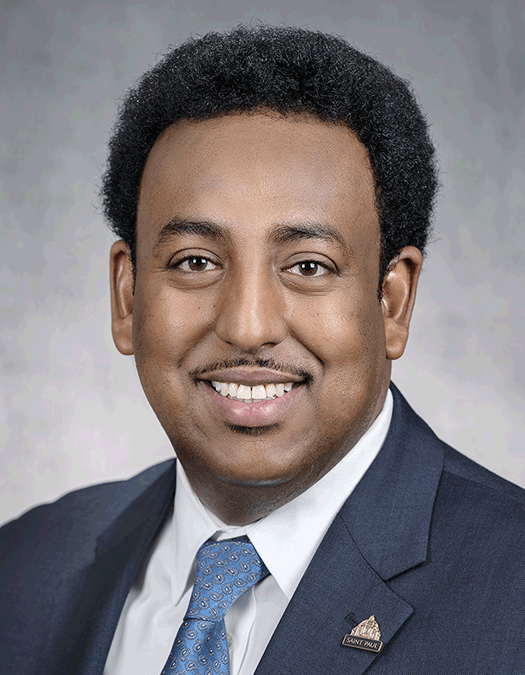
Rep. Samakab Hussein
Sponsored bills
Maddy summaryHF 1469 allocates $850,000 for fiscal year 2026 and another $850,000 for fiscal year 2027 from the workforce development fund to provide job skills training for individuals recently released from prison after a felony conviction (within 12 months of release). The funds are directed to Better Futures Minnesota, which must deliver the training and report annually on program outcomes. Required reports must include data on participant numbers, employment status, homelessness, recidivism, child support compliance, and specific job skills training provided. The bill directly affects formerly incarcerated Minnesotans with felony convictions and the state agency managing workforce development funds.
Maddy summaryHF 2264 allocates $350,000 for fiscal year 2026 and $350,000 for fiscal year 2027 from Minnesota’s workforce development fund to the 8218 Truce Center, a nonprofit organization. The funds are specifically for training local workers, covering costs like program development, job readiness support, placement services, and up to 10% for administrative expenses. This one-time appropriation expires on June 30, 2027, and directly supports the center’s workforce development services for community members. The bill does not create new programs but provides targeted funding for existing training initiatives.
Maddy summaryHF 2254 adds a $400 "baby bonus" to Minnesota's existing child credit for each qualifying child born during the tax year. This directly affects Minnesota taxpayers with newborn children, increasing their state income tax credit. The bill modifies the child credit calculation by adding the $400 per newborn (without reducing the minimum credit amount) and allows for potential advance payments. It takes effect for tax years beginning after December 31, 2024.
Maddy summaryHF 1582 modifies Minnesota's Teachers Retirement Association (TRA) benefits for educators. It allows teachers with 30 years of service to retire at age 60 without reduced annuity payments (previously requiring 35 years), adjusts early retirement penalties, and increases postretirement cost-of-living adjustments. The bill also raises employer contribution rates for school districts (from 13.3% to 17.3% for basic members) and increases pension adjustment revenue rates for school districts starting in 2026. These changes directly affect current and future TRA members, school districts funding retirement costs, and the state's retirement system budget.
Maddy summaryHF 498 appropriates $400,000 for fiscal year 2026 and $400,000 for fiscal year 2027 from the workforce development fund to provide a grant to the Urban League Twin Cities. The funds are specifically designated to support and expand the organization's workforce training and wealth-building programs. This one-time funding directly affects the Urban League Twin Cities' ability to deliver these services in the Twin Cities area. The bill provides concrete financial support for these existing community programs without altering broader policy.
Maddy summaryHF 2125 appropriates $1,000,000 from the general fund for fiscal year 2026 to the commissioner of human services, specifically to fund Generation Hope. The bill directs these funds to enhance culturally specific peer recovery and outreach programs by expanding culturally relevant services, conducting targeted outreach to underserved communities, providing cultural competency training for peer specialists, and partnering with community organizations. This one-time appropriation directly supports recovery services for individuals in underserved communities who need culturally informed care. The bill does not create new laws but provides dedicated funding for existing program enhancements.
Maddy summaryHF 2123 requires landlords with more than ten residential rental units to offer tenants the option to have their on-time rent payments reported to credit bureaus, without charging tenants or forcing participation. Tenants can opt out at any time, and landlords must stop reporting within 30 days of a request. The bill appropriates $500,000 for fiscal years 2026 and 2027 to provide grants to landlords - prioritizing those serving tenants at or below 50% of area median income - to cover costs for credit reporting services and technology. The Minnesota Housing Finance Agency must collect data on program participation and effectiveness, reporting findings to the legislature by March 1, 2027.
Maddy summaryHF 2141 allocates $400,000 from Minnesota's general fund for a one-time grant to the Organization of Liberians in Minnesota (OLM), a nonprofit community organization. The funds will cover the renovation, construction, and equipping of OLM's Brooklyn Park community center. This grant enables OLM to provide culturally relevant programs and services to Liberian community members in the northwest suburbs. The appropriation is available until the project is completed or abandoned, per state funding rules.
Maddy summaryHF 2139 appropriates $2 million for fiscal year 2026 and $2 million for 2027 to fund the Gateways2Growth Initiative through the Center for African Immigrants and Refugees Organization (CAIRO). The initiative provides training in information technology, commercial driver's license (CDL) programs, and healthcare careers (like nursing assistants and pharmacy technicians) specifically targeting historically underserved groups, including immigrants, refugees, rural residents, and those experiencing economic displacement. CAIRO must allocate funds equally between the Twin Cities metro area and other regions, prioritize underserved participants, and partner with employers for job placements. The bill requires annual reports tracking participant numbers, employment outcomes, wage growth, and how well the program addresses workforce shortages in these key sectors.