

Maddy summaryHF 2390 appropriates $275,000 for fiscal year 2026 and $275,000 for fiscal year 2027 from the workforce development fund to provide a grant to Workforce Development, Inc., for the Southeast Minnesota Workforce Development Area #8. The grant funds career training, education, and wraparound support services (including childcare, transportation, and housing assistance) for individuals with employment barriers in Steele County, aiming to address local worker shortages and help families move out of poverty. Up to 5% of the funds may cover administrative costs, and the grant is available until June 30, 2027, with unspent funds from year one carrying over to year two. The commissioner must report annually by January 15 to legislative committees on how the funds were used, including administrative expenses.
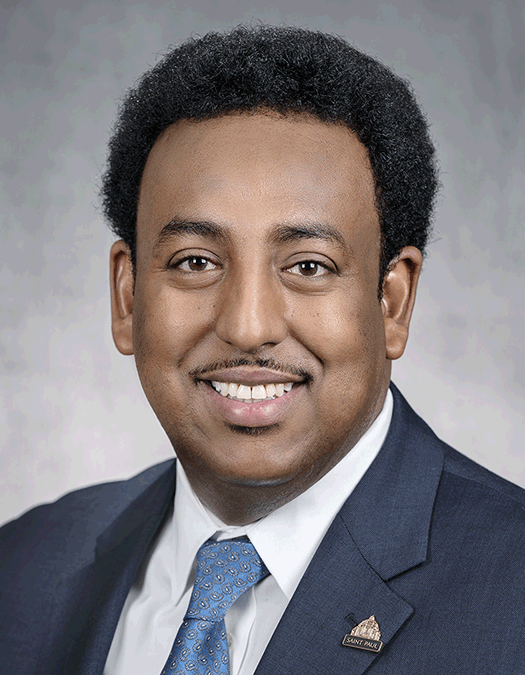
Rep. Samakab Hussein
Sponsored bills
Maddy summaryThis bill appropriates $375,000 for fiscal year 2026 and $375,000 for fiscal year 2027 from Minnesota's arts and cultural heritage fund to the Lake Superior Zoological Society. The funding is specifically for developing educational exhibits and programs focused on Minnesota's history and cultural heritage. The Lake Superior Zoological Society directly receives these funds to support its educational initiatives. The bill provides concrete financial support through established state funding mechanisms without altering broader policies.
Maddy summaryHF 2287 appropriates $100,000 from Minnesota's workforce development fund for a one-time grant to the Somali American Youth Enrichment Club (SAYEC). The funds support SAYEC's youth sports program and parent education program, with additional use for direct training, support services, and economic assistance for individuals facing employment barriers. This grant directly benefits Somali American youth and parents in Minnesota through structured community programs. The bill specifies no ongoing funding, making it a single-year appropriation for these targeted initiatives.
Maddy summaryHF 45 appropriates $1 million for fiscal year 2026 and $1 million for fiscal year 2027 from the general fund to support Minnesota's Supplemental Nutrition Assistance Outreach Program. This funding directly assists the commissioner of children, youth, and families in operating outreach efforts to help eligible Minnesotans access food assistance benefits. The bill provides specific, dedicated funding for the program under Minnesota Statutes, section 142F.12, without changing eligibility rules or benefit amounts. It ensures consistent financial support for outreach services that connect residents to existing nutrition assistance programs.
Maddy summaryHF 1461 appropriates $6.8 million from state bond proceeds to fund a specific project in Cosmos, Minnesota. The funds will support designing, constructing, and equipping a multifamily housing facility at 130 Neptune Street North, which will provide supportive services for senior citizens, a child care center for children not yet in kindergarten, and after-school/weekend programming for school-aged children. The state will issue bonds up to $6.8 million to cover this cost, following Minnesota’s bond issuance procedures. This bill directly affects the city of Cosmos and its residents by creating new housing and child care services at a specific location.
Maddy summaryHF 1105 amends Minnesota law to require the state health commissioner to *conduct* maternal death studies annually, changing the previous language from "may" to "must." This directly affects the Minnesota Department of Health, which must now systematically analyze preventable maternal deaths to improve healthcare systems. The bill mandates these studies to identify preventable causes and inform medical, health, and welfare service planning. Its key provision is making the maternal death study process mandatory, aiming to reduce preventable deaths through data-driven system improvements. The law applies statewide to all maternal health outcomes covered under Minnesota's health system.
Maddy summaryThis bill appropriates $375,000 for fiscal year 2026 and $375,000 for fiscal year 2027 from Minnesota's arts and cultural heritage fund to The Sanneh Foundation. The funding supports three specific programs: family nutritional distribution in the seven-county metropolitan area, senior community programming, and multicultural women's athletic programming. The Sanneh Foundation directly receives these funds to implement these community services.
Maddy summaryHF 2246 allocates $300,000 for fiscal year 2026 and $300,000 for fiscal year 2027 to the YMCA Center for Youth Voice to fund civic education programs for Minnesotans under 18. The bill requires these programs to teach constitutional principles, democratic foundations, and government structures, while also providing teacher professional development and educational resources. Unspent funds from 2026 may carry over to 2027. This legislation directly affects youth participants, teachers, and the YMCA Center for Youth Voice through dedicated funding for civic education.
Maddy summaryHF 2263 provides $170,000 for the 2026 fiscal year and $144,000 for 2027 to St. Paul Public Schools' East African Magnet School. The funding supports professional development for teachers on using first language resources and creating culturally relevant materials, including training on adapting stories and selecting resources. It requires all developed materials to be shared freely under a Creative Commons license across Minnesota schools. This is a one-time appropriation directly affecting East African Magnet School staff and students.
Maddy summaryHF 999 appropriates $100 million to the Midwest Minnesota Community Development Corporation (MMCDC) to administer a down payment assistance program for first-generation homebuyers. The program assists households where at least one adult never owned a home or lost one to foreclosure, with income at or below 100% of the area median income. It provides a no-interest loan covering up to 10% of a home's purchase price (capped at $32,000 initially), forgiven 20% annually over five years, usable for down payments or closing costs with a qualifying mortgage. MMCDC must report annually on program usage, demographics, and outcomes to the legislature.