

Maddy summaryHF 3074 creates legal rights for transportation network company (TNC) drivers in Minnesota to form and join labor organizations for collective bargaining. It directly affects "active drivers" who completed at least the median number of rides in the most recent two quarters, as defined by the bill. The law establishes a certification process where drivers can designate an exclusive representative (like a union) through the Bureau of Mediation Services, while prohibiting TNCs from controlling or dominating driver representation groups ("company unions"). Drivers gain the right to negotiate terms and conditions of work, including grievance procedures, with TNCs, and the bill defines "lockout" to prevent TNCs from restricting driver access to the platform during disputes.
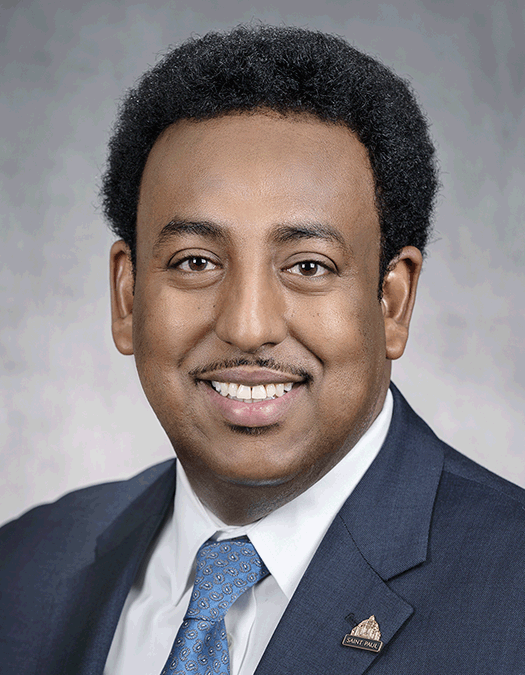
Rep. Samakab Hussein
Sponsored bills
Maddy summaryHF 3065 appropriates $250,000 for fiscal year 2026 and $250,000 for fiscal year 2027 from Minnesota's arts and cultural heritage fund to the Minnesota Humanities Center. This funding is specifically designated as a grant to Youth and Family Circle for outdoor programs aimed at youth. The programs focus on celebrating Minnesota's outdoor culture and heritage. The bill directly affects Youth and Family Circle by providing them with dedicated funding for these initiatives.
Maddy summaryHF 3062 appropriates $4.5 million from Minnesota's renewable development account for energy efficiency upgrades to the former St. Paul Athletic Club building. The funds, available until June 2028, will be granted to Youthprise for specific improvements including roof repairs to support solar panels, LED lighting installations, and design/engineering costs. This one-time appropriation directly affects the building's renovation and Youthprise as the recipient organization. The bill does not create new regulations but provides targeted funding for measurable energy efficiency enhancements.
Maddy summaryHF 1010 establishes a new licensure process for certified midwives in Minnesota through the Board of Nursing, creating a specific "Minnesota Certified Midwife Practice Act" (Chapter 148G). It amends health occupation definitions to include "licensed certified midwife," expands Medicaid coverage to include services provided by these licensed midwives, and sets civil/criminal penalties for violations. The bill directly affects certified midwives (requiring national certification plus state licensure) and Medicaid recipients who can now access midwifery care under their coverage. Key provisions define midwifery scope (including pregnancy, birth, and women's primary care) and set licensure terms, moving midwifery from an unregulated status to a licensed profession with expanded coverage.
Maddy summaryHF 2982 appropriates $500,000 for fiscal year 2026 and $500,000 for fiscal year 2027 from the general fund to create a grant for a nonprofit to establish a credit union. The credit union must specifically serve low-income individuals with limited access to traditional banking, offering deposit, loan, and investment services in a culturally appropriate way. It requires the credit union to operate at least one physical location and mandates a report on outcomes to legislative committees by February 15, 2028. This bill directly affects underserved Minnesotans by expanding access to banking services and the nonprofit implementing the credit union. The funding is a one-time appropriation with specific service requirements and reporting obligations.
Maddy summaryThis bill appropriates $100,000 for each of fiscal years 2026 and 2027 from the arts and cultural heritage fund to support a statewide Minnesota Youth Poet Laureate program. It directly affects young writers aged 13-19 through a competitive selection process modeled after the National Youth Poet Laureate program. The funds will be administered by the Minnesota Humanities Center via a grant to a nonprofit organization to operate the program, including awarding the Youth Poet Laureate and promoting the work of young writers across Minnesota. The program aims to celebrate youth literary talent and provide statewide opportunities for recognition.
Maddy summaryHF 1037 appropriates $4.75 million from the workforce development fund for a one-time project to renovate and expand the Metropolitan Center for Independent Living facility in St. Paul. The funds will cover acquiring land, predesign, construction, and equipment for the facility to provide expanded services. This directly affects the center’s ability to deliver independent living, vocational, and case management services to people with disabilities across the seven-county metropolitan area. The appropriation is available until the project is completed or abandoned, per state statute.
Maddy summaryHF 2039 allocates $4,511,000 from the general fund for the Minnesota Youth Program during fiscal year 2026. This funding is available for either year of the biennium and is added to the program's base budget. The bill directly affects the Minnesota Youth Program by providing dedicated state funding for its operations. It is a straightforward funding measure with no policy changes or new requirements.
Maddy summaryHF 3031 appropriates $300,000 from Minnesota's arts and cultural heritage fund for fiscal year 2026 to support the Upsala Area Historical Society. The funding directly supports the society's museum operations to preserve historical artifacts and the area's immigrant history. The bill provides concrete financial support for ongoing preservation efforts within the Upsala community. This is a direct funding allocation with no additional policy changes beyond the specified grant.
Maddy summaryHF 264, the "Larry R. Hill Medical Reform Act," requires all licensed Minnesota correctional facilities (both public and private) to meet specific medical care standards. The bill amends state law to mandate facilities implement policies covering mental health screening, suicide prevention, medication verification, discharge planning with prescribed medications, telehealth use, and death reviews. These requirements directly affect incarcerated individuals by improving access to consistent medical and mental health care while holding facilities accountable through commissioner inspections. The law aims to standardize care practices without creating new programs, focusing on operational changes to enhance safety and treatment.