

Maddy summaryHF 2147 exempts hot tubs or whirlpools on houseboats and single-unit rental properties from most public pool safety requirements in Minnesota. It requires property owners to ensure water temperature stays below 106°F, test chlorine/bromine, pH, and alkalinity before each rental, and provide renters with a specific notice about the exemption. The bill mandates a posted warning: "NOTICE: This spa is exempt from certain state and local sanitary requirements... USE AT YOUR OWN RISK." It directly affects rental property owners, resorts, and renters of these properties, while prohibiting local governments from adding extra requirements for qualifying hot water pools.
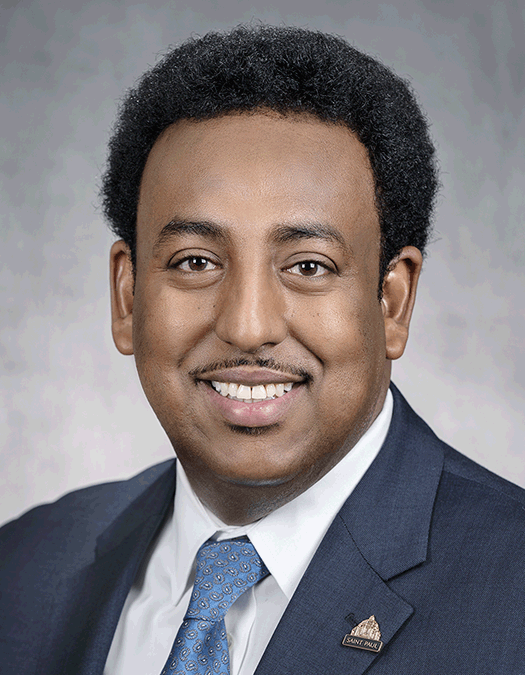
Rep. Samakab Hussein
Sponsored bills
Maddy summaryHF 3157 appropriates $500,000 for fiscal year 2026 and $500,000 for fiscal year 2027 from the workforce development fund to provide a one-time grant to Union Gospel Mission Twin Cities. The funds will support adult education and workforce development services for adults experiencing homelessness, hunger, or addiction, including job skills training, GED/ESL classes, and job readiness programs. The bill also covers essential support services like clothing, transportation, and childcare to help remove employment barriers. This is a direct funding mechanism to sustain existing services at the nonprofit, not a new policy.
Maddy summaryHF 2018 requires Minnesota municipalities to permit multifamily residential developments (buildings with 13+ units or mixed-use buildings with ≥50% residential space) in zoning districts that allow commercial uses, effective until December 31, 2029. It limits local governments' ability to block such projects through comprehensive plan amendments or zoning changes, mandating approval under defined conditions. Municipalities must still enforce standards for public health, safety, infrastructure, and existing environmental protections (e.g., floodplains). The bill directly affects local zoning decisions, developers seeking to build apartment complexes, and residents in communities with commercial zoning. It does not override state/federal prohibitions or require affordable housing in all projects.
Maddy summaryHF 361 extends the deadline for using funds to implement the Capitol Mall Design Framework until June 30, 2025. It appropriates $4.5 million for the city of St. Paul to improve livability, economic health, and safety in the Capitol Area, including $500,000 specifically for technical assistance through the Capitol Area Architectural and Planning Board to help residents and businesses apply for community grants. The bill repeals and cancels the previous Capitol Area community vitality account established in 2023, transferring any remaining funds to the general fund. This legislation directly affects the city of St. Paul, the Capitol Area Architectural and Planning Board, and local businesses and residents in the Capitol Area.
Maddy summaryHF 3158 proposes a constitutional amendment requiring a two-thirds vote in both the Minnesota House and Senate to authorize public funding for the design, construction, or renovation of a professional sports facility. Currently, a simple majority vote suffices for such funding. The amendment must be submitted to voters in the 2026 general election, where they will decide whether to adopt the two-thirds requirement. If approved by voters, this change would become part of the Minnesota Constitution, affecting future legislative decisions on sports facility funding.
Maddy summaryHF 2565 extends a one-time $1 million grant from the workforce development fund to Ramsey County (in partnership with St. Paul) for workforce development programs. It directly supports youth and young adults aged 18-30 through initiatives like the "Learn and Earn" program, which includes technology training and a driver's license academy. The funding, available until June 30, 2028, is specifically for these targeted training pathways and is not an ongoing appropriation. This bill modifies the existing grant authorization to extend its availability through the specified deadline.
Maddy summaryHF 2993 appropriates $6.75 million from the general fund for a one-time grant to Saint Paul Urban Tennis, a nonprofit organization. The funds will cover predesign, design, construction, furnishing, and equipping of a new tennis and life learning community center in Saint Paul. This grant directly supports the nonprofit’s project to build a facility serving local residents, particularly youth and underserved communities. The appropriation is available until the project is completed or abandoned, per state funding rules.
Maddy summaryHF 3066 establishes a state-funded program providing adaptive swimming lessons and water safety education for children aged 3-21 with developmental delays and their parents. The program, funded with $500,000 annually for 2026-2027, offers 12 weeks of lessons per child through vouchers distributed equitably, including swim kits and culturally appropriate parent education. Eligible participants must meet income requirements (e.g., enrolled in Medicaid, MinnesotaCare, or free school meals programs), and instructors must hold specific certifications for neurodivergent children and water safety. The commissioner of health will administer the program in partnership with St. Paul and autism advocacy groups, ensuring access in low-income communities and tracking participation.
Maddy summaryHF 2140 requires certain Minnesota municipalities to create "mixed-use housing zones" by June 30, 2027. Covered cities include those in Anoka, Carver, Dakota, Hennepin, Ramsey, Scott, or Washington counties, plus any municipality with 10,000+ residents. These zones must permit residential developments with at least three units (within 0.5 miles of certain streets) or four units (within 0.25 miles), including duplexes, triplexes, and fourplexes. The bill defines "mixed-use development" as buildings where at least 50% of usable space is for residential units, and it exempts these zoning changes from requiring comprehensive plan amendments before 2029.
Maddy summaryHF 1914 appropriates state funds for three key human services programs in Minnesota. It provides emergency services grants for immediate crisis support, county grants to address homelessness gaps (prioritizing Tribal Nation partnerships and interventions like 24/7 shelters), and funding for provider capacity-building collaboratives. The capacity-building program helps service providers access stable funding streams, including Medicaid waivers and housing support programs. These funds are allocated for fiscal years 2026 and 2027, with unspent first-year money rolling over to the second year. The bill directly affects counties, service providers, and people experiencing homelessness by expanding access to crisis support and housing-focused services.