

Maddy summaryHF 3305 appropriates $5 million in state bond funds to support capital improvements at the Hallie Q. Brown Community Center in St. Paul. The funding covers predesign, construction, renovation, and expansion of the facility, including ADA accessibility upgrades, energy efficiency projects, mechanical system replacements, and preservation of the building's historic character. The money will be provided through state bond sales authorized under Minnesota law. This bill directly affects the City of St. Paul (as the grant recipient) and the community center's users, enabling physical upgrades to support ongoing operations.
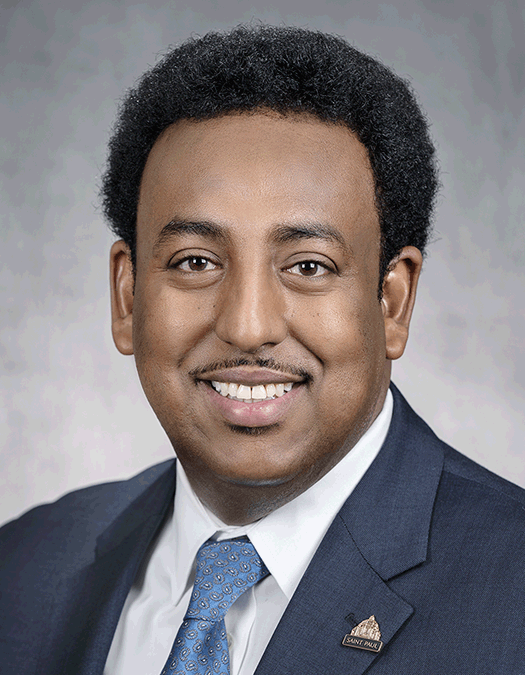
Rep. Samakab Hussein
Sponsored bills
Maddy summaryHF 1660 requires Minnesota's Commissioner of Children, Youth, and Families to conduct a statewide assessment of out-of-school youth programs for children and teens under 21. The commissioner must gather data on current programs, funding, and populations served, while engaging youth, families, and community providers to identify barriers and gaps. By February 2026, the commissioner must submit a report with findings and recommendations to legislative committees, including proposals to improve access and quality. The bill appropriates a one-time $ amount in fiscal year 2026 specifically for this assessment and reporting process.
Maddy summaryHF 1355 requires permit holders harvesting or destroying aquatic plants in Minnesota public waters to use scuba diving equipment safely and establishes safety standards for commercial diving operations. It mandates that applicants provide documentation of a recent third-party safety survey by a qualified professional (like a DLI consultant or insurance underwriter) and ensures divers have valid certification from accredited programs. The bill also requires employers to provide buoyancy control devices for workers using scuba equipment during these activities. These requirements apply directly to commercial entities and contractors seeking permits under Minnesota Statutes §103G.615 for aquatic plant management. The law aims to improve workplace safety for divers working in Minnesota's waterways.
Maddy summaryHF 3107 modifies Minnesota's sales and use tax exemption for businesses building large-scale agriculture processing facilities. The bill sets a $100 million capital investment threshold for eligibility, exempting building materials and supplies used in facilities processing agricultural crops (excluding livestock, poultry, or wood products). Tax must be collected at standard rates and then refunded per existing procedures. This change affects businesses planning major processing facility investments exceeding $100 million, effective after June 30, 2025.
Maddy summaryHF 1653 appropriates $1 million from state bonds to fund electric bus charging stations for school buses statewide. The bill directs the commissioner of commerce to provide grants to eligible school districts or public transit agencies under Minnesota Statutes §216C.374, specifically for installing Level 2 and Level 3 charging infrastructure. Funding comes from bonds sold by the state under established procedures, with grants awarded through the existing electric school bus deployment program. This measure directly affects school transportation systems seeking to transition to electric fleets, effective upon final enactment.
Maddy summaryHF 2523 appropriates $9 million from the general fund for fiscal year 2026 to provide grants to community-based HIV/AIDS support services providers in Minnesota. This funding, available until June 30, 2027, directly supports organizations offering critical services to people living with HIV/AIDS. The bill establishes a base appropriation of $9 million for fiscal year 2028, ensuring ongoing funding for these services. It does not change eligibility or service requirements but provides dedicated state funding for existing community support programs.
Maddy summaryThis bill appropriates $20 million ($10 million for each of fiscal years 2026 and 2027) to create regional food bank grants. It directs the commissioner of Children, Youth, and Families to distribute funds to regional food banks and federally recognized Minnesota tribes to purchase, transport, and distribute food through federal programs, with optional use for hygiene products like diapers. Recipients must comply with federal food assistance guidelines and report spending to the commissioner. The program aims to increase food availability for individuals and families in need across Minnesota.
Maddy summaryHF 640 expands Minnesota's fourth-degree assault law to protect transportation network company (TNC) drivers, such as those for Uber or Lyft, who were previously excluded from the statute. The bill amends Minnesota Statutes to define "transit operator" to include TNC drivers operating under section 65B.472, meaning assaulting them while performing ride-hailing duties would now be a gross misdemeanor. Penalties for such assaults include up to 364 days in jail or a $3,000 fine, matching protections currently available to public bus, light rail, and commuter rail operators. The law applies to crimes committed on or after August 1, 2025.
Maddy summaryThis bill appropriates $200,000 from the general fund for a one-time grant to Niyyah Recovery Initiative during fiscal year 2026. The funds are specifically designated to cover support program costs, community engagement, staffing, and targeted outreach to expand recovery services for individuals affected by substance use. The grant is available until June 30, 2027, and directly supports Niyyah Recovery Initiative's operational needs to increase access to critical recovery resources.
Maddy summaryHF 3196 establishes the African Youth Soccer League in Minnesota, directly serving youth of African descent by providing access to soccer facilities, training, and development programs. The bill requires the Children, Youth, and Families commissioner to partner with schools, community centers, and soccer clubs to secure resources, fund coaching licenses through the U.S. Soccer Federation, and provide mental health services for participants. It appropriates $3.7 million for each of fiscal years 2026 and 2027 to support league operations, including equipment grants, mentorship programs pairing youth with professional players, and college access funding. Annual reports must detail participation rates, spending, success stories (like scholarships), and the league's impact on mental health and community engagement.