

Maddy summaryHF 1318 requires all individuals purchasing a firearm in Minnesota to present proof of recent firearm safety training before completing the sale. This training must cover safe handling, storage, legal aspects of possession, and include a shooting qualification, demonstrated through certified courses or recent peace officer employment. Sellers must document the transaction with copies of identification, training proof, and firearm details, retaining these records for ten years and providing them to law enforcement upon request. The law applies to all firearm sales except those involving dealers, law enforcement, estate transfers, antique firearms, or collector-to-collector sales of curios/relics. Violating these requirements constitutes a misdemeanor.
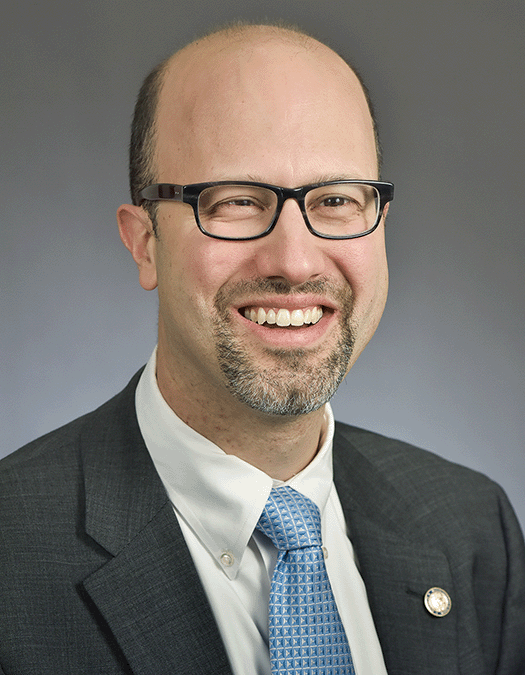
Rep. Dave Pinto
Sponsored bills
Maddy summaryHF 264, the "Larry R. Hill Medical Reform Act," requires all licensed Minnesota correctional facilities (both public and private) to meet specific medical care standards. The bill amends state law to mandate facilities implement policies covering mental health screening, suicide prevention, medication verification, discharge planning with prescribed medications, telehealth use, and death reviews. These requirements directly affect incarcerated individuals by improving access to consistent medical and mental health care while holding facilities accountable through commissioner inspections. The law aims to standardize care practices without creating new programs, focusing on operational changes to enhance safety and treatment.
Maddy summaryHF 470 appropriates $96.565 million from the general fund for each of fiscal years 2026 and 2027 to fund Minnesota's early learning scholarships program under Minnesota Statutes section 142D.25. This funding directly supports families with young children by providing financial assistance for early learning services. The bill establishes a specific, dedicated funding stream for the program, adding it to the base budget. It does not change eligibility criteria or program rules, only providing the necessary state funding to operate the existing scholarship program.
Maddy summaryHF 2902 modifies Minnesota's reintegration driver's license program. It extends the license expiration period from 15 to 24 months (from section 171.301, subd. 5) and establishes a clear pathway for holders to obtain a regular license after one full year of holding the reintegration license (section 171.301, subd. 6). To qualify, individuals must have held the license without cancellation or expiration beyond 90 days, meet standard application requirements, and pay applicable fees. The bill also requires the state to forgive outstanding reinstatement fees when issuing a regular license under these conditions. This directly affects Minnesotans with suspended driving privileges who are working to regain full driving rights.
Maddy summaryHF 2594 clarifies that protections for child abuse victim interviews apply to all types of recordings, not just videos, and updates terminology in statutes addressing child sexual abuse materials. The bill amends multiple Minnesota statutes (including 13.821, 144.296, and 617.246) to ensure court procedures for handling recordings of child victims are consistent and to modernize definitions of prohibited materials. It directly affects legal proceedings involving child abuse cases, law enforcement handling evidence, and individuals facing charges related to child sexual abuse materials. The changes aim to strengthen victim privacy protections and ensure statutory language accurately reflects current practices for prosecuting such offenses.
Maddy summaryHF 683 allows Minnesota cities and counties to adopt ranked choice voting (RCV) for local elections, such as mayoral or city council races. It establishes rules for how RCV would work, including counting votes by voter preferences and reallocating votes when candidates are eliminated. The bill permits local jurisdictions to use electronic voting systems that automatically handle vote reallocation, and it appropriates funds for implementation. This bill directly affects local governments choosing to implement RCV and voters in those jurisdictions participating in local elections. It does not change state or federal election rules.
Maddy summaryHF 2707 appropriates $11.125 million for each of fiscal years 2026 and 2027 from the general fund to support sexually exploited youth or youth at risk of sexual exploitation under Minnesota Statutes §256K.47. At least $9 million annually must fund street outreach, emergency shelter, regional navigators, and housing services for these youth. The bill directly affects vulnerable youth in Minnesota by providing dedicated funding for critical safe harbor resources and housing support. It establishes concrete funding mechanisms without altering existing statutes or creating new requirements.
Maddy summaryHF 2746 requires Minnesota law enforcement agencies to trace and report recovered or confiscated firearms through the federal eTrace system and National Integrated Ballistics Information Network (NIBIN). Agencies must register for eTrace, transmit firearm details immediately after recovery/confiscation, arrange for test-firing, and submit ballistics data for both firearms and shell casings. This applies to firearms obtained from crime scenes, seizures, forfeitures, abandoned items, or incidents involving unlawful discharges. The bill mandates these reporting procedures for all Minnesota law enforcement agencies to improve firearm tracking and investigation capabilities.
Maddy summaryHF 107 modifies Minnesota's unemployment insurance rules for workers involved in labor disputes. It specifies that workers participating in or directly affected by a labor dispute can receive benefits until the end of the week the dispute was active, while those not involved are eligible until the dispute began. The bill clarifies that certain situations - like employer safety violations, lockouts, or being fired before a dispute starts - do not make applicants ineligible. This directly affects workers who stop working due to labor conflicts, ensuring they maintain eligibility under defined conditions. The changes amend Minnesota Statutes section 268.085, subdivision 13b.
Maddy summaryHF 2603 allocates new funding to state agencies to strengthen fraud prevention and detection efforts. It specifically adds $391,000 for the Attorney General’s Medicaid Fraud Division, $5.88 million for child care program integrity, and $21.96 million (with $5.66 million in 2026) for program integrity analytics within the Department of Human Services. The bill updates multiple statutes to require agencies to implement new fraud prevention systems and reporting mechanisms for programs handling public funds. These changes directly affect state agencies managing Medicaid, child care, education, and human services programs.