

Maddy summaryHF 362 establishes a state licensing system for massage therapists and Asian bodywork therapists in Minnesota. It requires practitioners to meet specific educational standards (including minimum contact hours), pass a credentialing exam, and obtain a license from the Minnesota Department of Health. The bill defines both practices (e.g., Asian bodywork therapy uses techniques like pressing and stretching based on Chinese medical principles), sets application and renewal fees, and includes criminal penalties for practicing without a license. This directly affects therapists seeking to legally provide these services and ensures they meet standardized training and safety requirements, while also providing funding for implementation.
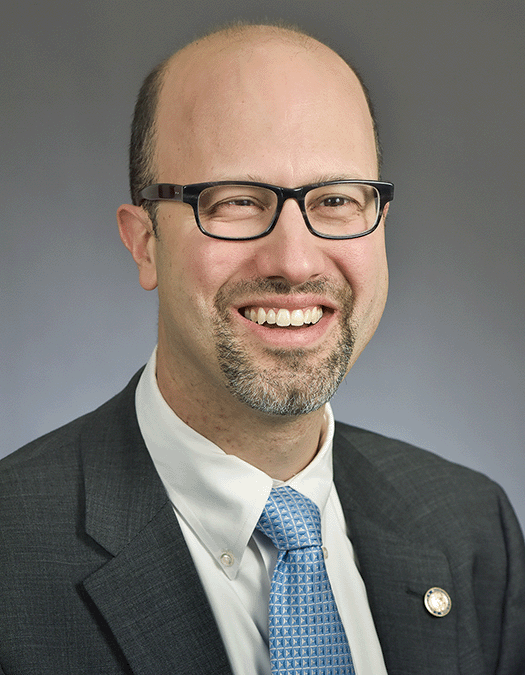
Rep. Dave Pinto
Sponsored bills
Maddy summaryThis bill allocates $1,602,000 from the state's general fund in fiscal year 2027 to the Office of the Attorney General. The funding is specifically designated to hire six additional attorneys to support the office's legal operations. The legislation does not change existing laws or procedures but provides financial resources for staffing expansion. It directly affects the Office of the Attorney General by increasing its budget for attorney positions.
Maddy summaryThis bill designates the toboggan as the official state sled of Minnesota. It adds a new provision to the state statutes to formally recognize this designation. The change affects the state government by establishing an official title for a winter activity equipment. The bill does not create new regulations or funding requirements, only a symbolic designation.
Maddy summaryThis bill creates a new grant program to provide social services and mental health support to victims of Operation Metro Surge, a federal immigration enforcement operation. The program will fund organizations that help affected individuals with basic needs like housing, food, and employment assistance, as well as mental health care. Eligible applicants include nonprofits, government agencies, tribal nations, and legal service providers, with priority given to areas most impacted by the operation. The bill appropriates unspecified funding from the state's general fund for one-time use through June 2029, requiring grantees to report on program participation and outcomes.
Maddy summaryHF 3407 prohibits the sale, possession, and distribution of "ghost guns" - firearms without unique serial numbers, undetectable by metal detectors, or made via 3D printing by unlicensed individuals. It restricts 3D printing of firearms to federally licensed manufacturers, bans sharing 3D gun design files, and requires all firearms to have engraved serial numbers. Owners of existing ghost guns must either have a licensed dealer add a serial number, remove the item from Minnesota, make it permanently inoperable, or surrender it within 180 days (or 30/60 days for inheritors/new residents). Violations carry penalties of up to five years in prison or $10,000 fines.
Maddy summaryThis bill modifies Minnesota's law on concealing identity in public places. It adds "protection from smoke, gas, or other airborne toxin" as a valid exception for wearing masks or disguises, while clarifying that the law generally prohibits such concealment (except for religious, entertainment, weather, or medical reasons). The bill specifically creates two new exceptions for law enforcement: undercover officers may conceal identity when necessary for investigations or safety, and tactical team members may wear face masks to prevent facial disfigurement. The law would not apply to these officers while performing official duties under these specified circumstances. (Note: This is a proposed bill pending in committee as of February 2026.)
Maddy summaryHF 3405 requires Minnesota's Bureau of Criminal Apprehension (BCA) to use its existing Use of Force Investigations Unit to investigate incidents involving federal agents. Specifically, it amends Minnesota Statutes 2024, section 299C.80, to include "federal agents" (defined as those employed by DHS, ICE, CBP, or USCIS) under the unit's duty to investigate cases involving peace officers or federal agents. The bill expands the unit's current mandate - which already covers incidents with state/local officers - to now cover all incidents involving the specified federal agencies. This change directly affects federal law enforcement personnel from those agencies operating in Minnesota.
Maddy summaryThis bill prohibits Minnesota law enforcement officers from detaining or transporting suspects in vehicles not specifically designed for human transport, such as standard patrol cars. It requires all such vehicles to be owned/leased by a law enforcement agency, clearly marked with the agency's identification, and equipped with seats and seat belts for each person transported. Exceptions apply during emergencies threatening life/safety or for undercover operations. The law directly affects police departments and officers who transport detainees, aiming to standardize safe transport conditions.
Maddy summaryHF 3357 would prohibit the possession of dangerous weapons (including guns, ammunition, or explosives) in Minnesota's Capitol complex buildings, making it a felony punishable by up to five years in prison or a $10,000 fine. The bill specifically applies to state buildings within the Capitol Area described in chapter 15B, excluding the National Guard Armory. Key exemptions include licensed peace officers on duty, permit holders who notify law enforcement, individuals displaying weapons as evidence with sheriff approval, and retired officers working in security roles under specific federal rules. The law would take effect on August 1, 2026, and directly affects anyone entering Capitol complex buildings, with limited exceptions for authorized personnel and specific lawful activities.
Maddy summaryHF 3665 modifies Minnesota's foster care placement plans to require agencies and guardians ad litem to include information about early childhood education and child care programs for children in foster care. This applies to children subject to compulsory school attendance who are enrolled in school, receiving home instruction, or in independent study programs. The bill amends Minnesota Statutes 260C.212 to add this requirement, ensuring placement plans address educational stability and access to early learning resources. It directly affects children in foster care, foster care agencies, and legal representatives by mandating this new information be included in their case planning.