

Maddy summaryHF 1762 proposes adding a new constitutional amendment to Minnesota's state constitution. If approved by voters, it would guarantee all persons equal rights under state law and prohibit discrimination based on race, color, national origin, ancestry, disability, or sex - including protections for pregnancy decisions, gender identity, gender expression, and sexual orientation. The amendment would apply to all state actions and agencies, requiring any discriminatory state action to be the "least restrictive means" of achieving a "compelling governmental interest." The proposed amendment must be submitted to voters in the 2026 general election, with implementation starting January 1, 2027, if ratified.
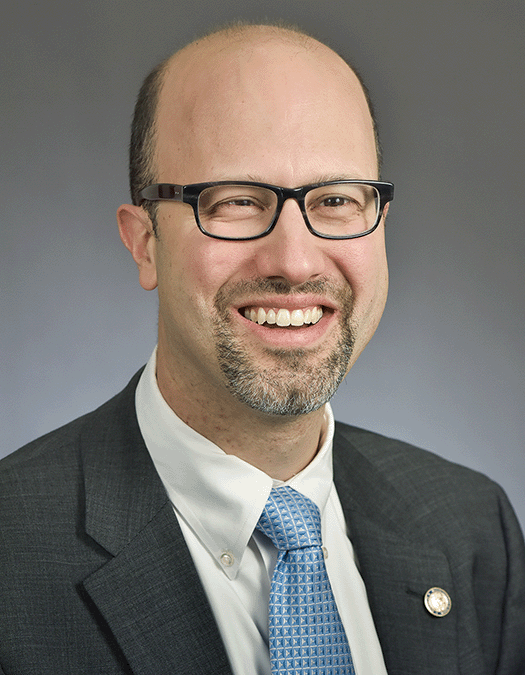
Rep. Dave Pinto
Sponsored bills
Maddy summaryHF 1757 requires anyone who owns, possesses, or controls a firearm to report a loss or theft to local law enforcement within 48 hours. Failure to report can result in escalating penalties, starting with a minor offense for the first violation and increasing to a gross misdemeanor for repeated failures. The bill also provides immunity from prosecution for storage-related offenses if the report is made on time and mandates that law enforcement agencies report lost or stolen firearms to the state commissioner within seven days. Additionally, the bill appropriates $36,000 for a one-time implementation of a reporting system to support these requirements.
Maddy summaryHF 1657 modifies Minnesota's controlled substances laws to clarify that the weight of fluid used in water pipes is excluded when calculating possession thresholds, except when the mixture contains four or more fluid ounces of fluid. This change directly affects individuals who possess controlled substances (like cocaine, methamphetamine, or opioids) in water pipe fluids, as it prevents the fluid weight from counting toward criminal offense levels based on total weight. Key provisions amend sections 152.021, 152.022, and 152.023 of Minnesota Statutes to exclude water pipe fluid from weight calculations in possession crimes. The bill aims to align legal standards with practical realities of how substances are consumed, avoiding disproportionate penalties for fluid weight. It does not alter penalties for the substances themselves, only the method for measuring possession quantities.
Maddy summaryHF 1812 establishes a state-run Minnesota Health Plan to guarantee comprehensive, affordable health care for every Minnesota resident. The plan covers all necessary medical, dental, vision, mental health, and long-term care services without co-pays, with premiums based on income. It creates new state entities including the Minnesota Health Board, Health Fund, Office of Health Quality and Planning, a patient advocacy ombudsman, and an auditor for the plan. The bill also requests a federal waiver under the Affordable Care Act to modify certain health insurance requirements and appropriates funding for implementation.
Maddy summaryHF 1276 modifies Minnesota's Northstar Care for Children program to adjust benefit rates for two specific groups: children under age six entering kinship or adoption assistance, and children transferred into the program. It requires that most children under six receive 50% of the standard benefit rate upon entry, while children placed with relatives under certain placement preferences receive the full benefit amount. The bill amends statutes to clarify these rate changes and ensures state funding adjustments account for eliminating the reduced rate for relative placements. This directly affects young children in foster care or adoption assistance programs and their caregivers.
Maddy summaryThis bill establishes the Department of Children, Youth, and Families in Minnesota, creating a new state agency to oversee child welfare, youth services, and family support programs. It grants the department's commissioner the authority to accept federal and private funding, make contracts with various organizations, and submit biennial reports on performance goals that focus on equity, program coordination, and reducing barriers for families. The legislation also reorganizes existing state laws by moving and copying relevant statutes into new chapters while repealing outdated sections to align with the new departmental structure.
Maddy summaryThis bill adjusts the state's education funding forecasts and appropriates specific amounts for the 2024 and 2025 school years. It directly affects public school districts, nonpublic schools, and students by updating the financial allocations for general education aid, transportation costs, and support for district consolidations. The legislation increases the general education aid budget for both years while simultaneously reducing funding for consolidation transition aid and abatement aid. Additionally, it modifies the amounts available for transporting students to postsecondary institutions and nonpublic schools, ensuring the state budget reflects updated enrollment and financial projections.
Maddy summaryHF 5237 is a supplemental budget bill that provides additional funding to the state's education system and related human services programs. The legislation directly affects public schools, charter schools, early childhood education providers, and families receiving child welfare or economic support services. Key provisions include allocating money for school operations, teacher salaries, special education, and facilities, while also adjusting funding forecasts for various state agencies. The bill amends existing laws to ensure these resources are distributed and managed according to updated needs, particularly regarding instructional hours and student support services.
Maddy summaryThis bill allows local jurisdictions in Minnesota to choose ranked choice voting for their local elections, where voters rank candidates in order of preference rather than selecting just one. It establishes specific rules for how these elections would be conducted, including procedures for counting votes and handling ballots where a candidate is eliminated based on the rankings. The legislation also permits local areas to use electronic voting machines that can automatically reallocate votes to remaining candidates after an initial winner is determined. However, the bill did not pass during the 2024 legislative session and therefore will not become law.
Maddy summaryThis bill requires the Bureau of Criminal Apprehension and Violent Crime Enforcement Teams to submit an annual report detailing their gun trafficking investigations, the number of firearms seized, and how funding for violent crime reduction was utilized. It also updates the legal definition of a "trigger activator" to include devices that allow a firearm to fire multiple shots with a single trigger pull or without requiring a subsequent pull. Additionally, the legislation increases penalties for transferring firearms to individuals who are legally ineligible to possess them, raising the maximum prison sentence from two years to five years if the weapon is used in a violent felony within a year of the transfer.