

Maddy summaryThis bill prohibits individuals in Minnesota from possessing specific semiautomatic military-style assault weapons and establishes criminal penalties for violations. It directly affects firearm owners, dealers, and manufacturers by defining banned weapons through a combination of specific model lists and functional criteria based on features like detachable magazines, pistol grips, and high-capacity magazines. The legislation amends existing state statutes to clarify which firearms are restricted, including certain rifles, pistols, shotguns, and conversion kits that resemble military weapons.
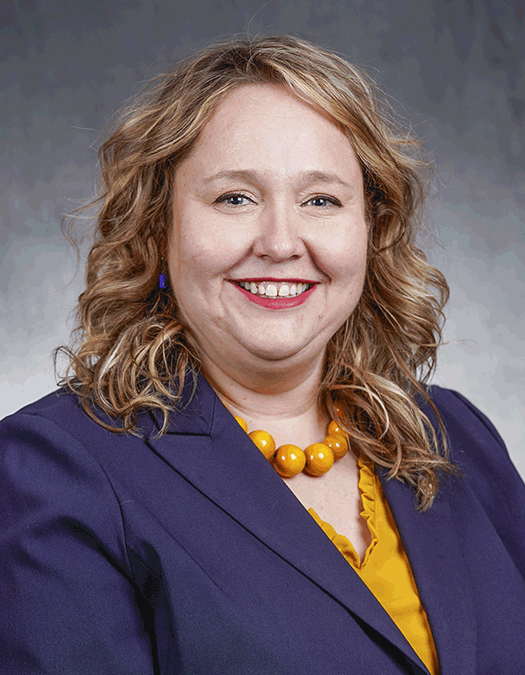
Rep. Emma Greenman
Sponsored bills
Maddy summaryThis bill creates a new grant program to provide social services and mental health support to victims of Operation Metro Surge, a federal immigration enforcement operation. The program will fund organizations that help affected individuals with basic needs like housing, food, and employment assistance, as well as mental health care. Eligible applicants include nonprofits, government agencies, tribal nations, and legal service providers, with priority given to areas most impacted by the operation. The bill appropriates unspecified funding from the state's general fund for one-time use through June 2029, requiring grantees to report on program participation and outcomes.
Maddy summaryThis bill requires Minnesota's secretary of state to create and distribute a voter information guide to every household with registered voters before each statewide general election. The guide must include voting eligibility requirements, registration deadlines, and forms for absentee ballots, while also being available in English and the three most common non-English languages spoken in the state. The legislation prohibits anyone from creating campaign materials that look deceptively similar to the official guide and authorizes the secretary of state to seek court orders or fines against violators.
Maddy summaryHF 3407 prohibits the sale, possession, and distribution of "ghost guns" - firearms without unique serial numbers, undetectable by metal detectors, or made via 3D printing by unlicensed individuals. It restricts 3D printing of firearms to federally licensed manufacturers, bans sharing 3D gun design files, and requires all firearms to have engraved serial numbers. Owners of existing ghost guns must either have a licensed dealer add a serial number, remove the item from Minnesota, make it permanently inoperable, or surrender it within 180 days (or 30/60 days for inheritors/new residents). Violations carry penalties of up to five years in prison or $10,000 fines.
Maddy summaryHF 3480 requires Minnesota to study the economic effects of the federal "Operation Metro Surge" immigration enforcement operation. The bill appropriates funding to contract a nonpartisan entity to quantify impacts on the state, child care providers, businesses, counties, cities, and school districts. The study must be completed and reported to key legislative committees by February 1, 2027. This is a procedural study bill focused on gathering data, not implementing new policy. The bill was introduced in February 2026 with multiple co-authors.
Maddy summaryHF 3293 creates the Minnesota Consumer Financial Protection Bureau (MCFPB) to enforce consumer financial laws and protect residents from unfair or deceptive practices in banking, lending, and other financial services. The bill establishes a commissioner appointed by the governor to oversee the bureau, which will investigate complaints, monitor financial markets, and enforce anti-discrimination rules in consumer finance. It appropriates funding for the bureau’s operations in fiscal years 2026 and 2027, and directs the commissioner to recruit staff with federal CFPB experience. The bureau directly affects Minnesota consumers and financial institutions operating in the state by providing a dedicated enforcement agency for consumer financial protection.
Maddy summaryMinnesota bill HF 1855 requires veterans benefits service providers (who charge fees) to be federally accredited by the U.S. Department of Veterans Affairs. It prohibits these providers from guaranteeing specific benefits or benefit amounts to veterans or their families. The bill mandates written disclosure statements and fee agreements before services are provided, and establishes civil penalties up to $1,000 per violation for noncompliance. This directly affects veterans seeking assistance with benefits appeals and the service providers offering those services.
Maddy summaryThis bill removes the legal authority for federal agents from U.S. Customs and Border Protection and U.S. Citizenship and Immigration Services to make arrests under Minnesota state law. It directly affects these federal agencies by eliminating their ability to conduct warrantless arrests within the state, except when assisting local law enforcement. The change amends existing statutes to delete provisions that previously allowed these officers to arrest individuals for specific crimes like assault or felonies when on duty or with a warrant. This policy adjustment limits arrest powers to state-authorized peace officers and private citizens, while still permitting federal agents to aid in executing warrants when requested by local officers.
Maddy summaryThis bill establishes a minimum wage requirement for workers employed at Minnesota's covered airports, including Minneapolis-St. Paul International Airport and other public airports under the Metropolitan Airports Commission. It applies to private companies and contractors that employ workers performing airport-related duties or preparing food for departing flights, excluding independent contractors and salaried professionals. The law mandates that employers pay a "quality service wage" starting in 2026, which combines the applicable minimum wage with supplemental benefits calculated according to federal Service Contract Act standards. The Minnesota Department of Labor and Industry will set the specific wage rate each year and has authority to issue compliance orders with penalties for violations.
Maddy summaryThis bill modifies Minnesota's law on concealing identity in public places. It adds "protection from smoke, gas, or other airborne toxin" as a valid exception for wearing masks or disguises, while clarifying that the law generally prohibits such concealment (except for religious, entertainment, weather, or medical reasons). The bill specifically creates two new exceptions for law enforcement: undercover officers may conceal identity when necessary for investigations or safety, and tactical team members may wear face masks to prevent facial disfigurement. The law would not apply to these officers while performing official duties under these specified circumstances. (Note: This is a proposed bill pending in committee as of February 2026.)