

Maddy summaryHF 961 appropriates $250,000 for each of the 2026 and 2027 fiscal years to fund the Hospitality Minnesota Education Foundation's ProStart program. This program provides high school students with culinary and hospitality management education, including curriculum, tools, skills training, professional development, and scholarships. The funds directly support addressing workforce shortages in Minnesota's hospitality industry by enhancing career pathways for students. This is a one-time appropriation specifically designated for these educational services in participating high schools.
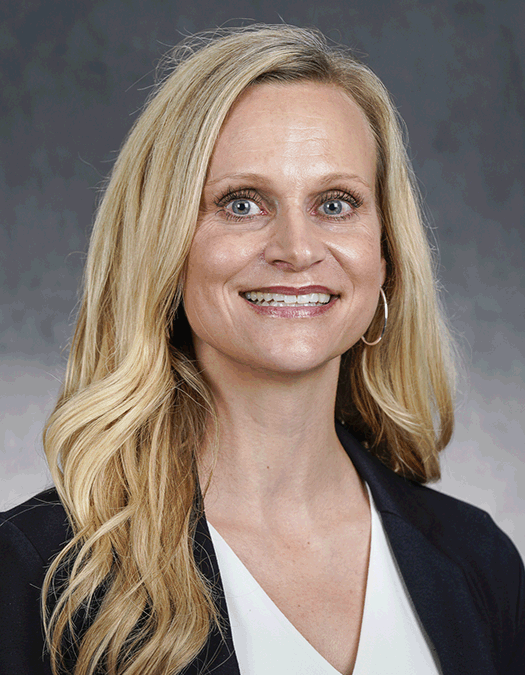
Rep. Krista Knudsen
Sponsored bills
Maddy summaryHF 897 amends Minnesota law to prohibit exposing children and vulnerable adults to fentanyl, methamphetamine, or related substances in specific locations. It makes it illegal for anyone to knowingly cause or permit such exposure in places like homes, public buildings, or overnight accommodations where children or vulnerable adults might be present. The bill adds criminal penalties for violations, including for exposing individuals to fentanyl (newly specified in the amendment) or methamphetamine-related materials. This directly affects caregivers, property owners, and anyone in environments where children or vulnerable adults could be present.
Maddy summaryHF 67 repeals Minnesota's automatic voter registration system, which previously added eligible residents to voter rolls when they applied for or renewed a driver's license or state ID. The bill removes provisions requiring DMV staff to offer automatic registration and eliminates related requirements in statutes governing voter registration (Minnesota Statutes 2024, sections 13.607 and 201.161). It also amends related laws to adjust processes for voter preregistration and application forms. This change directly affects voters who would have been automatically registered through DMV interactions, requiring them to proactively register instead.
Maddy summaryHF 4 proposes a constitutional amendment requiring Minnesota to return budget surplus funds to taxpayers. If approved, it would create a "Minnesota tax relief account" funded by revenue exceeding 105% of projected spending, using those funds to refund or reduce property and income taxes. Taxpayers would receive direct refunds or tax reductions, but only up to the amount they owe in taxes, with the account funded annually from the state's general fund surplus. The amendment must be voted on by voters in the 2026 general election.
Maddy summaryHF 167 modifies Minnesota's individual income tax system by removing limits on subtracting Social Security benefits, allowing taxpayers to subtract all their Social Security income without phaseout thresholds or maximums. It also updates income tax brackets, raising the first tax bracket threshold to $47,620 for married couples filing jointly and $47,620 for single filers (from $38,770 and $26,520, respectively). The bill additionally modifies property tax refund rules, though specific changes aren't detailed in the provided text. These changes apply to taxable years beginning after December 31, 2024.
Maddy summaryHF 26, titled the "Never Again Act," shifts emergency declaration authority from the governor to the Minnesota legislature. It repeals the governor's power to declare emergencies and establish a new process requiring legislative approval for emergency declarations and extensions. The bill also prohibits the governor from issuing emergency orders with the "full force and effect of law" and explicitly protects citizens' rights, including free speech, religious freedom, assembly, travel, gun rights, and the ability to operate businesses. These changes amend multiple sections of Minnesota Statutes to clarify that only the legislature may enact emergency measures with legal force during crises.
Maddy summaryHF 23 amends Minnesota Statutes section 181.932 to strengthen whistleblower protections for public employees. It expands the list of protected disclosures to include reporting gross mismanagement or waste of public funds (subsection 7), clarifies protections for health care quality concerns (subsection 4), and adds specific scenarios like reporting truthful scientific studies (subsection 5) or classified service communications about state services (subsection 6). These changes directly affect state and local government employees who report violations of law, safety risks, or financial misconduct. The bill modifies existing anti-retaliation language to explicitly cover these new disclosure types while maintaining that protected disclosures cannot override other legal data protections.
Maddy summaryHF 1380 requires Minnesota's Commissioner of Human Services to set a minimum $1,800 per day rate for Clay County's psychiatric residential treatment facility. It appropriates $1 million in fiscal year 2026 for Clay County to cover equipment and remodeling costs to convert a juvenile center into an 18-bed facility for youth under 21. The bill also allocates $1 million for fiscal year 2026 and $1 million for 2027 to fund start-up and capacity-building grants for psychiatric residential treatment facilities statewide, with $200,000 specifically designated for Clay County's new facility. These are one-time appropriations, available until June 2029.
Maddy summaryHF 2170 defines "cell-cultured meat" and "cell-cultured poultry" as products grown from animal cells in a controlled environment, rather than from slaughtered animals. The bill requires food labels to clearly state when a product contains cell-cultured meat or poultry, and mandates restaurants to prominently indicate such items on menus. It amends Minnesota food labeling laws (sections 31.12 and 31.633) and updates definitions in food product statutes (section 31A.02) to include these products under "meat food product" and "poultry food product." This directly affects food manufacturers, retailers, and restaurants selling or serving cell-cultured meat or poultry products in Minnesota.
Maddy summaryMinnesota's legislature has passed a resolution requesting Congress to call a constitutional convention under Article V of the U.S. Constitution. The resolution asks for proposed amendments to impose budget rules on federal spending, reduce federal government authority over states, and limit terms for federal officials and members of Congress. This is a procedural step - Minnesota is formally petitioning Congress, not creating new laws. The resolution serves as Minnesota's ongoing application for such a convention, pending similar actions by two-thirds of states.