

Maddy summaryThis bill creates a tax subtraction for pension income earned by volunteer firefighters in Minnesota, directly affecting individuals who serve as volunteer or on-call firefighters. The legislation defines volunteer firefighter pension income as annuity payments or lump-sum distributions from public retirement plans based on firefighting service. Starting with taxable years beginning after December 31, 2025, eligible recipients can subtract this income from their taxable income when filing state individual income tax returns. The bill amends existing Minnesota tax statutes to establish this new provision without changing how other retirement income is treated.
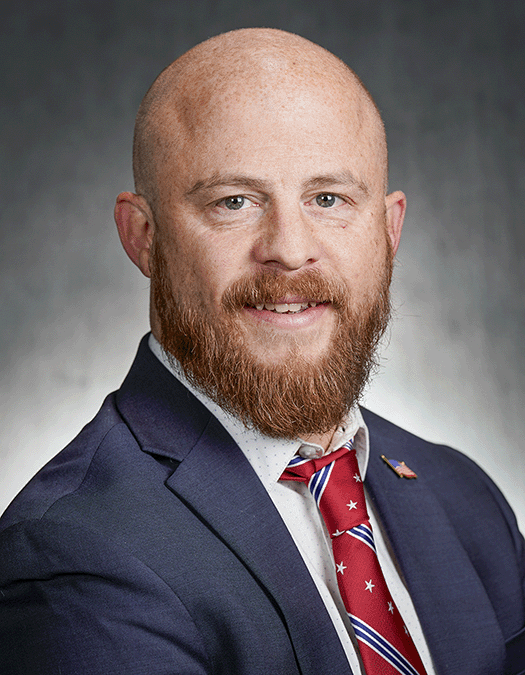
Rep. Drew Roach
Sponsored bills
Maddy summaryHF 3219, the "mRNA Bioweapons Prohibition Act," designates all mRNA-based medical products - including vaccines like those for COVID-19 - as "weapons of mass destruction" under Minnesota law. The bill prohibits possession, distribution, or manufacturing of these products, with criminal penalties for violations, and requires state/local officials to enforce the ban. It broadly defines "mRNA injections and products" to include any mRNA therapy, gene-altering agents, or nanoparticles, excluding only naturally occurring mRNA. The law takes effect August 1, 2025, and would directly affect individuals receiving mRNA-based medical treatments in Minnesota.
Maddy summaryHF 1323 prohibits undocumented noncitizens (students without legal U.S. immigration status) from receiving state-funded financial aid for higher education in Minnesota. The bill amends state law to explicitly state that undocumented students cannot receive any state tax revenue-funded aid, including grants, scholarships, tuition waivers, or other financial assistance from public colleges or the state. This applies to all state financial aid programs, excluding federal aid or private scholarships. The policy takes effect for fall 2025-2026 academic year aid awards.
Maddy summaryHF 2372 creates a voluntary "Minnesota Civic Seal" designation for high school students who complete specific civics requirements. To earn the seal, students must complete approved civics coursework, complete a project-based civic assessment, participate in at least one civic activity outside class (like voting in student elections or community service), and demonstrate civic dispositions. School districts may choose to participate but cannot charge students fees, must provide information about the program to all students, and must affix the seal to diplomas and transcripts for qualifying graduates. The program begins for students graduating in 2027 or later, with the Department of Education developing the insignia and guidelines to ensure equitable access for all students.
Maddy summaryThis bill repeals the Minnesota Child Care Assistance Program, which provided financial support to low-income families for child care services. The legislation removes numerous statutory sections that defined eligibility, certification requirements, and operational rules for the program, affecting families who previously received assistance and child care providers who operated under its framework. Key provisions include eliminating definitions for applicants, certified centers, and payment classifications, as well as deleting data collection and fraud investigation procedures tied to the program. The changes become effective on July 1, 2027, and require the state revisor to update all related statutes by that date.
Maddy summaryThis bill creates a sales tax exemption for preowned motor vehicles in Minnesota, meaning buyers would not pay the standard sales tax when purchasing a used car. The legislation defines a preowned vehicle as any motor vehicle that has been previously sold, titled, registered, or transferred to someone else and operated before the current sale. The exemption applies to sales and purchases made after June 30, 2026, and would directly affect private individuals and businesses buying used vehicles in the state. The bill amends existing tax statutes to add this new exemption category alongside other existing tax exemptions for specific groups and vehicle types.
Maddy summaryThis bill would allow Minnesota school resource officers who perform unpaid volunteer service to claim a subtraction from their individual income tax. The tax benefit is calculated by multiplying the number of volunteer hours by the hourly wage that would typically be paid to a school resource officer. To claim this subtraction, officers must provide documentation from their school showing the hours worked and the applicable hourly wage rate. The changes would take effect for tax years beginning after December 31, 2025.
Maddy summaryThis bill repeals the 100 percent carbon-free electricity standard that was set for Minnesota electric utilities by 2040. It removes the legal requirement for utilities to generate or procure electricity from carbon-free sources to meet specific percentage targets of 80 percent by 2030, 90 percent by 2035, and 100 percent by 2040. The change directly affects electric utilities operating in Minnesota by eliminating the mandate to achieve these renewable energy goals. This legislative action removes the previously established timeline for carbon-free electricity generation without adding new requirements.
Maddy summaryThis bill prohibits individuals receiving Minnesota public assistance programs from using licensed money transmitters to send money to foreign countries. It directly affects recipients of programs such as SNAP, medical assistance, child care assistance, and housing support. The law requires money transmitters to report every six months to state agencies any individuals who send money abroad, and state officials must then check if those individuals are enrolled in public assistance programs. If a recipient is found to have sent money to a foreign country while receiving aid, they will lose eligibility for all public assistance programs they were participating in.
Maddy summaryThis bill requires Minnesota's social studies standards to include information about the dangers and perils of communism and socialism, specifically during the 2030-2031 review and revision of state academic standards. The legislation mandates that the state commissioner incorporate details about estimated lives lost and negative outcomes associated with these ideologies into the updated curriculum. It directly affects Minnesota public school systems by setting a specific requirement for future social studies education content. The bill takes effect on July 1, 2026, and does not change current curriculum requirements but establishes a mandate for future revisions.