

Maddy summaryHF 2685 requires Minnesota schools to designate interscholastic, intramural, or club athletic teams as "males," "females," or "coed" based solely on students' biological sex at birth. The bill specifically mandates that teams designated for "females" must only include participants who were biologically female at birth. This amendment to Minnesota Statutes section 123B.49 directly affects all public and private school athletic programs in the state. The policy change replaces existing team designation practices with a requirement tied to sex assigned at birth, impacting transgender and intersex student-athletes seeking to participate on teams matching their gender identity.
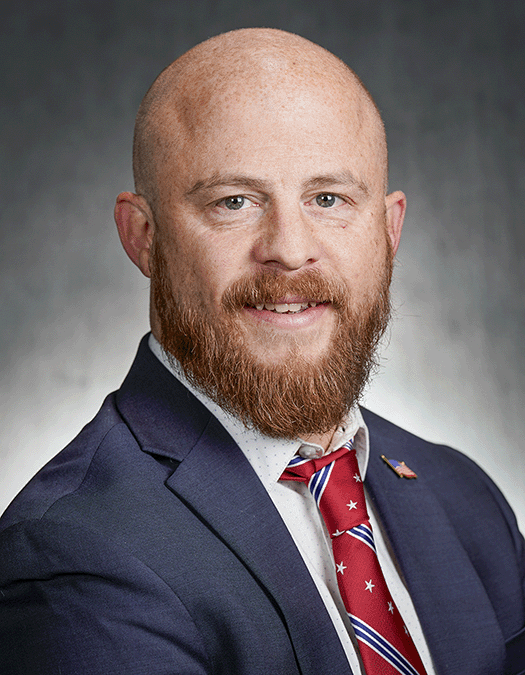
Rep. Drew Roach
Sponsored bills
Maddy summaryHF 3127 modifies Minnesota's pass-through entity tax election process, allowing certain businesses (like partnerships and S corporations) to file a single tax return instead of requiring each owner to file individually. It specifies that qualifying entities must meet ownership thresholds (over 50% of qualifying owners) to elect this tax, and the election is irrevocable for the tax year. The bill clarifies that the tax amount equals each qualifying owner's income multiplied by Minnesota's highest individual tax rate, without allowing standard deductions. This directly affects pass-through business owners and entities filing under Minnesota Statutes 289A.08 and 290.06. The changes streamline tax filing for these entities while maintaining the tax calculation method.
Maddy summaryThis bill removes the standard four-year statute of limitations for medical malpractice claims related to gender-affirming care received by minors in Minnesota. It defines gender-affirming care as medical or surgical interventions such as hormone therapy, puberty blockers, or gender reassignment surgery intended to affirm an individual's perceived gender identity that differs from their biological sex. The change allows patients or former patients to file lawsuits against healthcare providers for alleged errors or failures in such care without being restricted by the usual time limit. The amendment applies specifically to cases involving minor children and does not alter the statute of limitations for other types of medical malpractice claims.
Maddy summaryThis bill modifies Minnesota's annexation laws by limiting orderly annexation agreements to a maximum of ten years and clarifying that only parties to such agreements can annex the land covered by them. It also narrows the conditions under which municipalities can annex land through ordinances, restricting the process to specific scenarios like land owned by the municipality or areas completely surrounded by municipal limits. The changes aim to provide more structure and predictability to local government expansion while preventing municipalities from bypassing agreed-upon annexation terms.
Maddy summaryHF 3588 would expand who can request Minnesota's voter registration list by adding the national chair of a major political party to the current list of eligible requesters (registered voters). County auditors and the secretary of state must provide the list within five business days of a complete request with payment for copying, and make it available for free public inspection. The bill maintains restrictions requiring users to limit the list's use to election-related, political, or law enforcement purposes only. This change directly affects national political party leaders seeking voter data for campaign or organizational purposes.
Maddy summaryThis bill allows Minnesota counties and municipalities to delay compliance with state mandates that require them to change daily operations, reallocate resources, or shift spending priorities, unless the state also provides the necessary funding. It applies to state mandates that take effect after June 30, 2026, and gives local governments the option to wait for financial support before implementing such requirements. The legislation affects local governments across Minnesota by establishing a funding condition precedent for certain state-mandated changes.
Maddy summaryThis bill prohibits the state of Minnesota and its municipalities from entering into nondisclosure agreements with private individuals that would prevent the public from learning about land development projects, economic initiatives, or programs funded by tax revenues. The law applies to state agencies, local governments, and political subdivisions like counties and school districts, covering projects involving tax increment financing, economic development abatements, and municipal bonds. Any contract containing such prohibited confidentiality clauses would be automatically invalid and unenforceable, though the rest of the agreement would remain in effect. The bill also requires public disclosure of any contracts that violate these restrictions, ensuring transparency in government dealings with private parties.
Maddy summaryHF 103 prohibits Minnesota government entities (like police or local agencies) from requesting or obtaining "reverse-location data" (information tracking device locations, such as cell tower pings or GPS) without a court order, except during declared emergencies. It bans using such data in criminal cases, prevents courts from issuing related orders, and stops government entities from seeking this data through informal requests. The bill also allows individuals to sue if government entities improperly obtain this location data. This directly affects law enforcement, government agencies, and tech companies holding location information.
Maddy summaryHF 2526 expands exceptions to Minnesota's ban on gifts to local officials. It adds two new exceptions: (1) free mental health services (like counseling) from nonprofits supporting first responders, provided they're voluntary and not tied to official decisions; and (2) meals or events offering comfort after traumatic incidents involving first responders, open to all affected personnel. These changes apply to local officials like mayors and council members who interact with first responders. The bill modifies Minnesota Statutes section 471.895, adding these provisions while maintaining existing gift restrictions.
Maddy summaryHF 3237 bans the addition of fluoride (including sodium fluoride, hydrofluoric acid, sodium fluorosilicate, and hydrofluorosilicic acid) to public drinking water systems in Minnesota. It directly affects all public water systems serving at least 15 connections or 25 people annually, requiring them to stop adding fluoride by August 1, 2025. The bill repeals Minnesota Statutes section 144.145, which previously allowed and regulated fluoride addition for public health. The commissioner of health will enforce this prohibition, with violations subject to daily fines. This changes existing law by eliminating the requirement for fluoridation in municipal water systems.