

Maddy summaryHF 1800 modifies Minnesota's voting administration rules, primarily affecting voters registering on election day and residential facilities. It establishes new requirements for "vouching," allowing registered voters or eligible facility employees to personally vouch for new voters in their precinct - limiting each voter to vouching for up to eight people per election day. Residential facilities (like shelters, nursing homes, or transitional housing) must provide employee lists to county auditors 20 days before elections, and election judges must document vouching on public forms. The bill also adds reporting requirements, clarifies election judge party affiliation rules, and includes criminal penalties for violations, but does not specify the exact penalties in the provided text.
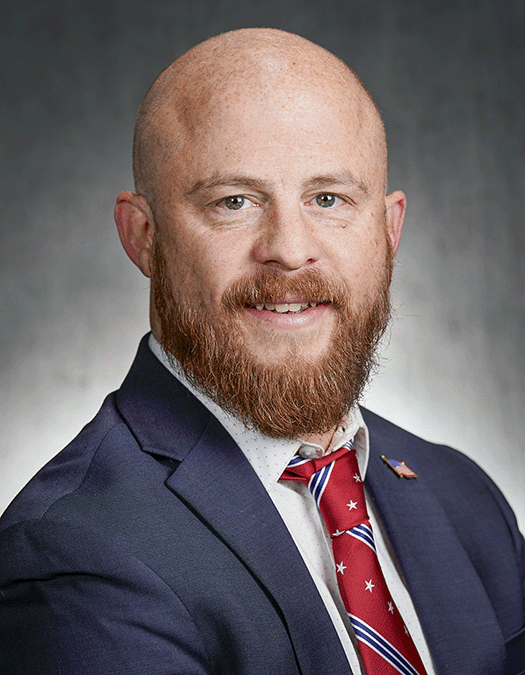
Rep. Drew Roach
Sponsored bills
Maddy summaryHF 1253 modifies Minnesota's absentee ballot procedures for certain voters. It shortens the timeline for mailing absentee ballots from 46 days to 28 days before elections (Minnesota Statutes 2024, § 203B.06, subd. 3) and moves the deadline for returning ballots from 8:00 p.m. to 3:00 p.m. on election day (§ 203B.08, subd. 1). The bill also prohibits correctional facilities from receiving absentee ballots, requiring county auditors to reject applications with correctional facility addresses (§ 203B.06, subd. 2). These changes directly affect absentee voters, election officials managing ballot distribution, and correctional facilities.
Maddy summaryHF 1022 modifies Minnesota's definitions for "moist snuff" and "tobacco products" in tax law. It defines "moist snuff" as finely cut, ground, or powdered smokeless tobacco containing nicotine intended for mouth placement (section 1.7-1.9). The bill explicitly includes nicotine solution products and moist snuff under "tobacco products" while excluding FDA-approved cessation products marketed solely for medical use (section 1.12-1.22). These changes, effective July 1, 2025, directly affect tobacco manufacturers, retailers, and consumers by clarifying which products fall under state tobacco taxation and regulation.
Maddy summaryHF 1955 creates a new license for home-based food businesses in Minnesota, allowing individuals to legally prepare and sell food from their residences. The bill establishes a "microenterprise home kitchen operation" license, valid annually from January 1 to December 31, requiring the commissioner to issue licenses within 30 days of application. It directly affects small home food entrepreneurs who want to sell prepared foods (like baked goods or meals) without needing a full commercial kitchen license. The license is separate from existing food handler classifications and requires annual renewal, with specific rules for application processing and fees. This change modifies multiple Minnesota statutes to add this new licensing category and appropriates funding for implementation.
Maddy summaryHF 1954 amends Minnesota's cottage food laws to increase the annual sales limit for home food producers from $78,000 to $85,000 and raise the registration fee exemption threshold from $5,000 to $8,500 (adjusted for inflation). It requires home food businesses to register annually with a $50 fee (waived for those under $8,500 in annual sales) and mandates clear labeling and signage stating "homemade, not subject to state inspection." The bill also adds a new requirement for the commissioner to submit biennial reports to the legislature by January 10, 2026, detailing the sales and fee thresholds and their inflation-adjusted values. These changes directly affect small-scale home food producers selling non-hazardous foods like baked goods or canned goods directly to consumers.
Maddy summaryHF 893 clarifies and strengthens Minnesota's self-defense laws by eliminating the requirement to retreat before using force when defending one's home or person. It expands the definition of "dwelling" to include occupied vehicles, porches, decks, and adjacent structures, and creates a legal presumption that someone entering a dwelling by stealth or force poses an imminent threat. The bill allows individuals to use deadly force without retreating in certain situations, such as when preventing a forcible felony or imminent harm to themselves or others. This directly affects Minnesotans using self-defense, particularly in home or vehicle defense scenarios.
Maddy summaryHF 1783 authorizes Minnesota to issue free special license plates for residents who have received the Legion of Merit military award. The bill allows eligible veterans to obtain these plates for personal-use vehicles (cars, trucks, motorcycles, or RVs) without paying registration fees or replacement costs. Plates can be transferred between vehicles owned by the same person, but must be used only for non-commercial purposes. This is a procedural change to Minnesota's license plate program, effective January 1, 2026.
Maddy summaryHF 898 withdraws Minnesota from the National Popular Vote Interstate Compact, a multi-state agreement that would have awarded the state's presidential electors based on the national popular vote. The bill amends Minnesota election law to revert to the state's existing method for selecting presidential electors: candidates are nominated by party conventions and elected based on congressional district and statewide vote totals, rather than the national popular vote. This change directly affects how Minnesota's 10 presidential electors are chosen in future elections. The bill repeals Minnesota Statutes sections 208.051 and 208.052, which had implemented the compact.
Maddy summaryHF 10 prohibits Minnesota state-funded financial assistance, including health coverage and college scholarships, for undocumented noncitizens. The bill explicitly excludes undocumented noncitizens (defined as those residing without U.S. Citizenship and Immigration Services approval) from MinnesotaCare (state health insurance) and the North Star Promise scholarship program. It amends state statutes to require that these programs deny eligibility to individuals without lawful immigration status. The policy change takes effect upon final enactment, with scholarship eligibility applying to awards beginning in the 2025-2026 academic year.
Maddy summaryHF 1786 amends Minnesota law to allow cities to issue on-sale liquor licenses to licensed cosmetology salons. This change directly affects cosmetology salons that already hold valid state licenses under section 155A.29, enabling them to serve alcohol on-site. The bill adds cosmetology salons to the list of approved establishments (previously including hotels, restaurants, and clubs) eligible for such licenses. The amendment modifies Minnesota Statutes section 340A.404, subdivision 1, and takes effect upon final enactment.