

Maddy summaryHF 2895 creates an education empowerment account program for Minnesota public school students in prekindergarten through grade 12. It establishes individual accounts funded annually with state general funds based on the statewide average per-pupil education revenue, adjusted for grade level. Parents can use these funds for approved expenses like tuition, textbooks, instructional materials, transportation, and technology devices, with unused balances after high school graduation transferable to postsecondary tuition. The bill requires the state education commissioner to manage applications, provide program information, and submit an annual report on the program's implementation.
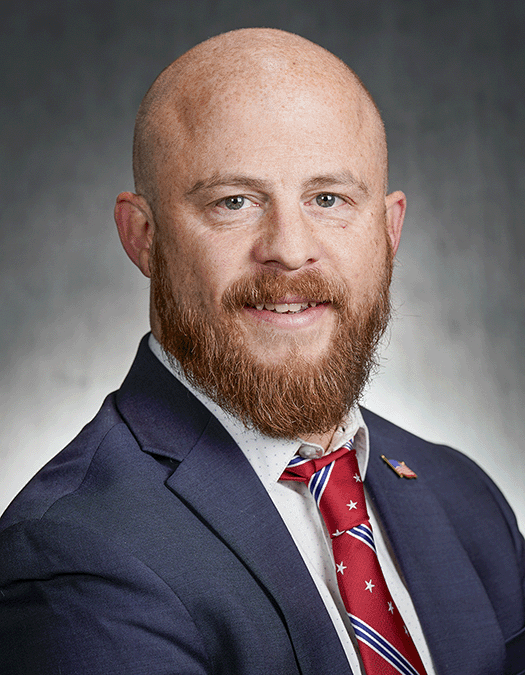
Rep. Drew Roach
Sponsored bills
Maddy summaryHF 3114 allows Minnesota cities to issue on-sale liquor licenses to cigar bars and tobacco product shops. This bill amends Minnesota Statutes § 340A.404, specifically adding cigar bars to the list of businesses cities may license for alcohol service (previously excluded). It directly affects cigar bars seeking to serve alcohol and cities with authority over liquor licensing. The change permits these businesses to operate with full liquor service under city licensing, without requiring additional state-level approvals beyond existing city processes.
Maddy summaryHF 19 establishes education savings accounts (ESAs) for Minnesota students from low-income households, defined as families earning no more than four times the income threshold for free school meals. The bill allows parents to use state funds to pay for qualifying education expenses - including tuition at eligible nonpublic schools, tutoring, approved curriculum, and school supplies - at participating schools or providers. Participation is capped at 5% of public school enrollment in the first year, increasing by 3% annually, with priority given to kindergarten students and those who attended public school full-time the prior year. The program directly affects eligible students (ages 18 and under) and their families, with funds restricted to approved educational services and materials.
Maddy summaryHF 1392 establishes a dedicated "consumer protection restitution account" to handle unclaimed funds from consumer protection cases in Minnesota. It requires that 50% of money recovered by the Attorney General in consumer enforcement actions - where funds aren't specifically designated for victims - be deposited into this account instead of the general fund. The account is used to distribute restitution to eligible consumers (those directly harmed by unlawful practices) who cannot be located or to whom payments weren't redeemed within 120 days, prioritizing cases with the oldest final court orders. This ensures unclaimed restitution money directly benefits victims rather than flowing into general state funding.
Maddy summaryHF 2448 prohibits counties, cities, and towns in Minnesota from banning the sale of flavored tobacco products, such as those with fruit, chocolate, mint, or candy flavors. It amends Minnesota Statutes to state that local governments may not enact ordinances that ban these products or create regulations making their sale impossible within their boundaries. The bill specifically defines "flavored products" as tobacco or nicotine products with non-tobacco tastes distinguishable before or during consumption. This law overrides any existing or future local ordinances attempting to restrict or ban such sales, while allowing local governments to maintain other tobacco sales regulations. The bill takes effect the day after final enactment.
Maddy summaryHF 2413 removes the requirement for a permit to carry a firearm in most public places in Minnesota, recognizing the Second Amendment right as stated in the bill. It directly affects law-abiding adults who are not prohibited from firearm possession under state or federal law, allowing them to carry openly or concealed without a permit in public spaces (excluding homes, businesses, gun shops, and specific outdoor areas for hunting). The bill adds a "no permit required" section (subd. 1c) while creating an optional permit system (subd. 1d) for those who want one, with requirements including safety training, age 21+, and background checks. It repeals existing permit-related provisions (subdivisions 1a, 1b, 16) and amends statutes to reflect these changes.
Maddy summaryHF 26, titled the "Never Again Act," shifts emergency declaration authority from the governor to the Minnesota legislature. It repeals the governor's power to declare emergencies and establish a new process requiring legislative approval for emergency declarations and extensions. The bill also prohibits the governor from issuing emergency orders with the "full force and effect of law" and explicitly protects citizens' rights, including free speech, religious freedom, assembly, travel, gun rights, and the ability to operate businesses. These changes amend multiple sections of Minnesota Statutes to clarify that only the legislature may enact emergency measures with legal force during crises.
Maddy summaryHF 1496 requires Minnesota voters applying for absentee ballots to verify their identity before the ballot is mailed. The bill amends election law to mandate that applicants provide a Minnesota driver's license number, state ID number, or last four Social Security digits. The secretary of state must verify this information against government databases before county auditors can mail ballots. This applies to all absentee ballot applicants except those in town elections held in March. The law aims to prevent fraudulent applications by confirming voter identities prior to ballot delivery.
Maddy summaryHF 2154 prohibits Minnesota law enforcement agencies from using traffic safety cameras (including speed and red-light cameras) for traffic enforcement. The bill cancels a $3.5 million appropriation for camera systems and repeals related statutes (Minnesota Statutes 2024, sections 169.011, 169.06, 169.14, and 169.147) that previously allowed such camera use. This directly affects local police departments and municipalities that operated or planned to use traffic cameras for issuing citations. The bill takes effect after August 1, 2025, ending the use of these systems for enforcement purposes.
Maddy summaryHF 24 amends Minnesota Statutes section 145.423 to require that infants born alive during an abortion be immediately recognized as human persons under the law and receive medical care. The bill mandates that medical personnel take "all reasonable measures consistent with good medical practice" to preserve the life and health of such infants, including compiling appropriate medical records. It directly affects healthcare providers performing abortions in Minnesota by establishing specific medical care obligations for infants born alive. The proposed changes would have taken effect the day after enactment, though the bill was not passed.