

Maddy summaryThis bill allocates $1.5 million from the arts and cultural heritage fund to the City of Minneapolis to create a public memorial honoring Renée Good and Alex Pretti. The memorial will feature statues, educational exhibits, and a space for community reflection, focusing on their deaths and the broader issues of civil rights and immigration enforcement. The project requires a collaborative planning process involving local residents, civil rights groups, artists, and historians, with oversight provided by a partnership including city officials and state legislators. While the state provides the initial funding, the city is permitted to seek additional private donations and partnerships to cover design, programming, and long-term maintenance costs.
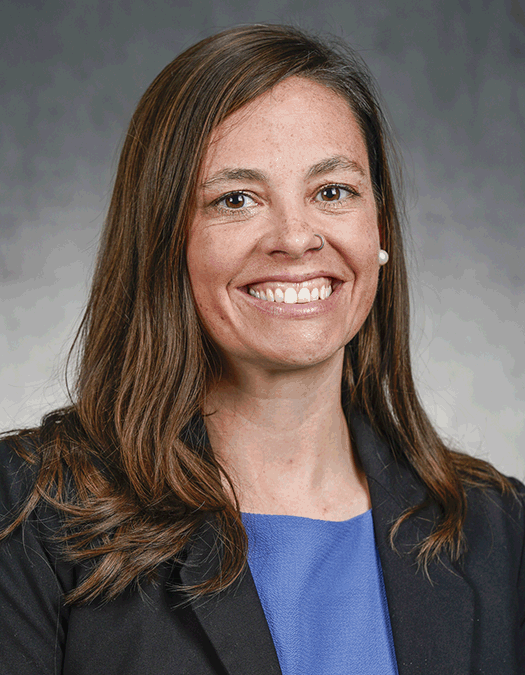
Rep. Kristi Pursell
Sponsored bills
Maddy summaryThis bill would allow nursing homes and assisted living facilities in Minnesota to permit residents to consume and display alcoholic beverages under specific conditions. The changes require that alcohol be consumed only by residents during resident-focused activities, with no one under 21 allowed to drink and all staff serving alcohol being at least 18 years old. Additionally, the bill prohibits selling alcohol or treating it as part of a commercial transaction within these facilities. The legislation directly affects nursing home operators, assisted living facility managers, and the residents who live in these care settings.
Maddy summaryHF 3452 classifies kratom as a Schedule II controlled substance in Minnesota, subjecting it to strict state regulations similar to opioids. The bill adds mitragynine and 7-hydroxymitragynine (the active compounds in kratom) to Schedule II, making unauthorized possession or sale illegal without a prescription. It repeals a prior law that only set penalties for selling kratom to minors or for minors possessing it. This change directly affects individuals who use or sell kratom, including businesses that currently sell kratom products, by applying full Schedule II restrictions.
Maddy summaryHF 3779 requires all health insurance plans in Minnesota to cover doula services - providing emotional and physical support during pregnancy, birth, and postpartum - without any deductibles, co-pays, or cost-sharing for enrollees. It prohibits health plans from imposing referral requirements, utilization reviews, or quantity limits on this coverage. Starting January 1, 2027, the commissioner of commerce will reimburse health plans for the costs of covering doula services, funded by annual state appropriations beginning in 2028. This bill directly affects health plan enrollees, particularly pregnant people seeking doula support, and health insurance companies that must now include this coverage.
Maddy summaryHF 3555 establishes rules for small, portable solar panels (under 1,200 watts) that homeowners can install to offset personal electricity use. The bill exempts these plug-in solar devices from requiring utility connection agreements, net metering rules, and additional fees or approvals. It also clarifies that utilities cannot be held liable for damage caused by these devices. This directly affects residential users seeking simple, low-barrier solar energy solutions without utility bureaucracy. The bill creates specific definitions and exemptions within Minnesota's energy code for these devices.
Maddy summarySF 2691 establishes clear standards for rent, utility charges, and fees in Minnesota manufactured home parks. It requires uniform rent rates (except for lot size/location or special services), prohibits fees based on household size, guests, home size, or occupancy, and mandates itemized billing for utilities. The bill also requires park owners to address safety hazards like dangerous trees within 14 days of resident notice and gives residents 60 days' written notice before rent increases. These changes directly affect manufactured home park residents and owners by increasing transparency and limiting arbitrary charges.
Maddy summaryThis bill establishes a legal framework in Minnesota to create an interstate agreement called the Interstate Fiscal Sovereignty Compact, which would allow member states to hold federal taxes in a state-controlled escrow fund rather than sending them directly to the federal government. The legislation defines key terms such as "member state" and "triggering event," and sets up a process where employers would deposit withheld federal income, Social Security, and unemployment taxes into this new state treasury fund once the compact is officially activated. Currently, no action is required from employers or the state until a governing body issues an order to start the escrow operations, meaning the bill does not immediately change how taxes are collected or paid. By creating a separate escrow fund, the bill aims to give states more control over federal tax revenue, though it requires other states to pass similar laws and join the agreement for the system to function.
Maddy summaryThis bill requires the Metropolitan Airports Commission to increase transparency regarding flights at Minneapolis-St. Paul International Airport that transport detained immigrants. Specifically, it mandates that the airport operator notify the commission whenever U.S. Immigration and Customs Enforcement arrives or departs with passengers being held in restraints. The legislation also requires the commission to install a live-streaming camera to record these flights and to submit monthly reports detailing the number of detained individuals, including minors, on each trip. These measures are designed to provide the public and state officials with real-time data and regular updates on immigration-related air traffic at the airport.
Maddy summaryThis Minnesota bill creates a $100 million relief program to help small businesses that experienced significant revenue declines between July 2024 and February 2026, which the bill attributes to federal enforcement activity. The program provides grants to operators of indoor retail or food market spaces with at least 25 small tenant businesses, requiring that most funds be used to offer rent forgiveness to existing tenants. To qualify, businesses must be Minnesota-based, have fewer than 50 employees, operate from a physical location, and show at least a 20 percent drop in revenue or sales during the specified period. Grant applications will be processed through a lottery system, with funds usable for payroll, rent, utilities, inventory, and other operational expenses, and the state must report on the program's outcomes by December 2026.
Maddy summaryHF 60 modifies Minnesota teacher licensure requirements by adding dyslexia training as a mandatory component for license renewal. The bill requires all licensed teachers renewing their licenses under sections 122A.181-122A.184 to complete two hours of free professional development on dyslexia, covering its effects on reading skills, instructional needs, and related health comorbidities. This training must be provided by the Professional Educator Licensing and Standards Board with input from dyslexia specialists, and teachers must complete it once - either during initial licensure or upon renewal. The requirements apply to all renewing teachers and take effect for licenses issued on or after July 1, 2027. The bill also updates renewal conditions for Tier 1 and Tier 2 licenses to include this dyslexia training.