

Maddy summaryThis bill requires social media platforms to report behavioral threat assessments to educational facilities and religious institutions in Minnesota when users pose a potential threat of targeted violence. The legislation defines key terms such as social media platforms, user-generated content, and targeted violence to establish clear boundaries for compliance. Platforms must implement systems to identify and report threats while protecting user privacy and maintaining existing safety protocols. The bill directly affects social media companies operating in Minnesota and institutions that receive threat reports, creating a new reporting framework for potential violence scenarios.
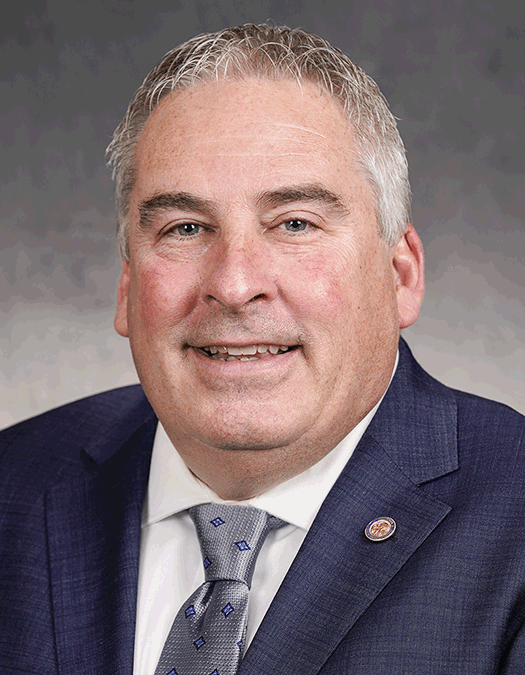
Rep. Jeff Witte
Sponsored bills
Maddy summaryHF 3396 establishes a property tax task force to investigate rising property taxes across Minnesota counties, cities, and school districts. The task force, composed of 6 members including legislators, local government leaders, and the state revenue commissioner, will study causes of tax increases and recommend ways to improve transparency in local government budget reporting. It must submit a report with these recommendations to the legislature by January 15, 2027, which will then require a public hearing during the next legislative session. This bill creates a process for studying property tax issues but does not change current tax laws or rates.
Maddy summaryHF 3498 increases penalties for transferring firearms to people legally prohibited from owning them, such as those denied permits or disqualified under Minnesota law. It raises the maximum prison term for standard transfers from two to three years and the fine to $10,000, while establishing a mandatory minimum three-year prison sentence (or the standard sentencing guideline term, whichever is longer) for transfers where the firearm is later used in a violent crime within one year. The bill also removes a previous defense allowing defendants to claim they were forced by a family member to transfer the firearm. This change directly affects individuals who transfer guns to ineligible persons, eliminating a legal option for those claiming coercion in domestic situations.
Maddy summaryThis bill updates Minnesota's horse racing laws by clarifying the definition of advance deposit wagering and establishing how the revenue from these wagers must be distributed. It requires racetracks to split source market fees from out-of-state wagers, with 28 percent going to standardbred tracks and 72 percent to Thoroughbred and Quarter Horse tracks. For out-of-state races, at least half of the fees collected must support breeders awards and purses, while in-state race fees must be used primarily for purses. The legislation also ensures that if a racetrack loses its license, the owed fees are redirected to other licensed tracks rather than being lost.
Maddy summaryThis bill allocates $2 million in state funding for fiscal year 2027 to support Minnesota-bred Thoroughbred horses. The money will be managed by the Minnesota Racing Commission to supplement race purses and provide financial assistance like grants and loans to breeders and owners. These funds are intended to encourage breeding and racing of Thoroughbreds born in Minnesota, with the appropriation available until June 30, 2029. The legislation directly affects horse racing operations and participants within the state's thoroughbred industry.
Maddy summaryThis bill requires correctional facilities in Minnesota to provide incarcerated individuals with the same medications they were taking before confinement, provided the prescriptions are verified as current and valid. The law applies to all licensed correctional facilities and ensures that inmates receive their prescribed medications unless specific exceptions apply. Exceptions include situations where a licensed health care professional determines the medication is medically inappropriate, when a more effective alternative medication is available with approval from the prescribing professional, or when an inmate formally requests to stop taking the medication. The bill defines licensed health care professionals as physicians, physician assistants, or advanced practice registered nurses who oversee inmate health care decisions.
Maddy summaryThis bill prohibits restrictions on displaying specific flags at residential properties. It voids any deed restriction, HOA rule, or local ordinance that limits owners or tenants from displaying the U.S. flag, Minnesota state flag, POW/MIA flag, military branch flags, or service flags (Blue Star/Gold Star). The law applies to all residential properties, including those governed by homeowners associations or rental agreements. It takes effect immediately upon enactment and invalidates any existing restrictions covering these flags, regardless of when they were adopted.
Maddy summaryThis bill modifies Minnesota's motor vehicle accident reporting requirements and allows local law enforcement to share certain data with contracted service providers. It defines "contracted service providers" as entities authorized by government agencies to help collect and manage crash report data, with these provisions taking effect on July 1, 2026. The legislation clarifies when accidents must be reported to the commissioner of public safety, including incidents involving fatalities, injuries requiring medical treatment away from the scene, disabling vehicle damage, or property damage to infrastructure. It also updates rules about who can access accident reports, allowing disclosure to accident parties, their legal representatives, insurers, and prosecutors while maintaining confidentiality for general use.
Maddy summaryThis bill authorizes the issuance of up to $22 million in state bonds to fund the replacement of unsafe and undersized buildings and facilities at Dakota County regional parks. The funds will be used to upgrade infrastructure at Lebanon Hills Regional Park and Lake Byllesby Regional Park, including new swimming beach facilities with accessible restrooms and showers, improved campground lodges with storm shelters, and updated trails and amenities. The legislation directs the commissioner of employment and economic development to manage the grant process for designing and constructing these improvements, with the bond sale handled by the commissioner of management and budget.
Maddy summaryHF 3562 modifies Minnesota's motor vehicle registration tax for passenger cars and hearses. It reduces the tax rate from 1.54-1.575% to 1.25-1.285% of a vehicle's manufacturer's suggested retail price (MSRP), depending on whether the vehicle was first registered in Minnesota before or on/after November 16, 2020. The tax amount decreases each year based on the vehicle's age (e.g., 100% of MSRP in year one, dropping to 10% in year ten), then becomes a flat $20 annually after the 10th year. This bill directly affects Minnesota vehicle owners paying registration fees for passenger cars and hearses, effective for registrations starting January 1, 2027.