

Maddy summaryThis bill modifies how the state of Minnesota calculates registration taxes for passenger automobiles and hearses, directly affecting vehicle owners and dealers. It lowers the tax rate applied to the manufacturer's suggested retail price from 1.54% to 1.25% for cars registered before November 2020, and from 1.575% to 1.285% for newer vehicles, while also removing destination charges from the calculation for most cars. The legislation adjusts the percentage of the vehicle price used for tax purposes as the car ages, reducing the rate each year until it reaches a flat fee in the eleventh year. These tax changes are scheduled to take effect for registration periods beginning on or after January 1, 2027.
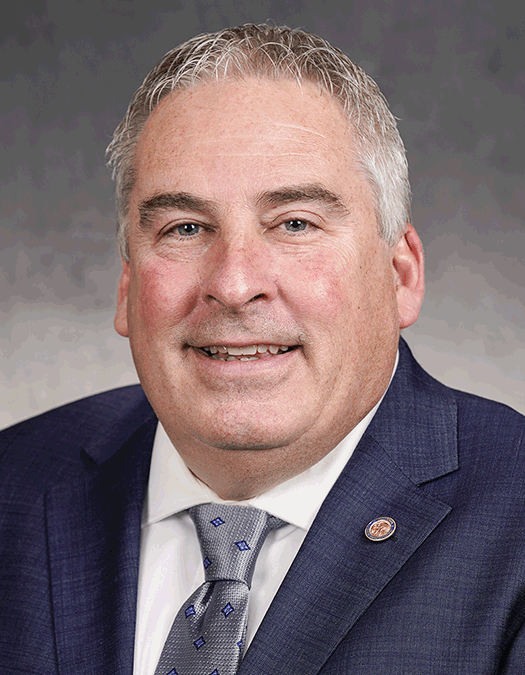
Rep. Jeff Witte
Sponsored bills
Maddy summaryThis bill strengthens penalties for falsely impersonating a peace officer in Minnesota by upgrading the offense from a misdemeanor to a felony and adding new crimes for impersonating while possessing a firearm or using marked law enforcement vehicles. It also establishes enhanced sentencing when someone commits other crimes while pretending to be an officer, including extending maximum jail time for serious offenses. Additionally, the law requires law enforcement officers to clearly identify themselves by name, agency, and identification number when interacting with the public. These changes directly affect individuals who falsely claim to be police officers and law enforcement personnel who must follow new identification requirements.
Maddy summaryThis bill allows law enforcement chiefs to give away old or retired police badges for free to former officers or the families of deceased officers. It specifically permits chiefs to provide these surplus badges to current or retired officers who were originally issued the badge, as well as to the spouses or children of peace officers who have died. The law defines a surplus badge as one bearing a seal before May 11, 2026, or a badge from a retired officer. This measure creates a new exception to existing rules that typically restrict the transfer of law enforcement identification.
Maddy summaryThis bill increases funding for peace officer training reimbursements in Minnesota, directing $2.949 million in the first year and $6.042 million in the second year to local governments for training costs. It establishes a $4.942 million annual Philando Castile Memorial Training Fund specifically for law enforcement training courses focused on use of force, crisis response, conflict management, cultural diversity, and autism training. The bill requires training sponsors to submit detailed course outlines, instructor qualifications, and learning assessments to the Peace Officer Standards and Training Board, with ongoing reviews to ensure courses meet approved learning outcomes. Additionally, it raises the base funding for reimbursing other board-approved training courses from $878,000 to $3.878 million starting in fiscal year 2028.
Maddy summaryHF 3602 requires all Minnesota public schools (K-12) to develop and adopt evidence-based school safety plans by May 2028, with the Minnesota School Safety Center reviewing and approving these plans. The bill establishes a School Safety Advisory Council, appropriates funding for the Center to create a model safety plan, and mandates that schools include mental health support and positive climate efforts in their plans. Schools failing to adopt approved plans must notify parents and staff by August 2028, and the Center must publicly report on compliance by December 2028. The law defines "evidence-based" using research standards like experimental studies or strong research rationale, and requires the Center to employ at least two mental health professionals.
Maddy summaryHF 3127 modifies Minnesota's pass-through entity tax election process, allowing certain businesses (like partnerships and S corporations) to file a single tax return instead of requiring each owner to file individually. It specifies that qualifying entities must meet ownership thresholds (over 50% of qualifying owners) to elect this tax, and the election is irrevocable for the tax year. The bill clarifies that the tax amount equals each qualifying owner's income multiplied by Minnesota's highest individual tax rate, without allowing standard deductions. This directly affects pass-through business owners and entities filing under Minnesota Statutes 289A.08 and 290.06. The changes streamline tax filing for these entities while maintaining the tax calculation method.
Maddy summaryThis bill temporarily suspends the hospital surcharge that Minnesota hospitals must pay to the state's medical assistance account. It amends existing state law to prohibit the 1.4 percent to 1.56 percent fee starting July 1, 2026, through July 1, 2027. The surcharge applies to most Minnesota hospitals but excludes federal Indian Health Service facilities and regional treatment centers. The change is set to take effect immediately upon final enactment of the legislation.
Maddy summaryThis bill increases criminal penalties for unlawful possession of firearms in Minnesota, directly affecting individuals who have prior violent crime convictions or are otherwise prohibited from owning guns. It raises the maximum prison sentence for those with violent crime convictions who possess firearms from 15 to 20 years and increases fines up to $30,000. The legislation also elevates penalties for prohibited persons possessing certain weapons from gross misdemeanors to felonies with up to 15 years in prison, and extends sentencing enhancements for offenses committed in sensitive locations like schools and parks. Additionally, it increases penalties for illegally transferring firearms to prohibited individuals, raising the maximum sentence from two to four years for private transfers and from five to eight years for transfers resulting in subsequent violent crimes. All changes take effect on August 1, 2026.
Maddy summaryHF 2817 amends Minnesota law to extend service line of duty death benefits to part-time, paid on-call, and volunteer firefighters. The bill updates the definition of "public safety officer" to include these firefighters when performing specific duties like firefighting, emergency medical services, or hazardous material response. This change ensures that the families of these firefighters who die while on duty receive the same death benefits previously available only to full-time firefighters. The policy applies to firefighters working for local government fire departments or independent nonprofit firefighting organizations.
Maddy summaryThis bill modifies Minnesota's existing rules about asking job applicants about their past pay history. It creates an exception to the general prohibition on pay history inquiries when that information is already a matter of public record under federal or state law, unless the employer specifically sought it to determine the applicant's wages. The legislation also clarifies that applicants can voluntarily share their pay history without being prompted, and employers may consider such voluntary disclosures to offer higher wages. Additionally, the bill preserves existing protections against wage discrimination and allows employers to discuss compensation expectations with applicants.