

Maddy summaryHF 278 increases fees for all-terrain vehicle (ATV) registrations and nonresident trail passes in Minnesota. It adds a $45 surcharge to all ATV registration fees (raising public-use fees from $6 to $20 annually) and increases the nonresident trail pass fee from $30 to $45 per year. The surcharge and higher pass fees fund grant-in-aid programs under Minnesota Statutes 84.927, specifically for constructing and maintaining ATV trails and use areas in counties and municipalities. This directly affects ATV owners (residents and nonresidents) who must pay these updated fees to operate on state or grant-in-aid trails.
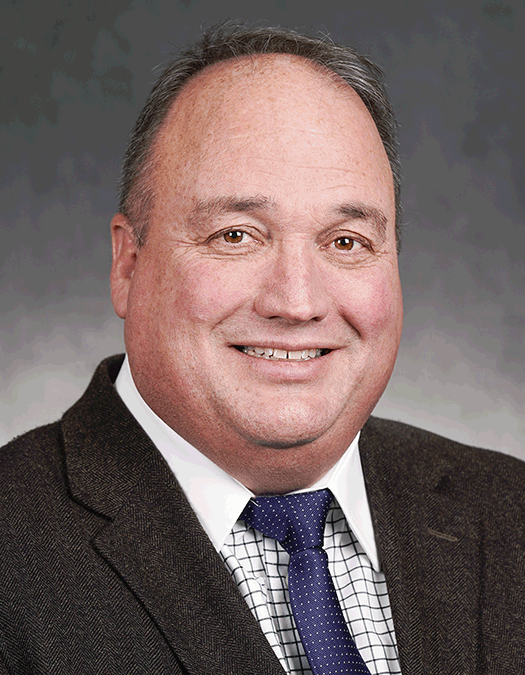
Rep. John Huot
Sponsored bills
Maddy summaryHF 1912 modifies Minnesota's rules for hospitals operating swing beds, which provide transitional care between hospital and nursing home settings. The bill requires hospitals to limit swing bed stays to 40 days (unless emergency approval is granted with specific documentation), restrict admissions to recently hospitalized or directly transferred patients, and submit annual reports on usage, charges, and patient data to the health commissioner. It specifically exempts Cook County critical access hospitals with attached nursing homes from the stay limits and admission rules, allowing them to use swing beds for nursing services without prior hospitalization. These changes directly affect hospitals seeking or maintaining swing bed licenses in Minnesota.
Maddy summaryHF 2320 requires health insurance plans in Minnesota to cover self-measured blood pressure monitoring devices and related services for enrollees diagnosed with uncontrolled hypertension. The coverage must include one device every three years and reimburse providers for patient training, data transmission, and co-interventions. This applies to all health plans regulated under Minnesota Statutes, effective January 1, 2026. The bill directly affects Minnesotans with uncontrolled hypertension who rely on insurance for medical equipment, ensuring they can access these devices without excessive out-of-pocket costs.
Maddy summaryHF 630 extends the expiration date of Minnesota's short-call substitute teacher pilot program from June 30, 2025, to June 30, 2027. The bill directly affects school districts, charter schools, and substitute teachers who qualify under the program by requiring an associate's degree or specific paraprofessional experience. Key provisions include mandating background checks, requiring districts to provide substitute training, and guaranteeing substitute teachers receive at least $200 per day or their regular pay rate. The extension allows the program to continue operating under its existing rules without changes to eligibility or requirements.
Maddy summaryHF 2363 grants residents of long-term care facilities in Minnesota the right to have one designated support person (such as a family member, partner, or close friend) physically present with them while receiving care. The bill amends Minnesota Statutes 2024, sections 144.651 and 144G.91, requiring facilities to allow this support person unless restricted for medical reasons (like during surgery) or if the person poses a safety threat. Facilities must follow internal grievance procedures if a support person is denied. This directly affects long-term care residents and facilities, ensuring they can choose a comfort person without facility interference, except in specific safety or clinical circumstances.
Maddy summaryHF 2364 establishes "Donate Life" special license plates in Minnesota. Vehicle owners who pay a $25 annual contribution to the organ and tissue donation account (in addition to standard plate fees) can obtain these plates, which must display a standard donation logo and "Donate Life" inscription. Funds collected through this contribution are deposited into a dedicated account and used to cover administrative costs, with remaining funds distributed to LifeSource, a nonprofit focused on organ donation activities like registry maintenance and public education. The bill takes effect January 1, 2026, for new plates issued on or after that date.
Maddy summaryHF 279 appropriates $752,000 from the natural resources fund for specific all-terrain vehicle (ATV) trail projects in St. Louis County and $200,000 for a route study in Duluth. The St. Louis County funds will support four local club projects - including engineering, construction, and right-of-way acquisition for trails managed by the Alborn Dirt Devils, Ranger Snowmobile/ATV, Twig Area Trail Riders, and Quad Cities ATV clubs. The Duluth study aims to establish connectivity for ATV routes in the western part of the city. All funds are one-time appropriations available until June 30, 2028.
Maddy summaryHF 2202 defines "food retailer" as grocery stores, supermarkets, and convenience stores primarily selling packaged groceries, and creates a new "off-sale limited malt liquor license" for these businesses. The bill defines "low-alcohol malt liquor" as containing 2% or less alcohol by weight and "limited malt liquor" as 1.5% to 15% alcohol by weight, clarifying labeling requirements. It amends licensing rules to allow food retailers to obtain licenses for off-sale sales of these malt liquor products, updating Minnesota Statutes sections 340A.101, 340A.402, and others. This directly affects grocery and convenience stores seeking to sell malt liquor under new licensing categories.
Maddy summaryHF 281 appropriates $380,000 for the Voyageur Country ATV Trail system and $175,000 for the Prospectors Loop Trail system in St. Louis County. The funds, from the natural resources fund, are for one-time use on trail design, right-of-way acquisition, permitting, and construction through June 2028. This bill directly affects St. Louis County by providing targeted funding for specific ATV trail projects.
Maddy summaryHF 2255 authorizes the state to issue up to $30 million in appropriation bonds to fund security improvements at the Vikings stadium in Minneapolis. The bill directs funds toward physical security measures like fencing, gates, crash barriers, and monitoring equipment (defined as a "secured perimeter"). Proceeds from the bonds must be deposited into a special fund to cover the cost of these security upgrades and related debt service. The stadium, owned by the Minnesota Sports Facilities Authority, is the direct beneficiary of this funding mechanism.