

Maddy summaryHF 1458 modifies Minnesota's requirements for becoming a certified public accountant (CPA). It extends current standards (150 college credits plus one year of relevant work experience) until July 1, 2030, after which new applicants will need either a master's degree plus one year of experience or a bachelor's degree plus two years of experience. The bill also establishes reciprocity, allowing CPAs licensed in other states with comparable requirements to practice in Minnesota without additional exams. This directly affects current and future CPA applicants in Minnesota and out-of-state CPAs seeking to practice in the state.
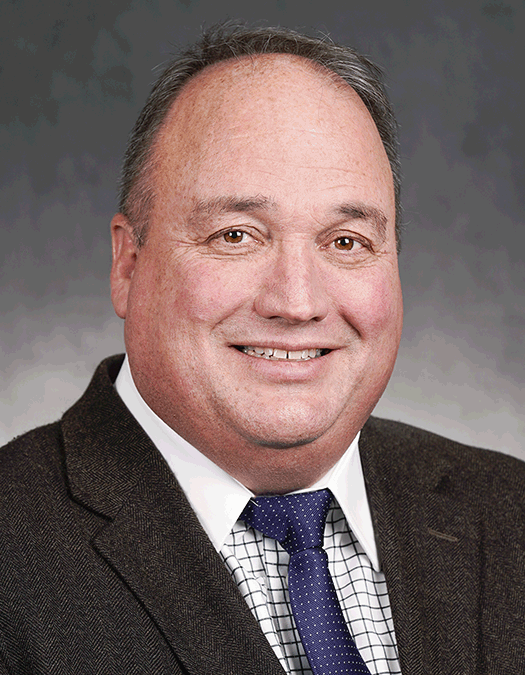
Rep. John Huot
Sponsored bills
Maddy summaryHF 2211 allocates $3.6 million from the general fund for each of fiscal years 2026 and 2027 to the Minnesota Commissioner of Health. This funding is specifically for grants to local and Tribal health departments to support substance misuse prevention, education, and recovery programs under Minnesota Statutes §144.197, subd. 4. The bill directly affects health departments that will receive these grants to expand community-based services. It does not create new requirements but provides dedicated funding for existing program frameworks focused on addressing substance misuse.
Maddy summaryHF 1292 expands eligibility for Minnesota's beginning farmer tax credits by adding specific requirements to qualify. It defines "beginning farmer" as someone who has entered farming within the last ten years, meets net worth limits, provides majority day-to-day farm labor, demonstrates farming knowledge or experience, shows profit potential through projected earnings, and completes a financial management program (with a waiver available for those with agricultural degrees or experience). The bill directly affects new or recent farmers seeking to establish operations in Minnesota, particularly those who may not have met prior eligibility criteria. The changes amend Minnesota Statutes section 41B.0391, aiming to support entry into farming through targeted tax assistance.
Maddy summaryHF 1175 requires Minnesota public school districts and charter schools to develop written cardiac emergency response plans by the 2026-2027 school year. These plans must include specific steps for responding to cardiac arrests, such as placing automatic defibrillators in accessible locations, training staff in CPR and defibrillator use, and conducting annual emergency simulations. The bill appropriates $2 million from the general fund to help schools implement these plans, covering costs for defibrillators, training, and related equipment. It directly affects all Minnesota schools, ensuring they are prepared for cardiac emergencies during school activities.
Maddy summaryHF 2034 appropriates $17,057,000 annually from the general fund and $255,000 annually from the natural resources fund for the Minnesota Zoological Garden (Minneapolis Zoo) during fiscal years 2026 and 2027. The funds are allocated directly to the Minnesota Zoological Board to support the zoo's operations and maintenance. This bill provides specific, targeted funding without altering zoo policies or creating new requirements. It affects the zoo's budget directly through these fixed annual appropriations.
Maddy summaryHF 61 requires Minnesota school districts and charter schools to provide approved mental health instruction for students in grades 4-12 starting in the 2026-2027 school year. It also mandates youth sports programs (for which fees are charged) to train coaches and officials on recognizing mental illness warning signs and suicide prevention. The bill modifies emergency intervention rules for schools, updating requirements for physical holding or seclusion. These changes directly affect public schools, charter schools, and youth sports organizations across Minnesota.
Maddy summaryHF 695 requires venues hosting public events (like concerts or festivals) to provide attendees with free access to drinkable water during events. Specifically, venues must offer one of three options: provide free bottled water, allow guests to bring their own bottled water, or let guests fill empty bottles with water on-site. The bill directly affects "places of entertainment" as defined in Minnesota law, including theaters, sports arenas, and event spaces. It creates a clear, practical requirement for water access without mandating specific infrastructure.
Maddy summaryHF 794 establishes a state dementia services program under Minnesota's commissioner of health to coordinate existing Alzheimer's and dementia-related services. The program will link state agencies, Tribal Nations, community groups, and research organizations to improve public awareness, update Minnesota's Alzheimer's Disease State Plan, and integrate early detection strategies into public health efforts. The bill appropriates funding from the general fund for the program, starting with an unspecified amount in fiscal year 2026 and a base amount in 2027. This directly affects Minnesotans living with dementia, their caregivers, and the state agencies and community organizations providing related services.
Maddy summaryHF 2475 reduces the percentage Minnesota homeowners must pay toward their homestead credit property tax refunds. The bill amends Minnesota Statutes section 290A.04 by lowering the "co-pay" rate for qualifying homeowners, decreasing the claimant's required payment from 12% to as low as 1.0% of property taxes for the lowest income brackets. This change directly affects homeowners with household incomes up to $135,409 who claim the homestead credit, increasing their state refund amount by reducing their out-of-pocket share. The state refund maximum remains $3,500 for most income levels, but the reduced co-pay means homeowners retain more of their property tax refund.
Maddy summaryHF 1361 appropriates $8 million from state bond proceeds to fund improvements at CHS Field in St. Paul. The city of St. Paul will receive the grant to cover predesign, construction, and equipment for upgrades meeting Major League Baseball standards, including a new locker room, enhanced visitor amenities, and environmental remediation of contaminated soil. The state will issue bonds up to $8 million to fund this appropriation, following Minnesota's bond sale procedures. This bill directly affects CHS Field's operations and the city's ability to modernize the stadium.