

Maddy summaryThis bill establishes the Equal Access to Broadband Act in Minnesota and updates existing laws to clarify definitions and rules for broadband services and infrastructure. It defines specific terms like "underserved areas" and "last-mile infrastructure" to help identify regions lacking high-speed internet and to distinguish between different parts of the network. The legislation also grants local governments the authority to require broadband providers to obtain a franchise or municipal authorization before placing infrastructure in public rights-of-way. Under this new framework, cities and counties can charge fees to broadband providers to cover costs associated with occupying public space or to generate revenue. Additionally, the bill ensures that various utility companies, including those providing broadband, can continue to use public roads for construction and maintenance without interfering with public safety.
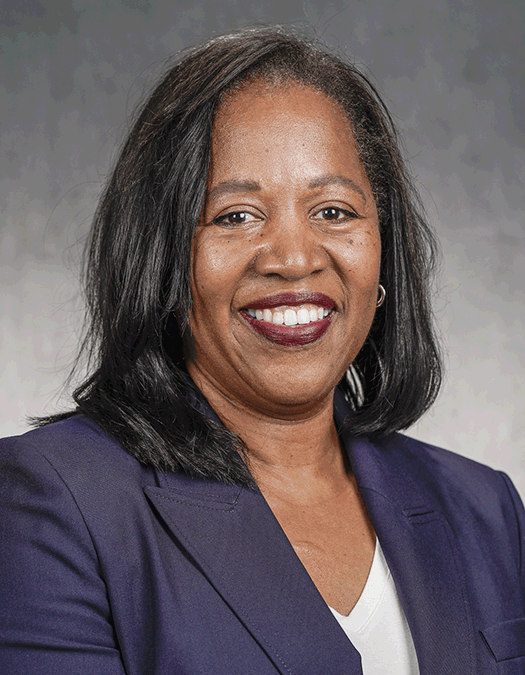
Rep. Mary Clardy
Sponsored bills
Maddy summaryThis bill requires digital video service providers, such as streaming and satellite companies, to pay a fee to local governments in Minnesota. The fee is set at five percent of the revenue these providers earn from subscribers living within each specific city or county. Providers must submit quarterly reports to local authorities and pay the collected fees directly to them within 45 days of each quarter ending. The money gathered through this fee is intended to support public, educational, and governmental programming channels available to residents. The law specifically excludes traditional cable systems that already pay franchise fees from this new requirement.
Maddy summaryThis bill allows individuals who provide direct support services to older adults or people with disabilities to qualify for MinnesotaCare health coverage, even if their household income is too high for standard eligibility. To qualify, a family member must work at least 20 hours per week providing non-professional care within their own home, and they must submit proof of this employment to receive coverage. The legislation also sets a fixed monthly premium of $80 for these eligible workers and allocates state funds to cover their healthcare costs without using federal money.
Maddy summaryThis bill creates two financial support programs in Minnesota to assist home care workers who are also pursuing higher education. The first program offers grants to students enrolled in degree programs who commit to working at least ten hours per week as home care providers for older adults or people with disabilities. The second program establishes a fund to forgive qualified education loans for individuals working in the same home care field. Both initiatives are administered by the Office of Higher Education, which must set application rules, determine award amounts up to $5,000, and submit annual reports to the legislature. Funding for these programs is transferred and appropriated from existing state resources.
Maddy summaryThis bill allocates $315,000 from the state's natural resources fund to help school districts build or improve accessible playgrounds. The funding specifically targets three districts in the Twin Cities area to upgrade equipment, create accessible pathways, and install specialized surface materials at designated elementary schools. To ensure the projects meet safety and accessibility standards, recipients must have their plans reviewed by certified specialists before or after construction. By January 2026, the districts receiving the money must submit a report detailing how the funds were spent and suggest ways other schools can enhance their playgrounds for greater inclusion.
Maddy summaryThis bill authorizes the issuance of up to $15 million in state bonds to fund the design and construction of new suicide prevention barriers on the Washington Avenue Pedestrian Bridge at the University of Minnesota. The appropriated funds will be used specifically to replace the existing pedestrian enclosure and install deterrent measures to address safety concerns at this location. The legislation requires that the project design process include consultation with individuals impacted by suicide, prevention organizations, and relevant experts. Once passed, the state will sell the bonds to generate the necessary capital for this infrastructure improvement.
Maddy summaryThis bill establishes the Minnesota African American Family Preservation and Child Welfare Disproportionality Act to protect African American children and families from unnecessary removal from their homes. It creates a new advisory council and requires social services agencies to make "active efforts," which is a higher standard than usual, to keep these children safely with their families while respecting their cultural values. The legislation also mandates specific reports on how well these new protections are working and sets a future effective date of July 1, 2027.
Maddy summaryThis bill modifies how the state handles licensing violations for home and community-based services providers in Minnesota. It ensures that penalties and corrective orders apply only to the specific service site or license where violations occurred, rather than automatically affecting all sites or licenses held by the same organization. The legislation also introduces new requirements for the Department of Human Services, including offering legal assistance, partnering with culturally specific organizations for training, and providing alternative dispute resolution services. Additionally, the bill mandates annual reports starting in 2025 that track enforcement actions and include data on the race and ethnicity of providers facing violations.