

Maddy summaryThis law establishes new standards to protect African American children and those from other disproportionately represented groups within Minnesota's child welfare system. It requires social services agencies to make continuous, rigorous efforts to keep families together and prevent unnecessary removal of children from their homes. The act defines a higher level of care called "active efforts," which mandates that agencies involve families in planning services and respect their cultural values. Additionally, the legislation sets specific criteria for what constitutes a permanent adoptive placement and ensures that these protections apply alongside existing laws for Native American children.
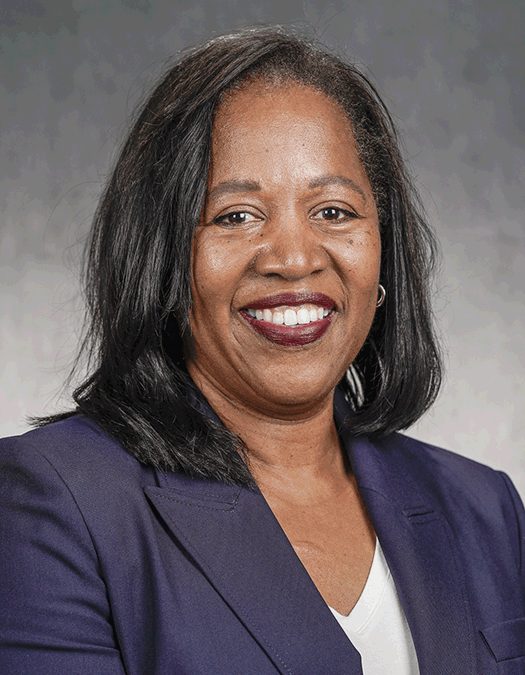
Rep. Mary Clardy
Sponsored bills
Maddy summaryThis bill expands access to essential government documents for individuals in Minnesota who are eligible for medical assistance and have been treated for a substance use disorder within the last 12 months. It allows these individuals to apply for certified birth records and identification cards or driver's licenses with waived fees, provided they submit a verification statement from a public-funded treatment provider confirming their eligibility and treatment history. The legislation also establishes specific data privacy rules for the personal information shared during this verification process. By removing financial barriers and streamlining the application requirements, the bill aims to ensure that people recovering from substance use disorders can obtain critical identification without incurring costs.
Maddy summaryHF 5237 is a supplemental budget bill that provides additional funding to the state's education system and related human services programs. The legislation directly affects public schools, charter schools, early childhood education providers, and families receiving child welfare or economic support services. Key provisions include allocating money for school operations, teacher salaries, special education, and facilities, while also adjusting funding forecasts for various state agencies. The bill amends existing laws to ensure these resources are distributed and managed according to updated needs, particularly regarding instructional hours and student support services.
Maddy summaryThis bill is a resolution from the Minnesota Legislature that formally asks Congress to overturn the Supreme Court ruling in Citizens United v. FEC. It requests that Congress propose a constitutional amendment to clarify that only natural persons, not corporations or other artificial entities, possess rights under the Constitution. The proposed amendment would also state that spending money to influence elections is not protected speech and would allow governments to regulate or limit campaign contributions to ensure equal political access. Additionally, the bill mandates that all permissible campaign spending must be publicly disclosed. Ultimately, the resolution directs state officials to send copies of the text to federal leaders and Minnesota's congressional representatives.
Maddy summaryThis bill prevents the Minnesota Public Utilities Commission from issuing permits to build pipelines designed to transport carbon dioxide. It directly affects energy companies and regulators by legally barring the approval of any new carbon dioxide pipeline routes in the state. The law takes effect immediately upon final passage, ensuring that no such permits can be granted under the current statute.
Maddy summaryThis bill proposes adding a new section to the Minnesota Constitution to guarantee equal rights and prohibit discrimination for all people. It specifically protects individuals from discrimination based on race, color, national origin, ancestry, disability, and sex, with the definition of sex explicitly including pregnancy, gender identity, and sexual orientation. If voters approve the amendment at the 2026 general election, the change will become effective on January 1, 2027. The text also establishes that any state action denying these rights must be the least restrictive way to achieve a very important government goal.
Maddy summaryThis bill modifies Minnesota's individual income tax rules by allowing taxpayers to subtract Social Security benefits and public pension income from their taxable income. It establishes specific dollar limits and phase-out thresholds based on a taxpayer's filing status and provisional income, ensuring that higher earners gradually lose access to these subtractions. The changes apply to retirees receiving benefits from state pension plans and aim to align state tax treatment more closely with federal standards for public pensions. These provisions take effect for taxable years beginning after December 31, 2022.
Maddy summaryThis bill proposes adding a new section to the Minnesota Constitution to guarantee equality under the law. The amendment would prohibit the state, its cities, counties, and other political subdivisions from denying or abridging rights based on race, color, creed, sex, sexual orientation, gender identity or expression, age, disability, ancestry, or national origin. If approved by voters at the 2024 general election, the change would take effect on January 1, 2025. The measure is titled the "Equal Rights Amendment" and requires a simple yes or no vote from the public.
Maddy summaryThis bill directs the Minnesota Legislature to provide a one-time funding of $25,000,000 from the state's general fund to the Department of Transportation for the Small Cities Assistance Account. The money is intended to support transportation projects in smaller cities within the state, with all funds required to be distributed in the July 2024 payment cycle. The legislation becomes effective immediately upon final passage by the legislature.
Maddy summaryThis bill requires the Bureau of Criminal Apprehension and Violent Crime Enforcement Teams to submit an annual report detailing their gun trafficking investigations, the number of firearms seized, and how funding for violent crime reduction was utilized. It also updates the legal definition of a "trigger activator" to include devices that allow a firearm to fire multiple shots with a single trigger pull or without requiring a subsequent pull. Additionally, the legislation increases penalties for transferring firearms to individuals who are legally ineligible to possess them, raising the maximum prison sentence from two years to five years if the weapon is used in a violent felony within a year of the transfer.