

Maddy summaryHF 2459 appropriates $150,000 for the 2026 fiscal year and $150,000 for 2027 to the Metro Deaf School. The funding provides services specifically for young children with deafness, deafblindness, or hard-of-hearing disabilities who do not qualify for existing state funding under Minnesota Statutes §124E.11(h). This is a one-time appropriation, directly supporting the school's ability to serve this specific student population. The bill does not change eligibility rules but provides dedicated funding for an underserved group.
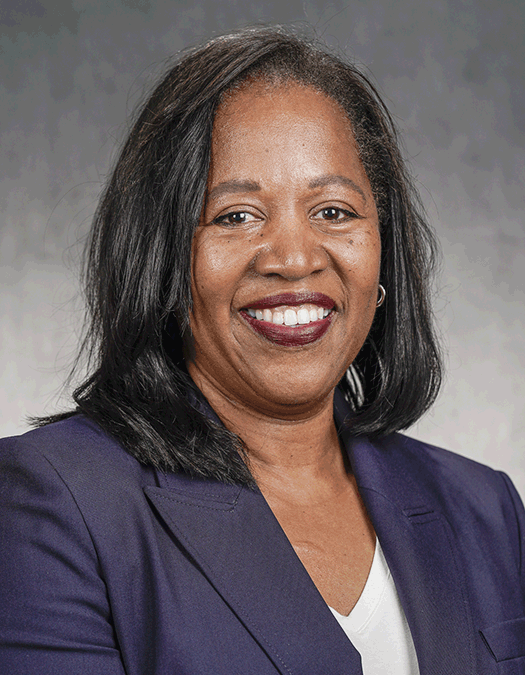
Rep. Mary Clardy
Sponsored bills
Maddy summaryHF 2326 modifies Minnesota's safe and supportive schools requirements for public school districts and schools. It mandates developmentally appropriate programming to help students identify, prevent, and respond to prohibited conduct, value diversity, and build conflict resolution skills using evidence-based social-emotional learning. The bill requires schools to train student bystanders, prevent inappropriate special education referrals for behavioral issues, and create positive school climates. It also establishes a state model policy defining prohibited conduct and outlines procedures for compliance reviews, complaint handling, and annual climate improvement planning, effective July 1, 2025.
Maddy summaryHF 2738 establishes voluntary microcredentials for teachers and administrators working with English learners, requiring specific professional development in culturally responsive teaching. It modifies Minnesota's English learner funding formula to provide additional revenue for students with limited or interrupted formal education (adding a 0.5 multiplier to the combined basic and concentration allowances). The bill also creates a new requirement for school districts to report English learner staff ratios and appropriates funds to support these changes. These provisions directly affect English learner students, school districts, and licensed teachers through updated funding, reporting, and professional development requirements.
Maddy summaryHF 1458 modifies Minnesota's requirements for becoming a certified public accountant (CPA). It extends current standards (150 college credits plus one year of relevant work experience) until July 1, 2030, after which new applicants will need either a master's degree plus one year of experience or a bachelor's degree plus two years of experience. The bill also establishes reciprocity, allowing CPAs licensed in other states with comparable requirements to practice in Minnesota without additional exams. This directly affects current and future CPA applicants in Minnesota and out-of-state CPAs seeking to practice in the state.
Maddy summaryHF 1509 limits when law enforcement can issue citations to pedestrians for crossing during certain traffic signal phases. It amends Minnesota Statutes § 169.06, subdivision 5, by clarifying that pedestrians facing a circular yellow traffic signal (not a dedicated pedestrian signal) cannot be cited for starting to cross when the yellow light first appears. The bill specifically prohibits citations for pedestrians who begin crossing during the yellow phase, as the signal warns there is "insufficient time to cross" before red. This directly affects pedestrians at intersections with standard traffic signals, ensuring they aren’t penalized for crossing during the yellow light warning.
Maddy summaryHF 1401 expands Minnesota's definition of "endangered" for the missing and endangered persons program. The bill adds specific circumstances that classify a missing person as endangered, including needing urgent medical care, having cognitive impairments like dementia, or being lost in dangerous wilderness areas. This change allows law enforcement to activate immediate search and rescue resources when these new criteria are met. The bill directly affects local police departments and individuals who go missing under these expanded circumstances, ensuring faster response for vulnerable cases.
Maddy summaryHF 775 requires Minnesota school districts to create written policies ensuring parents of children with disabilities can fully participate in their child's education. Specifically, districts must establish processes for providing free language assistance (like interpreters or translated documents) for non-English-speaking parents and reasonable accommodations (such as sign language interpreters or modified meeting formats) for parents with disabilities, without requiring health information disclosure. These policies must be posted in multiple languages on district websites, shared annually with parents, and kept confidential. The bill directly affects school districts and parents interacting with special education programs, effective July 1, 2025.
Maddy summaryHF 745 modifies how Minnesota school districts calculate compensatory revenue eligibility for low-income students, requiring districts to count children eligible through both direct certification (like SNAP benefits) and education benefits (such as school meal programs) as of October 1 each year. It adjusts spending rules, requiring at least 80% of compensatory revenue to be spent at individual school sites (with a temporary 40% allowance for 2026-2027 if meal program data is incomplete) and mandates reporting for adjustments due to enrollment changes. The bill establishes a Compensatory Revenue Task Force, composed of education officials, school board representatives, and parent advocates, to analyze the funding formula and make recommendations. It appropriates funds for these changes and takes effect for fiscal year 2026.
Maddy summaryHF 1377 appropriates $1.75 million annually (2026-2027) for matching grants, $350,000 annually for equipment grants, and $1 million annually for block grants to Minnesota public television stations. The bill directs the commissioner of administration to allocate these funds based on recommendations from the Minnesota Public Television Association. It directly affects public television stations eligible under Minnesota Statutes, section 129D.13, by providing dedicated state funding for operational support and equipment. The funding is sourced from the general fund and applies specifically to fiscal years 2026 and 2027.
Maddy summaryHF 2430 appropriates $2,000 per school district (or $40 per student, based on fall 2024 enrollment) from the general fund to compensate teachers for completing required Read Act training. This funding directly affects school districts, charter schools, and cooperative units providing direct instruction in Minnesota. Payments must be distributed by October 15, 2025, and are designated for fiscal year 2026. The bill mandates that districts use these funds to compensate eligible teachers as specified in existing law or through teacher union agreements.