

Maddy summaryHF 2636 requires Minnesota's Attorney General to submit an annual report by July 15 each year to legislative committees overseeing judiciary, civil law, or criminal law. The report must detail all legal cases challenging the constitutionality of state statutes, including the challenged statute, defense efforts, case status, staff time, and costs incurred during the prior fiscal year. This bill directly affects the Attorney General's office (which must prepare the report) and the specified legislative committees (which receive the report). The law creates no new policy but mandates transparency about how the office handles constitutional challenges to state laws.
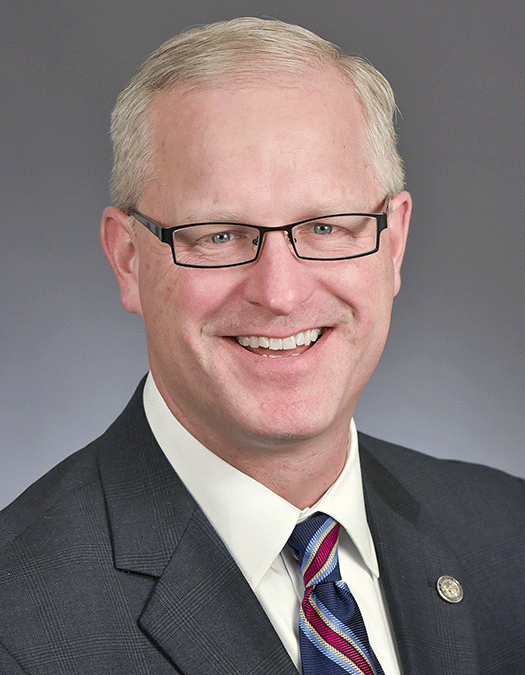
Rep. Jim Nash
Sponsored bills
Maddy summaryHF 2515 updates Minnesota's definition of "joint offices" within the legislature. It explicitly lists the Revisor of Statutes, Legislative Reference Library, Office of Legislative Auditor, Legislative Budget Office, and Legislative Coordinating Commission as joint offices, while adding that the definition also covers "any other joint legislative service office." This clarifies which legislative support entities are considered shared between the Senate and House. The bill does not create new policies or affect citizens directly - it only modifies an existing statutory definition.
Maddy summaryHF 1341 designates January 9 as Law Enforcement Appreciation Day in Minnesota, requiring the governor to issue an annual proclamation. It encourages school districts to partner with law enforcement agencies to create middle and high school "explorer" programs about law enforcement careers, which may count as course credit. The bill appropriates $6 million for 2026-2027 to reimburse agencies for peace officer training and $1 million for 2026 to fund pathway-to-policing programs that help recruit diverse candidates through local government grants. These provisions directly affect schools, law enforcement agencies, and local governments by supporting career education and training funding.
Maddy summaryHF 2561 expands the authority for Minnesota state universities to offer applied doctoral degrees in specific professional fields. The bill amends Minnesota Statutes to allow these universities to grant such degrees in education, business, psychology, physical therapy, audiology, nursing, cybersecurity, artificial intelligence, and other emerging workforce areas. This change directly affects state universities (like Minnesota State universities) and students seeking professional doctoral programs in these fields. The Board of Trustees will determine additional qualifying areas, but the University of Minnesota retains its existing authority to offer all doctoral degrees.
Maddy summaryThis bill recognizes Minnesota's historic state flag (described as a blue flag with a central emblem featuring 19 stars, the word "MINNESOTA," and scenes from the Great Seal) and grants all Minnesotans the right to display it. It requires the lieutenant governor to set standards for its display on state property, mandating it be shown during specified holidays and on Capitol grounds during legislative sessions. The bill also allows the historic flag to be displayed on other public property for ceremonial purposes, while requiring it to be placed beneath the official state flag when both are displayed together. It directly affects all Minnesotans who display the flag and government entities managing public property.
Maddy summaryHF 2396 modifies Minnesota's law for handling small claims against the state. It requires state department heads or their designees to settle claims for $7,000 or less related to property damage, personal injury, or death caused by state employees acting within their duties. The bill specifies that once a claimant accepts a settlement under this process, it becomes final and releases both the state and the involved employee from all further claims related to the same incident. This change streamlines the resolution of minor claims without requiring court involvement.
Maddy summaryHF 2397 amends Minnesota Statutes section 16B.97 to require the Commissioner of Administration to establish a central point of contact for reporting fraud, waste, misuse, or other unlawful uses of funds in Minnesota state grant programs. This central contact will receive public comments about violations, forward them to the relevant agency for action, and follow up as needed. The bill directly affects state agencies administering grant programs and the public who may report concerns about improper fund use. It does not change grant eligibility, funding levels, or program requirements - only creating a standardized reporting channel. (Amends Minn. Stat. § 16B.97, subd. 4(6))
Maddy summaryHF 26, titled the "Never Again Act," shifts emergency declaration authority from the governor to the Minnesota legislature. It repeals the governor's power to declare emergencies and establish a new process requiring legislative approval for emergency declarations and extensions. The bill also prohibits the governor from issuing emergency orders with the "full force and effect of law" and explicitly protects citizens' rights, including free speech, religious freedom, assembly, travel, gun rights, and the ability to operate businesses. These changes amend multiple sections of Minnesota Statutes to clarify that only the legislature may enact emergency measures with legal force during crises.
Maddy summaryHF 1060 eliminates the Legislative Commission on Minnesota Sports Facilities, a body established to oversee the Minnesota Sports Facilities Authority's financial management and operations. The bill repeals Minnesota Statutes 2024, section 3.8842, which created the commission and required it to review the authority's budgets, debt, and annual performance. This change removes a dedicated legislative oversight mechanism that previously provided annual reviews and recommendations on the authority's financial plans. The authority will no longer have this specific legislative committee responsible for monitoring its operations.
Maddy summaryHF 1062 repeals the Driver and Vehicle Systems Oversight Committee established in 2019. This committee reviewed the state's transition from the MNLARS driver's license system to a new VTRS system, including oversight of related costs, implementation progress, and fee recommendations. The bill removes this legislative committee structure without changing any operational rules for driver's license systems or fees. It is a procedural repeal targeting the committee's legal authority, not a substantive policy change.