

Maddy summaryHF 1418 transfers teacher grant programs from the Professional Educator Licensing and Standards Board (PELSB) to the Minnesota Department of Education. It requires the Department of Education to collaborate with PELSB and other agencies to produce an annual report by November 3 each even-numbered year, detailing state-funded programs aimed at increasing the racial and ethnic diversity of teachers. The report must include recommendations for policy changes, plans for sharing best practices among grant recipients, and whether an advisory council should be created to address teacher diversity shortages. This bill directly affects state education agencies, school districts receiving grants, and teacher recruitment programs focused on diversifying the workforce.
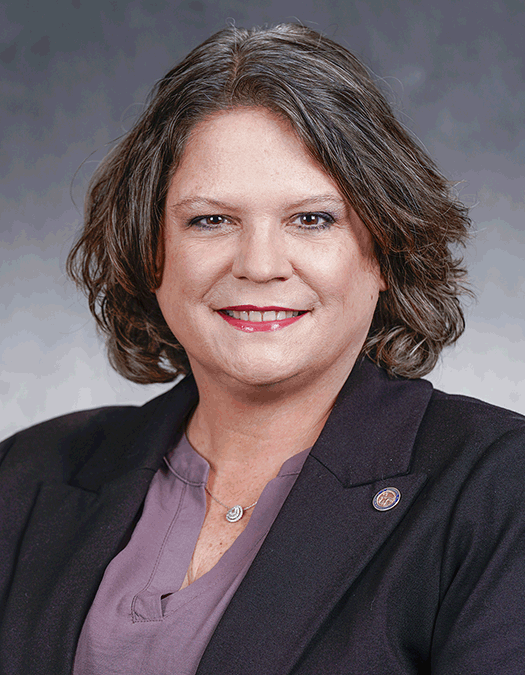
Rep. Cheryl Youakim
Sponsored bills
Maddy summaryHF 1550 allows Minnesota school districts to renew expiring capital projects referendums through a school board resolution instead of holding a new voter election, under specific conditions. It directly affects school districts with referendums nearing expiration that meet all renewal requirements. Key provisions require the renewal amount to match the expiring referendum, the renewal term to be no longer than the original term, and the board to hold a public hearing with a recorded vote before adopting a written resolution. The resolution must be submitted to the commissioner and county auditor by September 1, and cannot be used if the referendum was previously renewed via board action. This streamlines renewal for districts with unchanged project funding needs.
Maddy summaryHF 1415 increases funding for Minnesota's school unemployment aid program, which provides financial support to hourly school employees who face unemployment between academic terms. The bill appropriates specific additional funds from the general fund to the Department of Education for fiscal years 2026 and 2027. This directly affects hourly school workers, such as those in maintenance or summer programs, who qualify for unemployment aid under existing rules. The change simply adds more money to an existing account without altering eligibility or program structure.
Maddy summaryHF 1388 appropriates $10 million annually for fiscal years 2026 and 2027 to fund the Building Assets, Reducing Risks (BARR) Center. The center will deliver evidence-based programs to at least 40 schools serving high concentrations of students in poverty or from underrepresented groups (including Black, Indigenous, and People of Color communities), with geographic balance across urban, suburban, and rural areas. Key provisions focus on improving student social-emotional skills, increasing academic achievement for marginalized students, supporting teacher effectiveness, and boosting high school graduation rates. The funding requires the BARR Center to provide school coaching, professional development, and curriculum resources over a three-year period.
Maddy summaryHF 1230 appropriates $6,913,000 from the state transportation fund to the city of St. Louis Park for infrastructure improvements on Louisiana Avenue South and Oxford Street. The funding covers road reconstruction, bike paths, sidewalks, utility repairs (water, sewer, storm systems), bridge work, and related upgrades like streetlights and roundabouts. The state will issue bonds up to this amount to finance the project, as authorized under Minnesota law. This bill directly affects St. Louis Park residents and businesses by enabling specific street and utility improvements in the designated area.
Maddy summaryHF 1229 appropriates $4,050,000 from the state transportation fund to fund infrastructure improvements in St. Louis Park. The bill specifically covers property acquisition, design, construction, and upgrades to Wayzata Boulevard (from Louisiana Avenue to Zarthan Avenue), Zarthan Avenue (from Wayzata Boulevard to 200 feet south of 16th Street), and 16th Street (from Zarthan Avenue to Park Place Boulevard). This includes trail/sidewalk construction, utility repairs (water, sewer, storm sewer), streetlights, signals, pavement, curb, gutter, and roundabouts. The funds will be provided through state bonds authorized under Minnesota Statutes, section 16A.631 to 16A.675.
Maddy summaryHF 1159 expands Minnesota tax increment financing (TIF) district uses to allow transfers of tax increment revenue to local housing trust funds. It requires that transferred funds be used exclusively for qualified low-income housing projects meeting IRS Section 42 standards, including site acquisition, construction, rehabilitation, or public improvements directly related to such housing. The bill sets limits, such as ensuring housing costs do not exceed 150% of local single-family home averages (or $200,000 in metro areas/$125,000 elsewhere) and restricting transfers to housing trust funds established under Minnesota Statutes 462C.16. This policy change directly affects TIF districts and local housing trust funds by creating a new, regulated funding stream for affordable housing development.
Maddy summaryHF 846 allocates $3 million annually for 2026 and 2027 to fund registered special education apprenticeship programs. It provides $740,000 grants each year to four specific intermediate school districts (287, 288, 916, and 917) for these programs. The funds must cover program administration, apprentice stipends/tuition, mentor teacher stipends, and substitute teacher costs. This directly supports special education apprentices and their training partnerships with higher education institutions. The bill does not change existing laws but provides dedicated funding for these specific programs.
Maddy summaryHF 1123 exempts sales and use tax on construction materials used for renovations at Minneapolis-St. Paul International Airport. It directly affects contractors and subcontractors purchasing materials for airport infrastructure projects between July 2023 and December 2027. The bill requires the tax to be collected upfront but then fully refunded through the state's existing refund process. This applies retroactively to purchases made after June 30, 2023, and expires on January 1, 2028.
Maddy summaryHF 807 appropriates $10 million from state bond proceeds to fund two community hubs in Hopkins, Minnesota - located in Oakes Park (off Blake Road and Lake Street) and Valley Park (South Hopkins). The funds will cover predesign, construction, and equipping of the buildings for recreational, educational, civic, and emergency shelter use during extreme weather or power outages. The state will issue bonds up to $10 million under Minnesota Statutes (sections 16A.631-16A.675) to finance this grant to the city of Hopkins. This bill directly affects Hopkins residents by creating new public facilities and the city government as the grant recipient.