

Maddy summaryHF 2065 increases annual state funding for library online databases by $2.9 million for fiscal years 2026 and 2027. The bill appropriates these funds to the Department of Education to maintain statewide licenses for online research databases. These licenses directly benefit school media centers, public libraries, state government agency libraries, and college/university libraries across Minnesota. The funding ensures continued access to digital resources without requiring additional local spending.
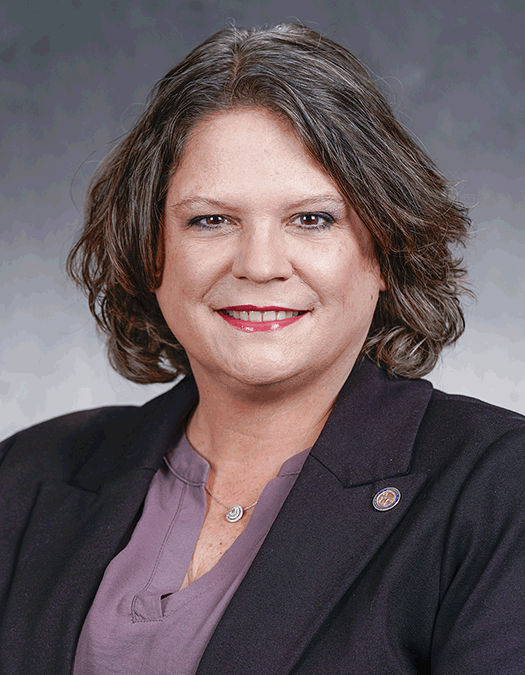
Rep. Cheryl Youakim
Sponsored bills
Maddy summaryThis bill modifies Minnesota's high-rise sprinkler system grant program to provide $10 million in funding for the Minnesota Housing Finance Agency. It directly affects owners of eligible high-rise affordable housing buildings (75+ feet tall or 7+ stories, with at least two-thirds of units affordable to households earning 50-60% of area median income). The program allows grants/loans up to $2 million per building for sprinkler installation, requiring a 25% match for nonprofits and 50% for for-profits. The funding comes from a one-time transfer of $10 million from the general fund to the housing development fund, then appropriated to the agency for this specific program.
Maddy summaryHF 62 is a technical correction that moves references to existing student attendance laws from Minnesota Statutes Chapter 120A to their appropriate chapters elsewhere in the statutes. This bill does not change any attendance policies, rules, or requirements for students, schools, or families. It only reorganizes where these laws are codified in the state code for clarity and consistency. The bill has no substantive impact on education practices or student attendance.
Maddy summaryHF 2362 appropriates $3 million for fiscal year 2026 and $3 million for fiscal year 2027 from the general fund to the commissioner of children, youth, and families. This funding is designated for existing youth intervention programs under Minnesota Statutes section 142A.43. The bill adds these amounts to the base funding for these programs, providing ongoing support. It directly affects state-administered youth intervention services by increasing their available resources.
Maddy summaryHF 2242 requires Minnesota's Commissioner of Human Services to select a single state pharmacy benefit manager (PBM) through a competitive bidding process. This PBM will handle all prescription drug claims for Minnesota's Medicaid (medical assistance) and MinnesotaCare programs, replacing the current system where multiple PBMs might be used. The bill mandates a master contract with this single PBM, specifies rules for drug coverage and reimbursement, and requires the commissioner to report on the program's operation. It also includes strict transparency requirements during procurement, such as disclosing potential conflicts of interest and financial ties between the PBM and pharmacies or drug manufacturers.
Maddy summaryThis bill appropriates $100,000 for each of fiscal years 2026 and 2027 from the arts and cultural heritage fund to support a statewide Minnesota Youth Poet Laureate program. It directly affects young writers aged 13-19 through a competitive selection process modeled after the National Youth Poet Laureate program. The funds will be administered by the Minnesota Humanities Center via a grant to a nonprofit organization to operate the program, including awarding the Youth Poet Laureate and promoting the work of young writers across Minnesota. The program aims to celebrate youth literary talent and provide statewide opportunities for recognition.
Maddy summaryHF 2968 limits how Minnesota counties can collect property tax levies for certain assessment services. It requires counties with cities of the first class (like Minneapolis) to have city assessors handle property assessments within those cities, while county assessors retain only supervisory duties. The bill also restricts county levies for assessment services to specific duties listed in the law, primarily affecting counties with cities over 400,000 people and cities under 30,000 population. This change takes effect for property assessments starting in 2026.
Maddy summaryHF 2996 modifies Minnesota's unemployment insurance rules by tightening the definition of "available for suitable employment." It requires applicants to be ready to accept work immediately if their current schedule (like regular classes) prevents it, unless they can change their schedule. The bill also states applicants absent from their local job market for personal reasons (not job searching) or with work-hour restrictions beyond typical job requirements are ineligible. This directly affects unemployment benefit applicants who have scheduling conflicts, personal absences, or restricted availability. The changes aim to clarify eligibility for unemployment insurance benefits under Minnesota Statutes 268.085.
Maddy summaryHF 2988 extends the tax exemption for Minnesota State High School League event tickets and admissions, and continues the annual transfer of associated sales tax savings to a nonprofit foundation. The bill amends statutes to maintain the exemption for league events (sec. 297A.70, subd. 11a) and the requirement for the League to transfer those savings to the foundation (sec. 128C.24) until July 1, 2037. The foundation uses these funds to award grants, prioritizing athletic fee scholarships for students, while considering gender balance, school size, and geographic location. This directly affects high school students participating in league activities by preserving access to financial support through the existing program. The extension applies to all future sales and purchases after the bill's enactment date.
Maddy summaryHF 1392 establishes a dedicated "consumer protection restitution account" to handle unclaimed funds from consumer protection cases in Minnesota. It requires that 50% of money recovered by the Attorney General in consumer enforcement actions - where funds aren't specifically designated for victims - be deposited into this account instead of the general fund. The account is used to distribute restitution to eligible consumers (those directly harmed by unlawful practices) who cannot be located or to whom payments weren't redeemed within 120 days, prioritizing cases with the oldest final court orders. This ensures unclaimed restitution money directly benefits victims rather than flowing into general state funding.