

Maddy summaryHF 1355 requires permit holders harvesting or destroying aquatic plants in Minnesota public waters to use scuba diving equipment safely and establishes safety standards for commercial diving operations. It mandates that applicants provide documentation of a recent third-party safety survey by a qualified professional (like a DLI consultant or insurance underwriter) and ensures divers have valid certification from accredited programs. The bill also requires employers to provide buoyancy control devices for workers using scuba equipment during these activities. These requirements apply directly to commercial entities and contractors seeking permits under Minnesota Statutes §103G.615 for aquatic plant management. The law aims to improve workplace safety for divers working in Minnesota's waterways.
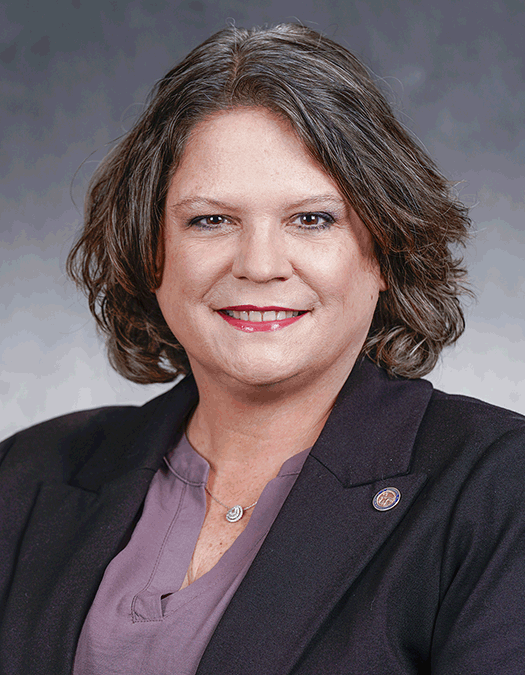
Rep. Cheryl Youakim
Sponsored bills
Maddy summaryHF 3231 amends Minnesota's charter school laws to modify authorizer responsibilities and board membership rules. It requires charter school authorizers (like school districts or independent entities) to document annual staff training on chartering and their duties in annual reports, and mandates they complete department-approved training each year. The bill also tightens board membership requirements for charter schools, prohibiting contractors, employees of the school, or individuals with conflicts of interest (like family members employed by the school) from serving on boards. These changes directly affect charter school authorizers and the boards of individual charter schools. The bill focuses on procedural oversight, not funding or curriculum changes.
Maddy summaryHF 1314 appropriates $10 million from bond proceeds to fund the acquisition of private lands within existing Minnesota state parks and recreation areas. This money, raised by issuing up to $10 million in state bonds, is specifically for creating new parks or expanding current ones. The bill directly affects the Commissioner of Natural Resources (who administers the funds) and private landowners willing to sell property within designated park boundaries. It establishes a dedicated funding mechanism through bonds instead of general state funds for park land expansion.
Maddy summaryThis bill appropriates $342,000 from the general fund for each of fiscal years 2026 and 2027 to the Minnesota Rare Disease Advisory Council. It directly provides funding to support the council's operations under Minnesota Statutes section 256.4835. The funding mechanism is a straightforward annual appropriation for the council's existing statutory purpose, with no new program requirements or eligibility changes. The bill affects the council and the rare disease community it serves by ensuring ongoing financial support for its advisory work.
Maddy summaryHF 51 authorizes Minnesota school districts to use state education funds for roof repairs and replacements costing $100,000 or more per site as part of the long-term facilities maintenance program. School districts must develop a ten-year facility plan that includes a roof maintenance schedule, health and safety measures (like indoor air quality management), and provisions for gender-neutral restrooms at each school. The bill amends Minnesota Statutes to explicitly include roof projects in eligible uses of the funding, effective for fiscal year 2027 and later. This legislation expands the types of maintenance projects that can be funded under the existing education finance program without changing the overall funding formula.
Maddy summaryHF 2228 establishes a 13-member task force to address insurance affordability issues affecting homeowners, renters in multifamily housing, common interest communities, cooperatives, and small businesses. The task force will review topics like risk mitigation, liability laws, reinsurance markets, and climate-related claim costs, then submit recommendations by February 2026. The bill appropriates $200,000 from the general fund to cover the task force’s operational costs through June 2026. It does not make immediate policy changes but requires a final report with findings and draft legislation to strengthen Minnesota’s property insurance system.
Maddy summaryHF 1644 creates a grant program to fund family permanent supportive housing in Minnesota. It appropriates $1.5 million for fiscal year 2026 to provide $15,000 per family served to nonprofit organizations or Tribal governments operating housing for families facing barriers like homelessness, mental health challenges, or child protection referrals. The program requires grantees to offer specific services - including child-centered education, job training, counseling referrals, and 24/7 on-site staffing - to help families maintain stable housing and support children's well-being. Funding must serve 60% of families in the metro area, 40% outside it, and at least 10% from Minnesota Tribal Nations.
Maddy summaryHF 2994 appropriates $1 million from the workforce development fund to create a child care pilot program for Hennepin County law enforcement and first responders. The funding, available until June 2027, will help the Sheriff's Office partner with WomenVenture to recruit child care providers who can accommodate irregular work shifts, covering costs like business planning, training, and family scholarships. The program aims to improve retention by addressing a key challenge for these workers. By December 2027, the Sheriff's Office must submit a report detailing how the funds were used and recommending future child care solutions for public safety staff.
Maddy summaryHF 1999 restricts how people can request public data from Minnesota school districts. It requires requesters to provide their identity (no anonymous requests) and pay for costs if they fail to appear to inspect the data in person. The law applies to all public data requests to school districts under Minnesota's government data practices law, but does not affect requests made by students under separate privacy rules. These changes take effect 24 hours after the bill is signed into law.
Maddy summaryHF 1124 allows Minnesota school districts to begin the 2025-2026 and 2026-2027 school years before Labor Day, which is currently prohibited under state law. This temporary change applies only to those two specific school years and does not alter the standard start date requirement for other years. School districts choosing this option must report their start dates to the education commissioner, who will then compile and submit a list of participating districts to legislators by January 5, 2027. The bill directly affects public school districts in Minnesota for those two school years.