

Maddy summaryThis bill allocates state funding in fiscal year 2027 to the Pollution Control Agency to conduct a study on critical materials found in Minnesota's waste stream. The study will estimate the volume of products containing these materials, measure how much is currently recovered through recycling, and assess the total amount present in waste. The commissioner must complete the research and submit the findings to legislative committees by October 1, 2028. "Critical materials" are defined as specific resources listed by the U.S. Department of Energy that are essential for national security and economic stability.
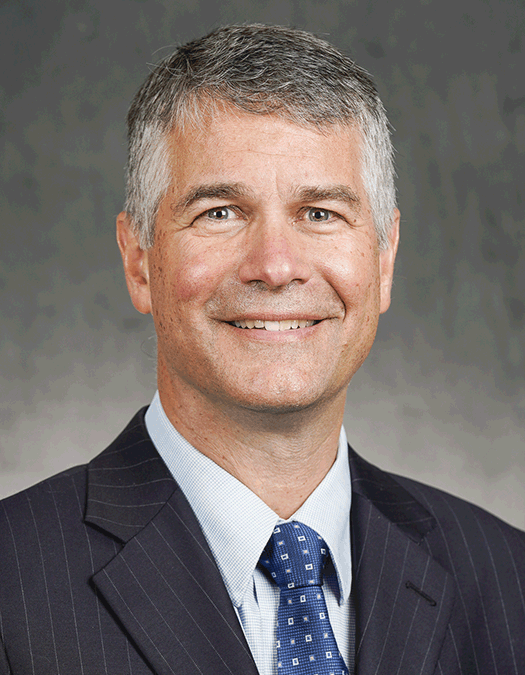
Rep. Larry Kraft
Sponsored bills
Maddy summaryThis bill allocates $250,000 from the state's general fund to conduct a study on how increased immigration enforcement affects Minnesota's economy. The analysis, which must be completed by February 1, 2027, will examine the impact on the workforce, small businesses, and key industries such as agriculture, healthcare, and construction. It will also look at regional differences across the state and how enforcement might influence consumer spending and tax revenue. The report will be submitted to legislative leaders overseeing workforce and economic development, with the option to hire an independent third party to prepare the findings.
Maddy summaryThis bill allocates $1.5 million from the arts and cultural heritage fund to the City of Minneapolis to create a public memorial honoring Renée Good and Alex Pretti. The memorial will feature statues, educational exhibits, and a space for community reflection, focusing on their deaths and the broader issues of civil rights and immigration enforcement. The project requires a collaborative planning process involving local residents, civil rights groups, artists, and historians, with oversight provided by a partnership including city officials and state legislators. While the state provides the initial funding, the city is permitted to seek additional private donations and partnerships to cover design, programming, and long-term maintenance costs.
Maddy summaryThis bill requires public utilities in Minnesota to create detailed plans for building thermal energy networks, which distribute heat through underground pipes to buildings. The legislation directly affects utility companies that want to construct these heating systems, mandating that they submit comprehensive service plans to the state commission. These plans must include project costs, construction schedules, customer transition strategies, and commitments to use local labor and prevailing wage standards. The bill also expands the legal definition of "public utility" to include operators of thermal energy networks, subjecting them to existing utility regulations.
Maddy summaryHF 3452 classifies kratom as a Schedule II controlled substance in Minnesota, subjecting it to strict state regulations similar to opioids. The bill adds mitragynine and 7-hydroxymitragynine (the active compounds in kratom) to Schedule II, making unauthorized possession or sale illegal without a prescription. It repeals a prior law that only set penalties for selling kratom to minors or for minors possessing it. This change directly affects individuals who use or sell kratom, including businesses that currently sell kratom products, by applying full Schedule II restrictions.
Maddy summaryHF 3779 requires all health insurance plans in Minnesota to cover doula services - providing emotional and physical support during pregnancy, birth, and postpartum - without any deductibles, co-pays, or cost-sharing for enrollees. It prohibits health plans from imposing referral requirements, utilization reviews, or quantity limits on this coverage. Starting January 1, 2027, the commissioner of commerce will reimburse health plans for the costs of covering doula services, funded by annual state appropriations beginning in 2028. This bill directly affects health plan enrollees, particularly pregnant people seeking doula support, and health insurance companies that must now include this coverage.
Maddy summaryHF 3555 establishes rules for small, portable solar panels (under 1,200 watts) that homeowners can install to offset personal electricity use. The bill exempts these plug-in solar devices from requiring utility connection agreements, net metering rules, and additional fees or approvals. It also clarifies that utilities cannot be held liable for damage caused by these devices. This directly affects residential users seeking simple, low-barrier solar energy solutions without utility bureaucracy. The bill creates specific definitions and exemptions within Minnesota's energy code for these devices.
Maddy summaryHF 3802 amends Minnesota's energy certificate of need exemptions, removing the requirement for certain energy projects to seek state approval. The bill specifically exempts projects like wind/solar facilities (including repowering projects that don't exceed capacity limits), transmission line upgrades (e.g., converting to natural gas or increasing efficiency by ≤10%), and energy storage systems from the standard review process. It also clarifies exemptions for small transmission lines (≤1 mile) and upgrades using existing rights-of-way. These changes directly affect energy developers and utilities building or modifying infrastructure, streamlining approval for projects that align with existing state energy policies. The bill focuses on updating technical definitions and scope rather than creating new regulatory requirements.
Maddy summaryThis bill establishes a legal framework in Minnesota to create an interstate agreement called the Interstate Fiscal Sovereignty Compact, which would allow member states to hold federal taxes in a state-controlled escrow fund rather than sending them directly to the federal government. The legislation defines key terms such as "member state" and "triggering event," and sets up a process where employers would deposit withheld federal income, Social Security, and unemployment taxes into this new state treasury fund once the compact is officially activated. Currently, no action is required from employers or the state until a governing body issues an order to start the escrow operations, meaning the bill does not immediately change how taxes are collected or paid. By creating a separate escrow fund, the bill aims to give states more control over federal tax revenue, though it requires other states to pass similar laws and join the agreement for the system to function.
Maddy summaryThis bill requires the Metropolitan Airports Commission to increase transparency regarding flights at Minneapolis-St. Paul International Airport that transport detained immigrants. Specifically, it mandates that the airport operator notify the commission whenever U.S. Immigration and Customs Enforcement arrives or departs with passengers being held in restraints. The legislation also requires the commission to install a live-streaming camera to record these flights and to submit monthly reports detailing the number of detained individuals, including minors, on each trip. These measures are designed to provide the public and state officials with real-time data and regular updates on immigration-related air traffic at the airport.