

Maddy summaryThis bill establishes new grant programs and provides funding for adult and children's mental health services in Minnesota, with specific priority given to areas affected by Operation Metro Surge. It creates culturally responsive mental health grants for adults and children, funds mobile crisis teams including vehicle purchases, and supports school-linked mental health services. The legislation also expands eligibility for various mental health services such as housing support, crisis intervention, and specialized care for youth at risk of psychosis or bipolar disorder.
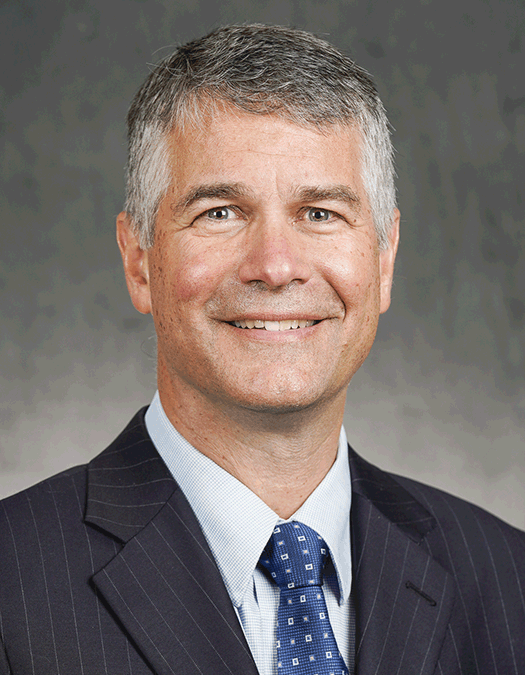
Rep. Larry Kraft
Sponsored bills
Maddy summaryThis bill establishes new licensing requirements for drivers impaired by substances other than alcohol, such as drugs or cannabis, in Minnesota. It defines specific violations related to drug and substance impairment and sets license revocation periods that vary based on prior driving incidents and whether the driver has a history of alcohol-related offenses. Drivers with prior impaired driving records who commit substance-related violations must use ignition interlock devices or complete testing requirements before regaining their licenses. The legislation also authorizes the state to create detailed rules for enforcement and appropriates funds for implementation.
Maddy summaryThis bill establishes new requirements for transit planning and performance evaluation in seven Minnesota counties, including Anoka, Carver, Dakota, Hennepin, Ramsey, Scott, and Washington. It defines high-frequency transit service with specific scheduling standards and mandates that regional transportation plans include public input, detailed highway improvement timelines, and airport development assessments. The legislation also requires regular performance evaluations of the transit system using peer-reviewed benchmarks and limits certain highway projects to prioritize transit-oriented development. Additionally, the bill authorizes reallocation of funds to support these updated planning and performance standards.
Maddy summaryThis bill requires companies that collect consumer data in Minnesota to label their privacy notices as "surveillance notices" if they sell personal data, use it for targeted advertising, or engage in profiling that affects consumers. The legislation amends existing privacy laws to mandate clear, accessible notices that explain what data is collected, how it's used, and how consumers can opt out of specific data practices. Companies must post these notices online with a prominent link on their websites or app pages and provide them in languages matching their service offerings. The law also requires notifications when privacy practices change materially, allowing consumers to withdraw consent for new data collection.
Maddy summaryHF 3748 appropriates $250 million from the general fund for grants to replace lead service lines in municipal water systems. This funding directly helps water utilities and homeowners affected by lead pipes, which pose health risks. The grants are administered by the Public Facilities Authority under Minnesota Statutes, section 446A.077, and are available until June 30, 2034. The bill provides one-time state funding to accelerate the replacement of hazardous lead pipes in drinking water infrastructure.
Maddy summaryHF 63 modifies Minnesota school board membership by requiring public school districts to select two student members starting in the 2025-2026 school year. Student members must be enrolled in grades 9-12, reside in the district, and be chosen through a process allowing all eligible students to vote. These student members gain voting rights on all board matters, serve two-year terms, and may serve no more than two terms. The bill directly affects all Minnesota public school districts and their student populations, aiming to increase student voice in school governance.
Maddy summaryHF 1795 appropriates state funds for Minnesota's farm-to-school and early childhood care programs, directly supporting schools and child care providers serving children. The bill allocates specific funding for fiscal years 2026 and 2027 to purchase Minnesota-grown fruits, vegetables, meat, poultry, grain, and dairy for these settings, including reimbursements for equipment and food purchases. It also sets aside $150,000 annually for a statewide coordinator to assist farmers and institutions, and allows limited state funding (up to 7.5% of federal funds) to support federal program administration. Eligible entities must participate in federal nutrition programs like the National School Lunch Program.
Maddy summaryThis bill allocates $1.5 million from Minnesota's general fund to support the Somali Museum of Minnesota in building a new facility. The money will be used to design, construct, furnish, and equip the new building in Minneapolis to preserve Somali cultural heritage and display artifacts. This is a one-time appropriation available until the project is completed or abandoned, and the funds are managed by the commissioner of employment and economic development. The legislation directly affects the Somali Museum of Minnesota by providing financial resources for its expansion and preservation efforts.
Maddy summaryThis bill establishes a new vehicle weight surcharge and modifies how passenger automobile registration taxes are calculated in Minnesota. It directly affects vehicle owners by requiring additional fees based on vehicle weight and adjusting tax rates based on the manufacturer's suggested retail price. The key provisions include a tiered weight surcharge schedule that charges more for heavier vehicles, a registration tax calculation that uses a percentage of the vehicle's price that decreases over the vehicle's life, and requirements for dealers and registrars to disclose specific pricing information. The bill also appropriates funds and requires a report, with changes taking effect for registration periods starting on or after January 1, 2027.
Maddy summaryHF 3350 establishes a lifetime ban on firearm possession for individuals convicted of misdemeanor or gross misdemeanor domestic assault offenses in Minnesota. This law directly affects people convicted of these specific domestic violence crimes by permanently prohibiting them from owning, buying, or possessing firearms. The bill amends Minnesota Statutes to add this ban as a standard consequence of such convictions, replacing any prior provisions that might have allowed firearm access after sentencing. It creates a concrete policy change that restricts firearm access for this group for life, without exceptions for future conduct.