

Maddy summaryThis bill appropriates $250,000 from Minnesota's workforce development fund for fiscal year 2027 to provide a grant to 180 Degrees, an organization serving teens in Hennepin, Ramsey, Stearns, Carver, and Olmsted Counties. The funding supports programs that help youth and young adults at risk of or experiencing homelessness develop job skills through career exploration, resume building, mock interviews, and work readiness training. This one-time appropriation aims to improve employment readiness and provide exposure to career opportunities for young people in need. The legislation directs the commissioner of employment and economic development to administer the grant.
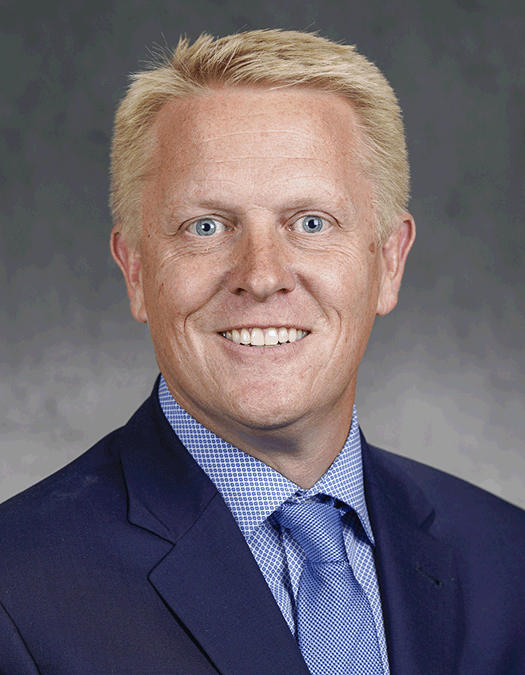
Rep. Andrew Myers
Sponsored bills
Maddy summaryThis bill requires the Minnesota commissioner to adopt the 2024 International Energy Conservation Code as part of the state building code without making any state-level amendments. The provision directly affects building construction, renovation, and energy efficiency standards across Minnesota by streamlining the adoption process for this national model code. The bill modifies existing state statutes to mandate this specific adoption without allowing modifications, ensuring the code is implemented as written. This change impacts contractors, building officials, and property owners by establishing a uniform energy conservation standard that aligns with federal model codes.
Maddy summaryThis bill authorizes city attorneys in Hennepin and Ramsey Counties to prosecute certain felony and gross misdemeanor offenses when the county attorney declines to do so, provided the alleged crime occurred within the city limits and was discovered during a motor vehicle stop for an equipment violation. It also expands the power of city attorneys to issue administrative subpoenas to obtain records from businesses involved in wage theft, welfare fraud, and identity theft investigations, while clarifying that these powers do not extend to private individuals or their homes. Additionally, the bill allows city attorneys to request physical examinations and tests from coroners or medical examiners in criminal cases, giving them the same access to forensic evidence as county attorneys and district courts. These changes apply to crimes committed on or after the law's effective date, with retroactive application for cases where legal time limits have not expired.
Maddy summaryHF 400 requires Minnesota's Commissioner of Commerce to pay health insurance companies to offset costs when new state-mandated health benefits increase premiums for consumers. This applies to health plans sold in individual, small group, and large group markets. The Commissioner must make these payments within 60 days of receiving a cost statement from the company, using the federal process for cost calculation to ensure accurate measurements. The bill takes effect January 1, 2026, for all new mandated health benefit proposals enacted after that date.
Maddy summaryThis bill requires petroleum pump owners in Minnesota to display updated stickers showing the current state gasoline tax rate and federal tax amount. The signs must include a statement explaining that state tax revenue is used only for roads and bridges, and that the state tax amount adjusts automatically each January 1 based on inflation. The state director of weights and measures will distribute these signs to fuel retailers and update them annually to reflect current tax rates. The bill also prohibits penalties for missing or damaged signs, ensuring compliance without financial punishment for retailers.
Maddy summaryThis bill authorizes the sale of state bonds to raise up to $5 million for the Hennepin County Sheriff's Office Forensic Science Laboratory. The funds will be used to design and renovate or expand the facility in Minneapolis to create a modern regional forensic science center. The appropriation comes from the bond proceeds fund and is directed to the commissioner of public safety for distribution to Hennepin County. The bill requires the commissioner of management and budget to issue the bonds according to existing state statutes and constitutional provisions.
Maddy summaryThis bill allocates $7 million from Minnesota's general fund to support the city of Chaska in hosting Professional Golfers' Association of America championship events. The money will be given to the Explore Minnesota director to provide a grant that helps attract and cover costs for at least one men's and one women's PGA championship. This one-time appropriation is intended to boost economic development in Chaska by bringing major golf tournaments to the area. The funds are available until June 30, 2027, and the bill was introduced in the Minnesota House of Representatives.
Maddy summaryHF 2874 regulates "earned wage access services" in Minnesota, which allow workers to access a portion of their earned but unpaid wages before their regular pay date. The bill directly affects Minnesota residents who use these services and the companies (providers) offering them. Key requirements include: providers must clearly disclose all fees, offer a no-cost option for accessing wages, prohibit tying services to voluntary tips/donations, and allow consumers to cancel services without fees. The law excludes payroll services and employers who directly provide early wage access to their own employees. It aims to ensure transparency and prevent unfair practices in this growing financial service.
Maddy summaryHF 3808 limits late fees charged by homeowners' associations (HOAs) and other common interest communities in Minnesota. It requires these associations to create written policies outlining how fines are assessed and collected, and to provide clear disclosures about these policies to residents. The bill amends several Minnesota statutes to establish specific caps on late fees and mandate transparent procedures for fee collection. These changes directly affect HOAs and their residents by making fee structures more predictable and preventing excessive charges. The policy focuses on procedural transparency and consumer protection within residential community associations.
Maddy summaryThis bill allows grocery stores to donate eggs past their quality assurance date to food banks instead of discarding them. It modifies Minnesota law to permit donation of Grade AA eggs after 31 days or Grade A eggs after 46 days past their pack date, provided the eggs: remain in original packaging, were previously graded, stay refrigerated, are distributed within 30 days of the quality date, and carry specific labels including "Donated Eggs - Not for Resale." The change directly affects retailers who would otherwise remove these eggs from sale and food assistance programs receiving the donations. It creates a clear pathway for safe donation while maintaining labeling and handling requirements.