

Maddy summaryHF 3748 appropriates $250 million from the general fund for grants to replace lead service lines in municipal water systems. This funding directly helps water utilities and homeowners affected by lead pipes, which pose health risks. The grants are administered by the Public Facilities Authority under Minnesota Statutes, section 446A.077, and are available until June 30, 2034. The bill provides one-time state funding to accelerate the replacement of hazardous lead pipes in drinking water infrastructure.
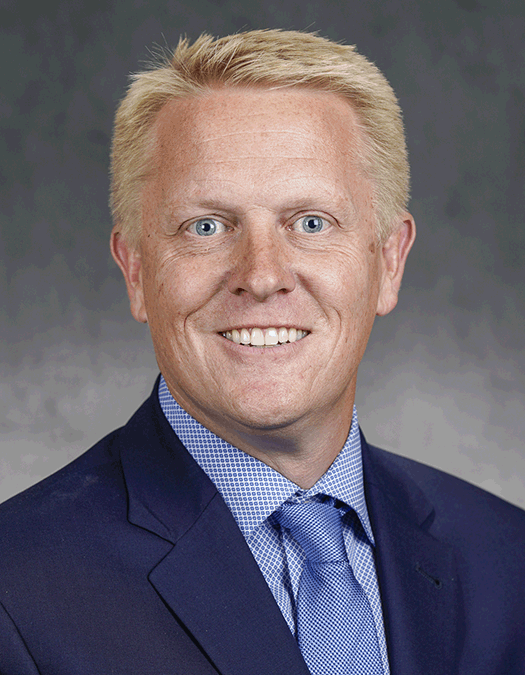
Rep. Andrew Myers
Sponsored bills
Maddy summaryHF 821 appropriates $3.866 million for each of fiscal years 2026 and 2027 to fund nitrate mitigation for private drinking water wells in Dodge, Fillmore, Goodhue, Houston, Mower, Olmsted, Wabasha, and Winona counties. It directly affects private well owners in these counties with nitrate levels exceeding 10 mg/L, prioritizing households at or below 300% of the federal poverty guideline and those with infants or pregnant individuals. The funding covers reverse osmosis systems, well repairs, and reconstruction, plus education and outreach. The commissioner of agriculture may also transfer funds to the commissioner of health to administer the program, with up to 6.5% of the appropriation allowed for administrative costs.
Maddy summaryThis bill updates Minnesota's individual income tax law to align with a recent federal expansion of the dependent care credit. It directly affects Minnesota taxpayers by allowing them to claim the enhanced federal credit on their state tax returns. The legislation amends state statutes to include the new federal provision and ensures the change applies retroactively to match the federal effective date. This adjustment ensures Minnesota taxpayers receive the same tax benefit for dependent care expenses as provided under federal law.
Maddy summaryHF 3654 renames Minnesota’s "Local Optional Revenue Program" to the "Local Education Revenue Program" and increases its funding. The bill establishes a new calculation method using regional wage data to determine school district revenue, with a base allowance of $979 for fiscal year 2027 (adjusted annually). It also adds $132 per adjusted pupil unit to charter school funding and modifies how districts calculate local revenue levies based on property values. The changes directly affect Minnesota school districts and charter schools by altering their state education funding formulas, effective for fiscal year 2027 and beyond.
Maddy summaryHF 3397 modifies Minnesota's motor vehicle registration tax for passenger cars and hearses. It reduces the tax rate to 1.145% for vehicles first registered in Minnesota before November 16, 2020, and to 1.18% for vehicles registered on or after that date (down from previous rates). The tax calculation decreases annually over the vehicle's life (from 100% in year one to 10% in year ten), then caps at $20 per year after the tenth year. This change applies to taxes payable for registration periods starting January 1, 2027, and affects all owners of passenger vehicles and hearses registered in Minnesota.
Maddy summaryHF 792 exempts Minnesota veterans with a total service-connected disability from multiple vehicle-related fees, including registration taxes, license plate fees, title fees, driver's license/ID card fees, and motor vehicle sales taxes. The exemption applies to up to two vehicles registered by the veteran or jointly with a spouse/domestic partner, covering standard fees but excluding personalized plate fees or required special plate donations. It amends existing tax statutes to implement these changes, effective January 1, 2026, for registration periods starting on or after that date. The bill directly affects qualifying veterans by reducing their vehicle ownership costs without altering other tax obligations.
Maddy summaryThis bill prohibits the sale, installation, or transfer of counterfeit airbag parts and nonfunctional airbags in Minnesota motor vehicles. It defines counterfeit parts as those bearing unauthorized manufacturer marks and nonfunctional airbags as those that are damaged, electrically faulty, or designed to mislead owners about their working status. Dealers, mechanics, and vehicle sellers must comply with these restrictions, with exceptions for law enforcement vehicles and owners unaware of the defects. Violations are classified as gross misdemeanors, and the law takes effect on August 1, 2026.
Maddy summaryHF 3386 creates an 85% state income tax credit for Minnesota farmers who donate qualifying food to food shelves. The credit applies to donations eligible for federal tax deductions, but is limited to 50% of the farmer's real property taxes for the year. Farmers cannot use the same donation for other state tax benefits, and any unused credit can be carried forward for up to five years. The bill takes effect for taxable years beginning after December 31, 2025.
Maddy summaryThis bill requires the state trunk highway fund to pay for utility relocation costs when federally funded highway projects force local governments or tribal governments to move their light, water, sewer, or stormwater systems. The law applies specifically to utility systems owned by local units of government or tribal governments that are authorized to use public highways for their infrastructure. Under the new provision, the state commissioner must determine the remaining service life of affected utilities and reimburse the owners for relocation expenses, but only up to the amount the federal government would reimburse for interstate highway projects. This change clarifies funding responsibilities for utility relocations tied to trunk highway construction, ensuring costs are covered by the state fund rather than local entities.
Maddy summaryThis bill requires state granting agencies to conduct unannounced, in-person site visits for grants exceeding $10,000 to monitor how funds are used. The law applies to organizations and individuals receiving state grants and mandates that agencies report on grant status when requested by the commissioner. Agencies must perform at least one visit per 12-month period for grants disbursed over multiple years, with exceptions only allowed for entire grant programs rather than individual cases. The measure aims to strengthen oversight of state grant administration while allowing flexibility for programs where on-site visits may not be practical.