

Maddy summaryHF 3764 requires all public Minnesota K-12 schools to implement 24/7 anonymous reporting systems by July 2028. The systems must include mobile apps, multilingual crisis centers staffed by trained professionals, and protocols for school teams to respond to threats involving students, staff, or school property. Schools must also provide evidence-based student violence prevention training and public awareness campaigns. Nonpublic schools are exempt, and the Department of Education must compile a list of approved systems and submit annual reports to legislators. This bill directly affects public schools and aims to improve safety reporting mechanisms through concrete, structured requirements.
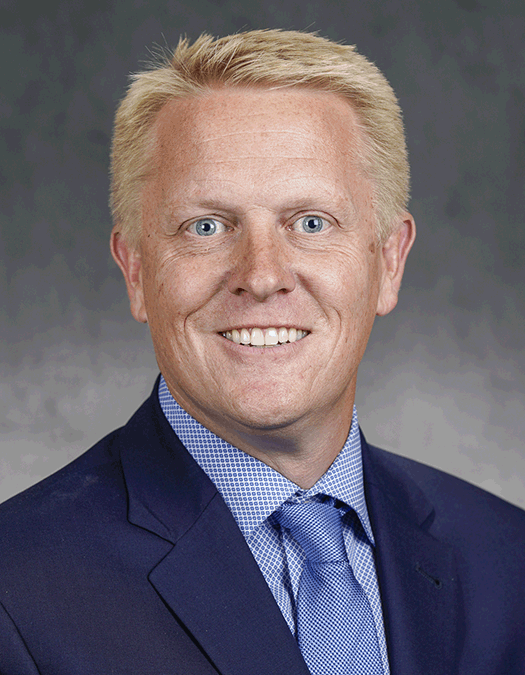
Rep. Andrew Myers
Sponsored bills
Maddy summaryHF 3513 defines key terms for autonomous vehicles in Minnesota Statutes, establishing a regulatory foundation for future rules. It adds definitions for terms like "automated driving system" (level 4/5 vehicles), "dynamic driving task," "minimal risk condition," and "on-demand autonomous vehicle network" to clarify operational standards. The bill does not impose new restrictions or requirements but creates the terminology needed for future legislation governing autonomous vehicle safety and operation. This procedural update prepares Minnesota’s legal framework for regulating self-driving technology as it develops.
Maddy summaryHF 2646 converts the "Governor's Council on an Age-Friendly Minnesota" into the "Age-Friendly Minnesota Council" to coordinate state efforts for older adults. The bill establishes a 15-member council including state agency representatives and public members to address disparities affecting older Minnesotans in greater Minnesota, communities of color, and Indigenous communities. Key provisions require the council to review grants, identify barriers to age-friendly services, promote equity, and make policy recommendations to state agencies and the legislature. The bill also codifies existing grant mechanisms and appropriates funds to support these coordinated efforts across state government, communities, and businesses.
Maddy summaryThis bill creates a new tax in Minnesota that targets individuals and organizations convicted of fraud or those identified by the state revenue commissioner as having obtained money through deceitful means. The tax requires anyone who has successfully defrauded state programs to pay back 100 percent of the stolen amount, regardless of any existing fines or restitution already ordered by courts. The state revenue commissioner is tasked with investigating suspected fraud, setting up a system to collect these payments, and ensuring the recovered funds are used specifically for income and property tax relief. The law applies retroactively to fraud cases determined after December 31, 2019, and also covers people who were paid to help commit the fraud.
Maddy summaryThis bill modifies the duties of Minnesota's school trust lands director and establishes new reporting requirements for the Legislative Permanent School Fund Commission. The director will be required to develop a ten-year strategic plan and a 25-year framework for managing school trust lands, with goals to retain core assets, increase their value, and explore revenue-generating options including ecosystem services markets. Additionally, the director must submit an annual written report by January 15 each year detailing management activities, financial positions, and recommended statutory changes to improve asset allocation. The bill also clarifies the director's role as temporary trustee during eminent domain proceedings and requires quarterly public meetings to inform beneficiaries and the public about trust land management work. These changes take effect on July 1, 2026.
Maddy summaryHF 3753 establishes a pilot program to enhance school safety through threat assessment. The Minnesota Department of Public Safety will contract with a vendor to provide real-time monitoring, threat alerts, and door-locking capabilities using predictive analytics, with services integrating into existing school security systems. One school district per congressional district (including both large and small districts) will participate, excluding those already using similar systems. The program requires a report by January 2027 evaluating effectiveness, gathering feedback from schools, and recommending statewide implementation, funded by a $4 million appropriation from the general fund for fiscal year 2027.
Maddy summaryThis bill modifies how Minnesota calculates registration taxes for passenger cars and hearses by lowering the tax rate based on the vehicle's manufacturer's suggested retail price. It changes the tax calculation for new vehicles registered on or after November 16, 2020, and reduces the percentage of the vehicle's value taxed for each subsequent year of ownership. The legislation also establishes a process to transfer money from the state's general fund to the highway user tax distribution fund to cover any revenue shortfall caused by these tax reductions.
Maddy summaryThis bill allows online students in Minnesota to keep their free public school enrollment even if they temporarily leave the state, provided they meet specific conditions such as maintaining at least one parent's Minnesota residency and planning to return. The legislation requires that students have been enrolled for at least one year, agree on a course of study with their school district, and be physically absent for no more than 60 consecutive school days. Additionally, the bill appropriates state funds to support the education costs for these students and takes effect on July 1, 2026.
Maddy summaryHF 409 increases funding for Minnesota public school districts by raising local optional revenue allowances. It sets new annual allowance amounts: $250 for first-tier, $300 for second-tier, and $424 for third-tier local revenue starting in fiscal year 2026. School districts calculate their revenue using these allowances multiplied by adjusted pupil units, with levies tied to property values per student. The bill also appropriates additional state funds for general education aid in fiscal years 2026 and 2027. This directly affects all Minnesota school districts receiving state education funding.
Maddy summaryHF 57 increases state funding for special education by raising the cross-subsidy aid factor from 44% (for 2024-2025) to 50% for 2026 and 54% for 2027 and later. This directly affects Minnesota school districts that receive special education funding, providing them with higher state payments based on their previous year's special education costs. The bill appropriates specific funds for these increased payments in fiscal years 2026 and 2027. The change takes effect for special education aid calculations beginning in fiscal year 2026.