

Maddy summaryHF 1234 requires Minnesota public contracting agencies to provide detailed payment notifications to contractors and subcontractors within three business days of making payments on public projects. The bill mandates that notifications include the payment amount, date, recipient name, scope of work covered, and reasons for any withheld retainage or payment. This directly affects contractors and subcontractors working on state-funded construction or public improvement projects. The law aims to increase transparency by ensuring all parties receive clear, timely information about payments and withholdings. It amends Minnesota Statutes sections 15.72 (subd. 4) and 337.10 to enforce these requirements.
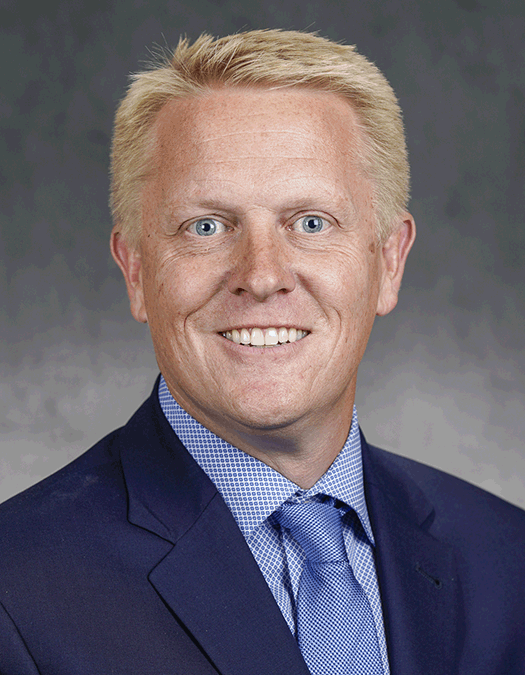
Rep. Andrew Myers
Sponsored bills
Maddy summaryThis bill establishes the Minnesota Imagination Library program, which provides free age-appropriate books to children from birth to age five. The program will be run by a partnership between the state Department of Education and the Dollywood Foundation, utilizing local nonprofits, school districts, or libraries to distribute books. To receive state matching funds, local partners must contribute 50% of the costs for books and mailing while enrolling children in their areas. The state will provide the other 50% match and select a nonprofit to manage daily operations and marketing goals. The bill also requires annual reports on enrollment numbers and the program's impact on kindergarten readiness, along with funding for the fiscal years 2027 through 2029.
Maddy summaryThis bill authorizes the issuance of up to $11 million in state bonds to fund improvements to Marked Trunk Highway 7 in several cities including Chanhassen, Deephaven, Excelsior, Greenwood, Minnetonka, Minnetrista, Shorewood, and St. Bonifacius. The funds will be used for planning, design, engineering, environmental analysis, property acquisition, and construction work as part of planned highway maintenance. The commissioner of transportation will receive the money from the trunk highway fund's bond proceeds account to carry out these projects, while the commissioner of management and budget is responsible for selling and issuing the bonds according to state law.
Maddy summaryThis bill creates a new misdemeanor offense for entering specific locations like schools, places of worship, or hospitals for the purpose of civil immigration enforcement without a warrant. It directly affects immigration officers and other individuals who might attempt to conduct civil immigration checks in these designated "sensitive spaces." The law requires a warrant signed by a judicial officer and a reasonable belief that the target is present before such entry is permitted. If someone violates this rule, they could be charged with a misdemeanor. The legislation aims to protect these communities by restricting unauthorized civil immigration actions within their boundaries.
Maddy summaryThis bill extends the time limit for prosecuting certain theft and fraud crimes in Minnesota, particularly those involving public funds and medical assistance fraud. It directly affects prosecutors, law enforcement agencies, and individuals accused of these offenses by allowing more time to file charges. The key change increases the statute of limitations for theft of public money to ten years and adjusts timeframes for other financial crimes based on the amount stolen or number of victims. The bill also adds provisions that pause the clock if a defendant participates in pretrial diversion programs or if DNA evidence is being analyzed. These changes take effect on August 1, 2026, and apply to crimes committed on or after that date.
Maddy summaryHF 3762 allows Minnesota chiefs of police and sheriffs to access certain expunged criminal records (those sealed after January 1, 2015) specifically to determine if a person is eligible to purchase, receive, or carry a firearm. This exception applies only during firearm background checks under Minnesota Statutes § 609A.037, not for general law enforcement purposes. The bill amends existing expungement law to permit this limited access while requiring law enforcement to handle these records carefully and restrict their use solely to firearm eligibility determinations. It directly affects individuals with expunged records who apply for firearms and law enforcement agencies conducting background checks.
Maddy summaryHF 403 establishes a property tax credit for Minnesota seniors who own and occupy their homes as primary residences. It directly affects residents aged 65 or older (or married couples where one spouse is 65+ and the other is 62+) who have owned and lived in their home since January 2 of the application year. The credit reduces property taxes by comparing the current year’s tax (after other credits) to the previous year’s tax adjusted by 1.08, but cannot lower taxes below $0. Funding for the credit is appropriated annually from the state general fund to reimburse local governments and school districts, effective for 2026 property assessments.
Maddy summaryThis bill repeals a previous requirement that assumed a $250 million reduction in special education funding for the 2027-2028 biennium and subsequent years. Under the new provisions, the state commissioner of management and budget will no longer be required to forecast this specific funding cut when preparing revenue and expenditure forecasts. The legislation also removes the mandate that the legislature must identify enacted provisions from the Blue Ribbon Commission on Special Education to offset the assumed funding reduction. If savings from those provisions fall short of $250 million, the commissioner of education would no longer be required to reduce the special education cross subsidy aid factor to make up the difference. The changes take effect the day following final enactment of the bill.
Maddy summaryThis bill establishes a task force within Minnesota's Department of Veterans Affairs to address mental health service access for veterans living in rural areas. The task force will be responsible for identifying challenges and developing recommendations to improve how these veterans receive mental health care. Funding is allocated from the state's general fund to support the task force's operations over three fiscal years, starting in 2027. The legislation directly affects the Department of Veterans Affairs and rural veterans who may face barriers to accessing mental health services.
Maddy summaryHF 3511 increases state funding for school safety and local optional school aid while changing Minnesota's school meal program. It limits state-paid free and reduced-price school lunches to families earning at or below 500% of the federal poverty level (approximately $160,000 for a family of four in 2024), replacing the previous "free school meals program" with an "enhanced school meals program." The bill also reduces state reimbursement rates for school lunches starting in fiscal year 2028 - from 12.5 cents per full-paid/free meal to 6.25 cents - while requiring schools to adopt new meal policies preventing "lunch shaming" and ensuring students receive meals regardless of unpaid debt. This directly affects Minnesota public schools and families with children enrolled in the national school lunch program.