

Maddy summaryHF 1845 expands Minnesota's definition of "veteran" to include two specific groups: (1) Hmong veterans naturalized under the federal Hmong Veterans' Naturalization Act of 2000, and (2) individuals who served honorably with secret guerrilla units or irregular forces operating from Laos in support of U.S. forces between February 28, 1961, and May 14, 1975. The bill amends Minnesota Statutes section 197.447 to add these categories to the existing definition, ensuring these veterans qualify for state benefits. It also creates an advisory task force of veterans, experts, and community members to help determine eligibility under the new definition. This change directly affects Hmong veterans and Laotian-based veterans who previously may not have met Minnesota's veteran criteria.
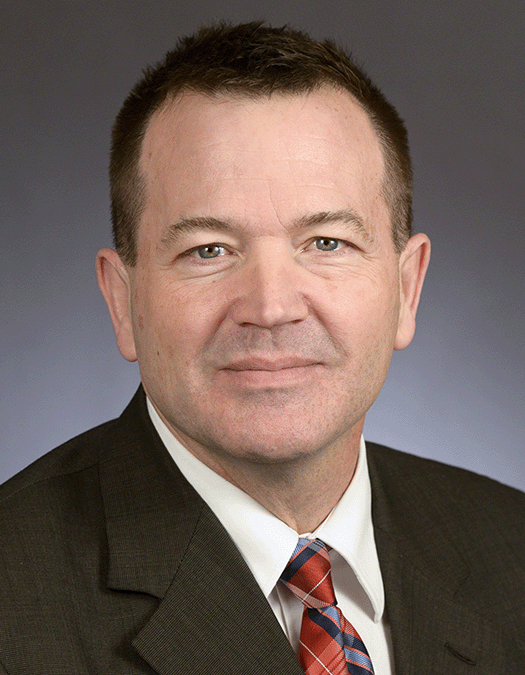
Rep. Leon Lillie
Sponsored bills
Maddy summaryThis bill appropriates $375,000 for fiscal year 2026 and $375,000 for fiscal year 2027 from Minnesota's arts and cultural heritage fund to The Sanneh Foundation. The funding supports three specific programs: family nutritional distribution in the seven-county metropolitan area, senior community programming, and multicultural women's athletic programming. The Sanneh Foundation directly receives these funds to implement these community services.
Maddy summaryHF 1997 appropriates $25,000 for fiscal year 2026 and $25,000 for fiscal year 2027 from the general fund to provide a grant to Fishing with Vets, a nonprofit organization. The grant funds guided fishing trips for veterans across Minnesota, directly benefiting veterans seeking recreational therapy. The bill requires the commissioner of veterans affairs to submit annual reports by January 15 detailing how the grant money was spent, including any administrative costs, to legislative committees and the Legislative Reference Library. Fishing with Vets must provide necessary information to support these reports.
Maddy summaryHF 2236 amends Minnesota Statutes section 53C.08, subdivision 1, by removing outdated language from the existing law governing retail installment contracts. This bill does not change any substantive requirements for contracts, such as written terms, prohibitions on confession of judgment, or delinquency charge limits. It directly affects businesses and consumers using retail installment contracts (e.g., car loans) by updating the statutory language to reflect current practice. The bill is purely procedural, removing obsolete phrasing without adding or altering any policy requirements.
Maddy summaryHF 2254 adds a $400 "baby bonus" to Minnesota's existing child credit for each qualifying child born during the tax year. This directly affects Minnesota taxpayers with newborn children, increasing their state income tax credit. The bill modifies the child credit calculation by adding the $400 per newborn (without reducing the minimum credit amount) and allows for potential advance payments. It takes effect for tax years beginning after December 31, 2024.
Maddy summaryHF 1582 modifies Minnesota's Teachers Retirement Association (TRA) benefits for educators. It allows teachers with 30 years of service to retire at age 60 without reduced annuity payments (previously requiring 35 years), adjusts early retirement penalties, and increases postretirement cost-of-living adjustments. The bill also raises employer contribution rates for school districts (from 13.3% to 17.3% for basic members) and increases pension adjustment revenue rates for school districts starting in 2026. These changes directly affect current and future TRA members, school districts funding retirement costs, and the state's retirement system budget.
Maddy summaryHF 2084 allocates $300,000 for fiscal year 2026 and $300,000 for fiscal year 2027 from Minnesota's arts and cultural heritage fund to Hmong Zej Zog. The bill provides direct funding to this organization to preserve Hmong Minnesotans' heritage, history, language, and culture. The key mechanism is a specific annual appropriation for grant funding through the commissioner of administration. This funding supports targeted cultural preservation efforts for Minnesota's Hmong community.
Maddy summaryHF 1250 appropriates $168.5 million from Minnesota's Outdoor Heritage Fund for fiscal year 2026 (with $775,000 for 2027) to fund specific conservation projects. It directs funding toward acquiring land and restoring habitat for prairies, wetlands, and wildlife management areas across Minnesota, including projects in Martin County, the southern Red River Valley, and riparian buffer programs. Key provisions include $3.69 million for prairie chicken habitat partnerships, $4.97 million for wildlife management area acquisitions, and $4.09 million to expand habitat protection on private lands through conservation easements. These funds directly support state agencies and conservation partners working to protect native prairie ecosystems and wildlife habitats. The bill specifies that funds must be used for land acquisition, restoration, and habitat enhancement under existing conservation programs.
Maddy summaryHF 2144 appropriates unspecified funds from the general fund for the Family Homeless Prevention and Assistance Program under Minnesota Statutes § 462A.204, for fiscal years 2026 and 2027. The bill directly affects families in Minnesota at risk of homelessness by providing funding for prevention and assistance services. Key provisions include directing the Housing Finance Agency to administer the program using these allocated funds. This is a funding bill with no new policy requirements, solely authorizing budget resources for an existing state program.
Maddy summaryHF 2022 amends Minnesota Statutes to increase the maximum annual employer contribution for the supplemental retirement plan covering employees of the Minnesota State Colleges and Universities (MnSCU) system. Specifically, it raises the cap from $2,700 to $4,300 per employee per year for employer matching of employee contributions under this plan. This change directly affects MnSCU employees participating in the supplemental retirement plan, as it allows their employers to contribute more toward their retirement savings. The provision applies only to plans established under collective bargaining agreements or personnel policies that require dollar-for-dollar matching of employee contributions. The bill does not create new retirement programs but adjusts the funding limit for an existing plan.