

Maddy summaryHF 778 appropriates $26 million in state bond funds to the city of Plymouth for public infrastructure improvements in its City Center area (bounded by Vicksburg Lane and Highway 55). The funding covers specific projects including stormwater management, a new public parking ramp, reconstruction of Plymouth Boulevard, and expansion of the Plymouth Ice Center with associated road changes. The state will issue bonds up to $26 million to finance this appropriation, following standard state bond procedures. This bill directly affects Plymouth residents and city officials through these targeted infrastructure upgrades.
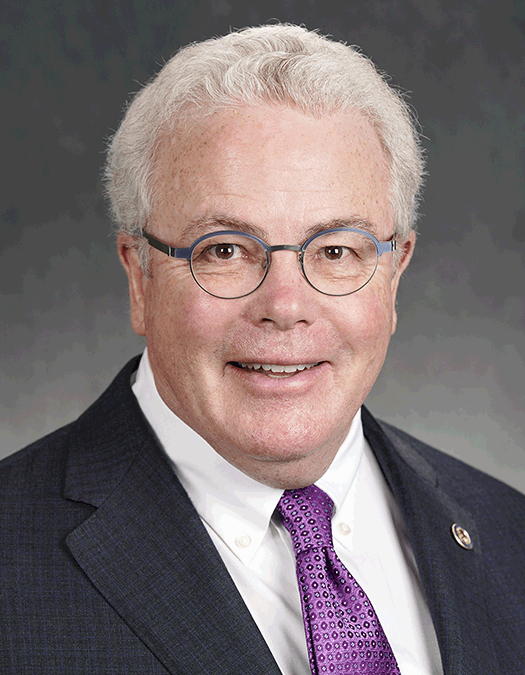
Rep. Ned Carroll
Sponsored bills
Maddy summaryHF 513 provides a refundable sales and use tax exemption for construction materials used in specific city of Plymouth projects. It covers materials purchased between January 1, 2024, and June 30, 2028, for six city center revitalization projects: a public parking ramp, Plymouth Boulevard renovation, Plymouth Ice Center expansion, regional stormwater ponding, roadway realignment, and Plymouth Community Center expansion. Businesses pay tax upfront but receive a refund through the same process used for other qualifying projects. The exemption applies retroactively to purchases made after December 31, 2023, and is funded from the state general fund.
Maddy summaryHF 141 modifies Minnesota's sustainable building guidelines to require state agencies to comply with these standards during the predesign phase for all new state buildings and major renovations. It directly affects state agencies planning construction or major renovations (defined as projects over 10,000 sq. ft. or involving mechanical system replacement). The bill adds specific requirements for reducing greenhouse gas emissions, improving indoor air quality, conserving water, and enhancing climate resilience into the guidelines, while mandating a report and appropriating funds for implementation. These changes apply to all state-funded projects after specified dates, ensuring sustainability is integrated early in the planning process.
Maddy summaryHF 235 appropriates $800,000 from state bond proceeds to fund specific capital improvements at Doug Woog Arena in South St. Paul, Minnesota. The funds are exclusively for roof replacement and HVAC system upgrades, to be used by the city for design, construction, and equipment. The state will issue up to $800,000 in bonds under Minnesota’s bond laws to cover this appropriation. This bill directly affects the city of South St. Paul and its public arena facility, with no broader policy changes beyond these targeted repairs.
Maddy summaryHF 262 prohibits employers from paying people with disabilities less than the state minimum wage, effective August 1, 2025 for new hires and August 1, 2027 for all current employees, ending the use of federal or state special certificates that allow subminimum wages. It requires providers of home and community-based services to report data on individuals currently paid subminimum wages by August 1, 2027, including personal details and employment metrics. The bill appropriates $38,000 in fiscal year 2026 and $75,000 in fiscal year 2027 to enhance the MnCHOICES system with employment-related resources. These changes directly affect employers, service providers, and people with disabilities working in supported employment programs across Minnesota.
Maddy summaryHF 160 amends Minnesota's tax increment financing rules to authorize special provisions for the city of Maple Grove. It creates a defined "soil deficiency district" within a specific project area in Maple Grove where soil conditions (like peat, poor terrain, or landfills) require significant preparation before commercial development can occur. The bill requires that at least 80% of the project area's acreage (excluding roads) must meet these soil conditions, and the cost of preparation must exceed the land's fair market value before work begins. This allows Maple Grove to use tax increment financing to fund necessary soil work, directly affecting property owners and developers in the designated area.
Maddy summaryThis bill prevents the Minnesota Public Utilities Commission from issuing permits to build pipelines designed to transport carbon dioxide. It directly affects energy companies and regulators by legally barring the approval of any new carbon dioxide pipeline routes in the state. The law takes effect immediately upon final passage, ensuring that no such permits can be granted under the current statute.
Maddy summaryThis bill modifies the rules governing the Hennepin Healthcare System to give the Hennepin County Board stronger oversight powers over the hospital's corporate board. Under the new provisions, the county board can dissolve the corporation, reorganize it, or remove the entire corporate board if it finds evidence of malfeasance, which includes actions like fraud, corruption, or serious ethical violations. Before taking such drastic steps, the county board must conduct a formal investigation that includes notifying the hospital and the state health commissioner, allowing the hospital to respond, and assessing how the action would impact patient care and financial obligations. Additionally, the bill clarifies that while the Hennepin County attorney serves as the system's legal counsel, the healthcare system retains the option to hire its own separate legal and government relations staff without needing county approval.
Maddy summaryThis bill establishes the Equal Access to Broadband Act in Minnesota and updates existing laws to clarify definitions and rules for broadband services and infrastructure. It defines specific terms like "underserved areas" and "last-mile infrastructure" to help identify regions lacking high-speed internet and to distinguish between different parts of the network. The legislation also grants local governments the authority to require broadband providers to obtain a franchise or municipal authorization before placing infrastructure in public rights-of-way. Under this new framework, cities and counties can charge fees to broadband providers to cover costs associated with occupying public space or to generate revenue. Additionally, the bill ensures that various utility companies, including those providing broadband, can continue to use public roads for construction and maintenance without interfering with public safety.