

Maddy summaryHF 2477 requires the Minnesota State High School League (MSHSL) to add cricket to its list of sanctioned interscholastic sports by July 1, 2025. The bill mandates MSHSL to form a cricket advisory group, launch pilot programs in at least three schools during the 2025-2026 school year, and expand participation to more schools by 2026-2027. By the 2027-2028 school year, MSHSL must finalize rules and establish a regular cricket season, preferably in the spring. This directly affects Minnesota high schools and the MSHSL governing body, as it changes which sports the league officially recognizes and regulates.
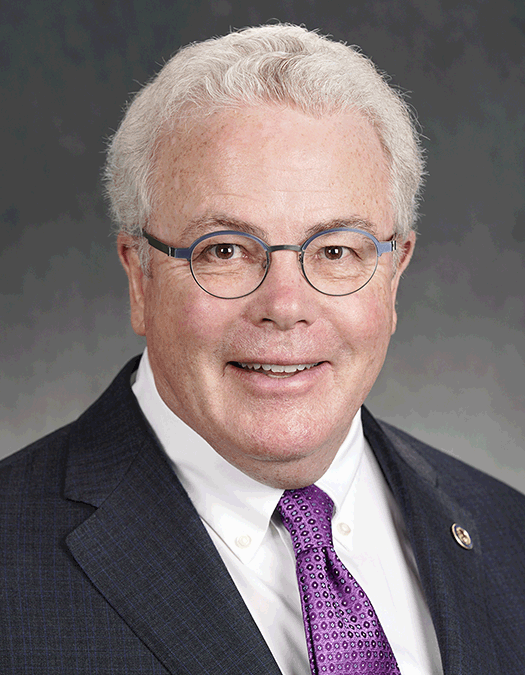
Rep. Ned Carroll
Sponsored bills
Maddy summaryHF 1005 adjusts payment rates for healthcare providers under Minnesota's medical assistance program. It increases reimbursement rates for certain residential services, sets a new statewide rate for behavioral health home services, and adjusts physician professional service rates. These changes directly affect hospitals, clinics, and care providers receiving state medical assistance payments for these specific services. The bill amends existing statutes to implement these rate adjustments while requiring budget neutrality for hospital payments. It does not create new programs but modifies existing payment structures for covered services.
Maddy summaryHF 2666 establishes special license plates for snowmobile owners in Minnesota. To qualify, applicants must be registered owners of certain vehicles (like cars, motorcycles, or RVs), pay special fees, and contribute to a dedicated snowmobile trails account. The bill appropriates all fees collected under this section to fund snowmobile trail development, maintenance, and easement acquisition through the Department of Natural Resources. This directly affects snowmobile owners who register their vehicles under the new plate system, starting January 1, 2026. The special plates are exempt from standard vehicle registration rules for plate transfers and fees.
Maddy summaryHF 2690 modifies Minnesota's medical assistance dental coverage by requiring the state commissioner to contract with a dedicated dental administrator starting January 1, 2026, if current managed care and county plans fail to meet performance benchmarks for dental access in 2024. This administrator will handle provider networks, claims processing, and ensure recipients have choice of dental providers meeting state payment rates, with a specific requirement that at least 55% of continuously enrolled medical assistance or MinnesotaCare recipients receive a dental visit by 2029. The bill also establishes a Health Services Advisory Council with a dental subcouncil to advise on evidence-based dental policies, coverage, and delivery models. These changes directly affect medical assistance and MinnesotaCare recipients (including low-income populations), dental providers, and managed care plans.
Maddy summaryHF 679 increases funding for Minnesota's Innovative Service-Learning Grants program. The bill raises the maximum grant award amounts for partnerships between schools (including districts, charter schools, and tribal schools) and community organizations. These grants support K-12 student-led projects that connect classroom learning to community needs, such as addressing local issues or exploring career paths. The legislation appropriates additional state funds to expand this existing program without changing eligibility rules or application requirements.
Maddy summaryHF 2765 modifies Minnesota's optometry scope of practice by adding specific restrictions to the existing law. The bill directly affects licensed optometrists by prohibiting them from administering prescription medications via injection (except for anaphylaxis treatment), performing invasive surgeries (including laser procedures), prescribing certain strong oral medications (like Schedule II/III drugs or steroids), and extending the duration of some prescriptions (limiting oral antivirals to 10 days and oral carbonic anhydrase inhibitors to 7 days). These changes clarify the boundaries of optometric practice under Minnesota Statutes 148.56. The bill does not alter optometrists' core duties like vision testing, lens prescribing, or diagnosing eye conditions.
Maddy summaryHF 2007 establishes a 15-member work group to improve spoken language health care interpreter services in Minnesota. The group, including interpreters, limited English proficiency (LEP) patients, health systems, and interpreter agencies, must develop recommendations on interpreter standards, reimbursement, rural access gaps, and telehealth requirements. It requires the work group to submit reports by October 2026, including survey findings and evidence-based research on current interpreter services. The bill directly affects healthcare interpreters, LEP patients, and healthcare providers by aiming to address barriers in language access and improve service quality statewide.
Maddy summaryHF 1175 requires Minnesota public school districts and charter schools to develop written cardiac emergency response plans by the 2026-2027 school year. These plans must include specific steps for responding to cardiac arrests, such as placing automatic defibrillators in accessible locations, training staff in CPR and defibrillator use, and conducting annual emergency simulations. The bill appropriates $2 million from the general fund to help schools implement these plans, covering costs for defibrillators, training, and related equipment. It directly affects all Minnesota schools, ensuring they are prepared for cardiac emergencies during school activities.
Maddy summaryHF 2248 amends Minnesota Statutes section 216B.2421 to add a new definition for "large energy facility" under subsection (9). The change specifically includes facilities designed to convert materials into combustible fuel with a processing capacity exceeding 75 tons per hour. This definition affects facilities that produce fuel from materials like biomass or waste, requiring them to meet the "large energy facility" threshold under Minnesota law. The bill does not alter existing definitions for power plants, transmission lines, pipelines, or other energy infrastructure categories.
Maddy summaryHF 794 establishes a state dementia services program under Minnesota's commissioner of health to coordinate existing Alzheimer's and dementia-related services. The program will link state agencies, Tribal Nations, community groups, and research organizations to improve public awareness, update Minnesota's Alzheimer's Disease State Plan, and integrate early detection strategies into public health efforts. The bill appropriates funding from the general fund for the program, starting with an unspecified amount in fiscal year 2026 and a base amount in 2027. This directly affects Minnesotans living with dementia, their caregivers, and the state agencies and community organizations providing related services.