

Maddy summaryHF 1392 establishes a dedicated "consumer protection restitution account" to handle unclaimed funds from consumer protection cases in Minnesota. It requires that 50% of money recovered by the Attorney General in consumer enforcement actions - where funds aren't specifically designated for victims - be deposited into this account instead of the general fund. The account is used to distribute restitution to eligible consumers (those directly harmed by unlawful practices) who cannot be located or to whom payments weren't redeemed within 120 days, prioritizing cases with the oldest final court orders. This ensures unclaimed restitution money directly benefits victims rather than flowing into general state funding.
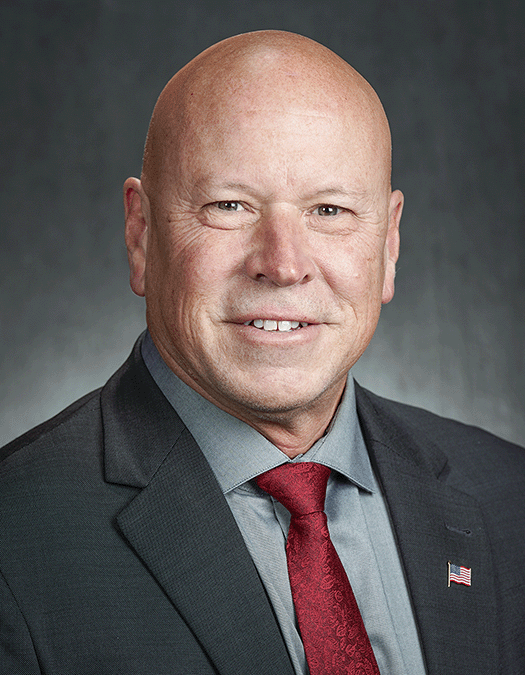
Rep. Wayne Johnson
Sponsored bills
Maddy summaryHF 1375 repeals Minnesota Statutes section 626.892, which established a specific process for selecting arbitrators in peace officer grievance cases. This repeal removes the requirement for a roster of six qualified arbitrators, defined qualifications (including cultural competency training), and fee schedules for resolving disputes over disciplinary actions, discharge, or termination of licensed peace officers under collective bargaining agreements. The change directly affects peace officers and law enforcement agencies handling such grievances.
Maddy summaryThis bill appropriates $6.4 million for fiscal years 2026 and 2027 to fund Minnesota's Small Business Assistance Partnerships Program under Minnesota Statutes §116J.682. It directly supports small businesses by providing two-year grants through local partnerships, with funding administered by the Department of Employment and Economic Development. The bill specifies that all grants must be awarded in the first year of funding, and up to 5% of the appropriation may cover administrative costs. This is a one-time funding measure, not an ongoing program.
Maddy summaryThis bill appropriates $1.5 million from Minnesota's general fund and $500,000 from the workforce development fund to support the 2026 Special Olympics USA Games. The funds will directly support the Games' operations and specifically target employment initiatives for individuals with intellectual and developmental disabilities. The $500,000 grant from the workforce fund is earmarked for activities aimed at increasing job opportunities for this community during the Games. These are one-time appropriations for fiscal year 2026, with no ongoing funding commitment.
Maddy summaryHF 1352 modifies Minnesota's definition of "residential generator" for solid waste management billing. It clarifies that multi-unit properties like apartment buildings, condos, or manufactured home parks where residents aren't separately billed for waste services (and the owner/association pays directly) are explicitly included as residential generators. This directly affects property owners, associations, and waste service providers managing such properties. The change ensures consistent billing responsibility for waste services in these multi-residence settings, effective July 1, 2025.
Maddy summaryHF 2238 requires Minnesota's commissioner to approve youth skills training programs in construction trades, specifically those conducted at central locations like headquarters or training facilities. It directly affects young workers in construction training programs and the commissioner who must review these programs. The bill adds a new rule to Minnesota Statutes 2024, section 175.46, mandating commissioner approval for eligible programs and exempting participants from conflicting child labor laws under section 181A.07, subdivision 7. This creates a streamlined pathway for youth to gain construction trade experience while complying with labor regulations.
Maddy summaryHF 1458 modifies Minnesota's requirements for becoming a certified public accountant (CPA). It extends current standards (150 college credits plus one year of relevant work experience) until July 1, 2030, after which new applicants will need either a master's degree plus one year of experience or a bachelor's degree plus two years of experience. The bill also establishes reciprocity, allowing CPAs licensed in other states with comparable requirements to practice in Minnesota without additional exams. This directly affects current and future CPA applicants in Minnesota and out-of-state CPAs seeking to practice in the state.
Maddy summaryHF 1976 modifies Minnesota's Paid Leave Law to clarify eligibility for paid leave benefits. It defines "covered employment" to include workers performing at least half their work in Minnesota, while excluding self-employed individuals, independent contractors, and seasonal hospitality workers (defined as employed up to 150 or 180 days in a year for hospitality employers). The bill also allows the state to contract with private companies to process leave applications, determine eligibility, and make payments. These changes provide clearer rules for employers and employees, particularly in the hospitality sector.
Maddy summaryHF 1003 appropriates $500,000 from the workforce development fund to Independent School District 294 in Houston for its Minnesota Virtual Academy career pathways program, in partnership with Operating Engineers Local 49. The program provides up to five semesters of courses leading to eligibility for the Operating Engineers apprenticeship program. It requires targeted outreach to students of color, Indigenous students, low-income students, and other underserved groups, and mandates an annual report to legislative committees detailing participant demographics, program spending, and recommendations for statewide improvements. This bill specifically supports one school district's program, not a statewide initiative.
Maddy summaryHF 701 appropriates funds from Minnesota's renewable development account to construct an anaerobic digestor energy system in Louisville Township. The bill specifically provides money for Recycling and Energy, in partnership with Dem-Con HZI Bioenergy, LLC, to build a facility that converts food and organic waste into renewable natural gas and biochar. This funding applies to fiscal years 2025 and 2026, with the system designed to process local organic waste streams. The bill directly affects Louisville Township residents and the designated companies by enabling this specific renewable energy project. The funding mechanism is a grant from the renewable development account to support the construction of the facility.