

Maddy summaryHF 841 appropriates a one-time emergency appropriation from the general fund to the commissioner of children, youth, and families for food shelf programs in Minnesota. The bill allocates unspecified funds to support existing food shelf programs under Minnesota Statutes section 142F.14, requiring quick distribution and making the funds available until June 30, 2026. This legislation directly affects community food shelves across Minnesota by providing state funding to support their operations. The bill focuses solely on funding allocation with no changes to program eligibility or structure. It is effective upon enactment and does not specify a dollar amount in the provided text.
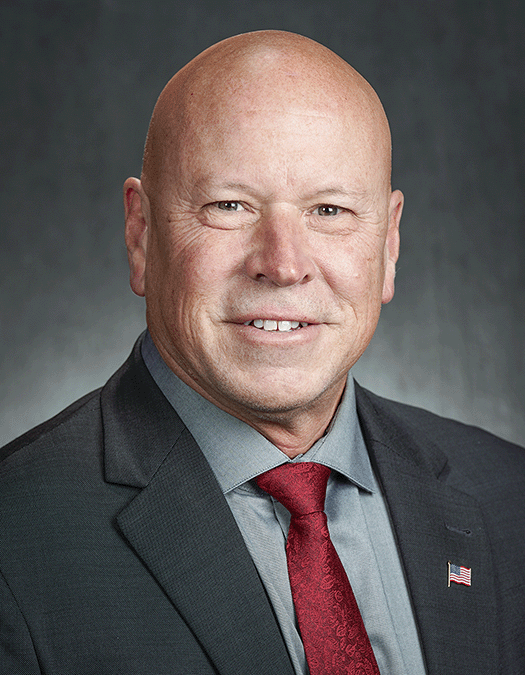
Rep. Wayne Johnson
Sponsored bills
Maddy summaryHF 1355 requires permit holders harvesting or destroying aquatic plants in Minnesota public waters to use scuba diving equipment safely and establishes safety standards for commercial diving operations. It mandates that applicants provide documentation of a recent third-party safety survey by a qualified professional (like a DLI consultant or insurance underwriter) and ensures divers have valid certification from accredited programs. The bill also requires employers to provide buoyancy control devices for workers using scuba equipment during these activities. These requirements apply directly to commercial entities and contractors seeking permits under Minnesota Statutes §103G.615 for aquatic plant management. The law aims to improve workplace safety for divers working in Minnesota's waterways.
Maddy summaryHF 1982 eliminates specific deadlines for schools to provide active transportation safety training to students in Minnesota. It repeals Minnesota Statutes 2024, section 123B.935, subdivision 2, which previously required schools to provide training within set timeframes (e.g., by the end of the third week for some students). The bill removes these mandatory timelines, giving schools flexibility in scheduling the training. This directly affects K-12 public and nonpublic schools in Minnesota that previously had to meet these deadlines. The change only modifies existing timing requirements - no new training requirements are added.
Maddy summaryHF 733 removes restrictions on handheld electronic devices used for bingo and pull-tab games in Minnesota. The bill amends state law to allow these devices, which must meet specific requirements like a $0.25 minimum ticket price, a limit of 36 bingo faces per game, and no slot machine-style features (e.g., spinning reels or bonus screens). It also requires devices to support visually impaired players and maintain transaction records. This change directly affects bingo and pull-tab operators by enabling new electronic gameplay options while maintaining key safeguards.
Maddy summaryThis bill appropriates $20 million ($10 million for each of fiscal years 2026 and 2027) to create regional food bank grants. It directs the commissioner of Children, Youth, and Families to distribute funds to regional food banks and federally recognized Minnesota tribes to purchase, transport, and distribute food through federal programs, with optional use for hygiene products like diapers. Recipients must comply with federal food assistance guidelines and report spending to the commissioner. The program aims to increase food availability for individuals and families in need across Minnesota.
Maddy summaryHF 1376 appropriates $1 million for fiscal year 2026 and $1 million for fiscal year 2027 from the general fund to support the FATHER Project through a grant to Goodwill Easter Seals Minnesota and its partners. The project operates in Rochester, St. Cloud, St. Paul, Minneapolis, and surrounding areas to assist fathers in overcoming economic and emotional barriers to supporting their children. It specifically includes programs for fathers reentering communities after confinement. The funding is designated solely for continuing these existing services in the specified regions.
Maddy summaryHF 1740 appropriates $X from Minnesota's arts and cultural heritage fund for fiscal year 2026 to support community cable television programming. The funds will be distributed through the Minnesota Association of Community Telecommunications Administrators to public, educational, and governmental cable channels across the state. This grant program specifically aims to fund local programming that promotes community and civic engagement. The bill directly affects community cable providers by providing dedicated funding for locally produced content, with no changes to existing regulatory frameworks.
Maddy summaryHF 2259 appropriates $3.5 million from the general fund for fiscal year 2026 to the commissioner of public safety specifically for violent crime enforcement teams. This one-time funding supports existing teams focused on addressing violent crime. The bill directly affects Minnesota's public safety agency and the teams it funds, without creating new laws or altering existing policies. It provides concrete financial resources for current enforcement efforts, with no additional mechanisms or requirements described.
Maddy summaryHF 2371 requires healthcare providers to obtain written, informed consent before performing pelvic, breast, urogenital, or rectal examinations on patients who are anesthetized or unconscious. This applies to most situations, with limited exceptions for emergencies, exams within a previously consented-to procedure, or court-ordered evidence collection. Violating this requirement is a gross misdemeanor and may lead to disciplinary action by the provider's licensing board. The law takes effect August 1, 2025, directly affecting patients under anesthesia/unconsciousness and healthcare professionals performing such exams.
Maddy summaryThis bill modifies Minnesota law to clarify and limit optometrists' authority to prescribe or administer certain drugs. It specifically sets new time limits: oral antivirals may not be prescribed for more than 10 days, oral steroids for more than 14 days (requiring physician consultation), and oral carbonic anhydrase inhibitors for more than seven days. These changes apply directly to licensed optometrists in Minnesota who prescribe medications for eye conditions under the Board of Optometry's rules. The bill maintains existing restrictions on intravenous injections, invasive surgery, and Schedule II/III oral drugs.