

Maddy summaryThis bill establishes a $4 million state funding program to support local outdoor recreation projects and trail connections in Minnesota. The legislation authorizes the sale of state bonds to raise the necessary funds, which will then be distributed as matching grants to eligible communities for park development and trail infrastructure. Local governments and organizations seeking to improve outdoor recreation areas or build trail networks can apply for these grants, which require them to contribute their own matching funds. The bill takes effect immediately upon final passage by the legislature.
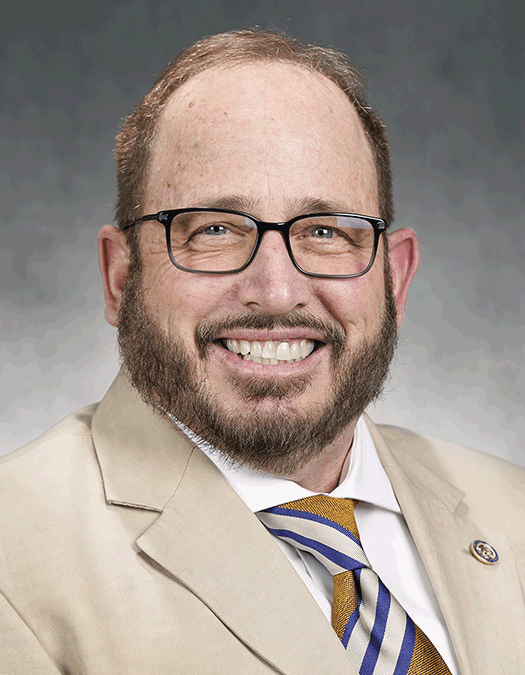
Rep. Roger Skraba
Sponsored bills
Maddy summaryThis bill designates the 1854 Ceded Territory as Minnesota's Core Moose Range and creates a new Moose Co-Stewardship Committee to manage moose restoration and research. The committee will include representatives from state agencies, Tribal nations, conservation groups, and the timber industry to develop management plans, coordinate habitat restoration, and review population data using both scientific and Indigenous knowledge. Revenue from moose licenses and auctions will fund research, habitat work, and committee expenses, while an annual report will track population trends and restoration outcomes. The bill also gives the commissioner authority to set bull-only hunting seasons and establish licensing processes based on population thresholds and habitat capacity.
Maddy summaryHF 3810 requires a licensed driver to be physically present in the driver's seat of any commercial motor vehicle using an automated driving system (levels 4-5 automation) while operating on public roads. The bill mandates the person must monitor the vehicle, intervene if unsafe, and be ready to take control. Violations impose penalties: a $2,000 misdemeanor fine for first offenses, escalating to gross misdemeanors with doubled fines for repeat violations by the same owner or lessor. This directly affects commercial trucking and bus operators seeking to deploy fully autonomous systems. The law aims to ensure human oversight during automated operation of commercial vehicles.
Maddy summaryThis bill designates iron ore as the official state mineral of Minnesota. It requires the Office of the Secretary of State to keep a photograph and a typical specimen of iron ore on file. The legislation adds a new section to the Minnesota Statutes to establish this designation.
Maddy summaryThis bill creates a new crime called disruption of worship services in Minnesota, targeting individuals who enter religious buildings with the intent to disrupt scheduled services by committing a crime. The law defines a religious establishment as a building used for worship that is clearly marked with a sign or other identifier. First-time offenders face gross misdemeanor charges, while repeat offenders could be charged with a felony punishable by up to five years in prison or a fine of $10,000 or both. The provisions take effect on August 1, 2026, and apply only to crimes committed on or after that date.
Maddy summaryThis bill requires publicly funded state and local correctional facilities in Minnesota to check the immigration status of certain noncitizens and notify U.S. Immigration and Customs Enforcement when they are housed there. The law applies to individuals in pretrial confinement, those convicted of felonies, and people committed to mental health institutions, mandating that facility officers immediately report nationality, conviction details, commitment duration, citizenship country, and last entry information to federal immigration authorities. Additionally, the bill requires a one-time review of all felony inmates in public facilities by July 1, 2026, to identify any noncitizens and report their status to federal officials. This policy change directly affects correctional facilities, sheriffs, and county officials who manage public institutions, while requiring them to share specific inmate information with U.S. immigration officers.
Maddy summaryHF 3562 modifies Minnesota's motor vehicle registration tax for passenger cars and hearses. It reduces the tax rate from 1.54-1.575% to 1.25-1.285% of a vehicle's manufacturer's suggested retail price (MSRP), depending on whether the vehicle was first registered in Minnesota before or on/after November 16, 2020. The tax amount decreases each year based on the vehicle's age (e.g., 100% of MSRP in year one, dropping to 10% in year ten), then becomes a flat $20 annually after the 10th year. This bill directly affects Minnesota vehicle owners paying registration fees for passenger cars and hearses, effective for registrations starting January 1, 2027.
Maddy summaryHF 275 modifies Minnesota's trapping regulations by changing how often certain traps must be checked. It allows body-gripping traps and snares (that can't drown animals) to be tended only once every third calendar day, instead of daily. The bill also permits foot-encapsulating traps within 50 feet of water without special permits during mink and muskrat season, while maintaining other restrictions. These changes replace an existing rule requiring daily snare checks (Minnesota Rules 6234.2400, subpart 10), directly affecting fur trappers and wildlife management practices.
Maddy summaryThis bill authorizes the issuance of up to $170,000 in state bonds to fund wastewater treatment system improvements for the Crane Lake Water and Sanitary District. The funds will be used to design, engineer, construct, and equip upgrades that include replacing mechanical systems, updating monitoring and control systems, and renovating facilities to support ongoing operations. The commissioner of management and budget is directed to sell and issue the bonds, with the appropriation becoming effective the day after the bill is enacted.
Maddy summaryThis bill authorizes the state of Minnesota to issue up to $3.7 million in bonds to fund public infrastructure improvements in the city of Cook. The funds will be used for two main projects: upgrading the city's wastewater collection and treatment systems with $1.5 million, and developing water and sewer infrastructure for the North Business Park with $2.2 million. The state Public Facilities Authority will manage the grants, and any unused funds can be redirected to similar projects within the same section. The bill takes effect immediately after being passed by the legislature.