

Maddy summaryHF 1331 requires the commissioner of natural resources to conduct an annual statewide survey to estimate Minnesota's wolf population. The survey must cover the entire state - not just historic wolf habitats - and be completed each year. This amendment to Minnesota Statutes section 97B.646 (wolf management) adds this requirement to the existing framework, which already includes a wolf management plan and quarterly mortality reporting. The bill directly affects state wildlife management practices under the Department of Natural Resources.
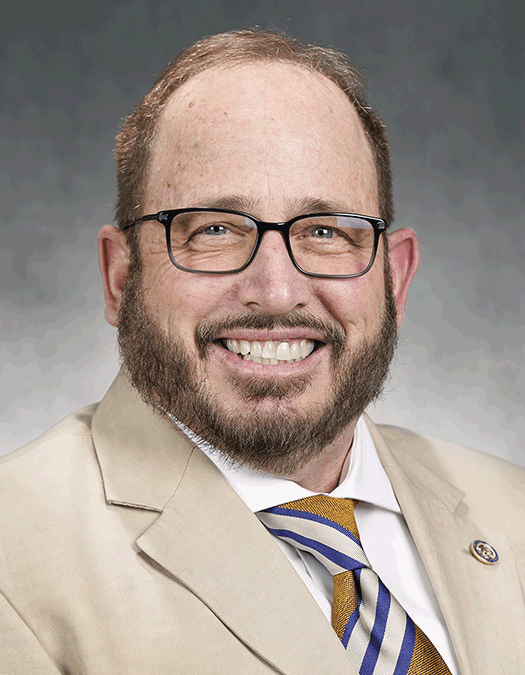
Rep. Roger Skraba
Sponsored bills
Maddy summaryHF 740 creates a new sales tax exemption for nonprofit animal shelters in Minnesota. It exempts shelters from sales tax on purchases directly used for rescuing, sheltering, and rehoming animals, such as supplies and equipment. However, the exemption does not cover construction materials, lodging/food at fundraising events exceeding 24 days yearly, or gambling-related activities. The exemption applies to sales of animals, associated supplies, and certain fundraising events, effective after June 30, 2025. This directly affects qualifying nonprofit shelters by reducing their operational costs.
Maddy summaryHF 1304 appropriates $10 million from state bond proceeds to fund Minnesota's Safe Routes to School grant program. The funds will be administered by the commissioner of transportation to provide grants to school districts for projects like sidewalks, crosswalks, and bike lanes that improve safety for students walking or biking to school. This bill authorizes the state to issue up to $10 million in bonds to finance the program, following established bond procedures under Minnesota law. The program directly benefits school districts and students by creating safer infrastructure for commuting to school.
Maddy summaryHF 1281 appropriates $750,000 from Minnesota's arts and cultural heritage fund for fiscal year 2026 to fund a lake sturgeon project at the Great Lakes Aquarium. The funds will support rearing and stocking lake sturgeon, along with public education about their historical, cultural, and biological significance in the St. Louis River. This project is implemented in partnership with the Minnesota Department of Natural Resources, the Fond du Lac Band of Lake Superior Chippewa, and the U.S. Fish and Wildlife Service. The bill directly affects these organizations by providing dedicated funding for conservation and educational activities focused on lake sturgeon recovery.
Maddy summaryHF 105 appropriates $42,000 from Minnesota's workforce development fund for Aspirus Lake View Hospital to train up to 12 new certified nursing assistants (CNAs) for local employers. The grant covers training costs, certification testing, and retention bonuses for trainees. Funds are available through June 30, 2027, for fiscal year 2026. This direct funding supports the hospital's workforce development program to address CNA staffing needs in the community.
Maddy summaryThis bill appropriates $500,000 for fiscal year 2026 and $500,000 for fiscal year 2027 from the general fund to support Minnesota's existing Loggers Safety Grant Program. The funds will be administered by the commissioner of labor and industry to provide safety grants directly to loggers and logging businesses. The program, established under Minnesota Laws 2021, First Special Session chapter 10, article 3, section 21, helps logging operations implement safety improvements. This funding ensures continued support for workplace safety initiatives in Minnesota's logging industry.
Maddy summaryThis bill appropriates $2.5 million for fiscal year 2026 and $2.5 million for fiscal year 2027 from the arts and cultural heritage fund to the Minnesota Humanities Center. The funding supports statewide humanities programs, including cultural programming focused on Minnesota, veterans and military experiences, educator professional development, and initiatives reflecting Black, Indigenous, and people of color communities. It directly affects the Minnesota Humanities Center, which will use the funds for outreach, partnerships, and expanded programming across the state. The bill makes no changes to existing laws but provides specific funding for these established program areas.
Maddy summaryHF 1035 creates a refundable sales tax exemption for construction materials purchased by Cook County Schools (Independent School District No. 166) for specific projects between June 1, 2025, and December 31, 2027. The exemption covers new facilities (secure entrances, gym, fitness center), renovations (classrooms, commons, bathrooms), and infrastructure updates (HVAC, security systems). Schools pay sales tax upfront but receive a full refund through the state’s existing process for similar school construction projects. This reduces immediate cash flow costs for the school district during eligible building work.
Maddy summaryHF 114 appropriates $500,000 for fiscal year 2026 and $500,000 for fiscal year 2027 from the arts and cultural heritage fund to provide grants to all 95 Minnesota county agricultural societies. The funds must be distributed equally to each county fair to enhance arts access, education, and the preservation of Minnesota's agricultural, historical, and cultural heritage. This grant program operates in addition to existing funding under Minnesota Statutes section 38.02. The commissioner of agriculture will develop grant criteria and seek public input to guide funding for projects supporting these goals.
Maddy summaryHF 636 removes the requirement for a permit to carry a firearm in public places for eligible Minnesotans, while creating an optional permit system. The bill amends Minnesota Statutes 624.714 to state that anyone not prohibited by state or federal law (and at least 21 years old) may carry a firearm without a permit in public places - defined as government-owned property or private property open to the public, excluding homes, businesses, gun shops, and hunting areas. An optional permit, which requires proof of pistol safety training and background checks for disqualifying offenses, remains available for those who choose it. This change directly affects eligible residents who currently need permits to carry firearms in public, eliminating that barrier while preserving the option for a permit.