

Maddy summaryHF 700 creates the "Minnesota Women's Bill of Rights" by establishing specific biological definitions for sex-related terms in all state statutes, rules, and agency policies. It defines "woman" as an adult human of female sex, "girl" as a female minor, and "sex" as biological sex assigned at birth (with only two sexes), explicitly stating gender identity cannot substitute for "sex." The bill requires state agencies, schools, and public entities to use these definitions when collecting data on sex, including in vital statistics and antidiscrimination compliance. It also prohibits using terms like "gender identity" as synonyms for "sex" in official contexts. This bill directly affects how Minnesota state government classifies individuals in all legal and administrative documents.
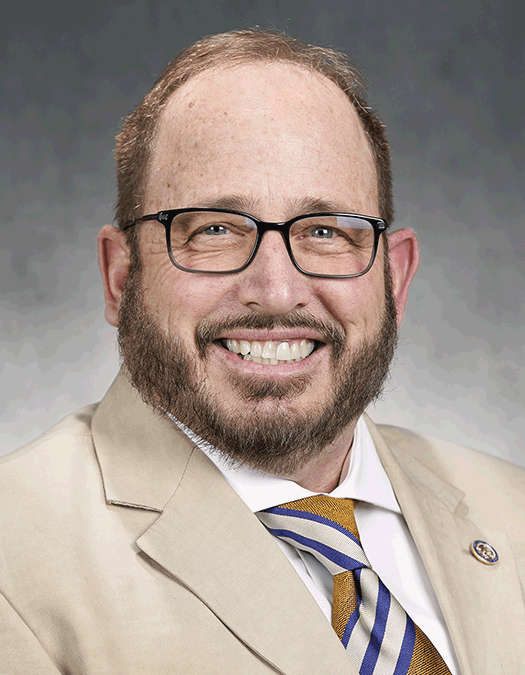
Rep. Roger Skraba
Sponsored bills
Maddy summaryHF 1253 modifies Minnesota's absentee ballot procedures for certain voters. It shortens the timeline for mailing absentee ballots from 46 days to 28 days before elections (Minnesota Statutes 2024, § 203B.06, subd. 3) and moves the deadline for returning ballots from 8:00 p.m. to 3:00 p.m. on election day (§ 203B.08, subd. 1). The bill also prohibits correctional facilities from receiving absentee ballots, requiring county auditors to reject applications with correctional facility addresses (§ 203B.06, subd. 2). These changes directly affect absentee voters, election officials managing ballot distribution, and correctional facilities.
Maddy summaryHF 11 delays the implementation of Minnesota's Paid Leave Law from 2026 to 2027, affecting employers, employees, and state agencies responsible for administering the program. The bill amends multiple statute sections to adjust key dates, including the start of employer premium payments (now January 1, 2027) and administrative requirements like public outreach and annual reporting. This one-year delay provides additional time for businesses to prepare for the new paid leave program without changing the law's core requirements. The law's substance - such as premium rates and fund management - remains unchanged, only the rollout timeline is extended.
Maddy summaryHF 1433 shortens notice periods for landlords handling tenant-abandoned property in Minnesota. It changes the required waiting period from 28 days to 14 days after a landlord learns a tenant has abandoned premises before they may sell the tenant's belongings. The bill also reduces the period from 60 days to 14 days after an eviction order before a landlord can hold a public sale of stored property. These changes directly affect landlords and tenants involved in eviction or abandonment cases under Minnesota law. The bill maintains existing requirements for landlords to notify tenants in writing and post notices before selling property.
Maddy summaryHF 1763 appropriates $25 million from the general fund for fiscal year 2026 to replace old aircraft shelters and construct new universal parking shelters at the Duluth Air National Guard Base for the 148th Fighter Wing, Minnesota Air National Guard. The funding covers removal of existing single-bay shelters and construction of new facilities. This is a one-time appropriation available until spent, specifically targeting infrastructure improvements at the Duluth base. The bill directly affects the 148th Fighter Wing's operations and maintenance at that location.
Maddy summaryHF 1241 repeals Minnesota's Paid Leave Law, which previously provided state-funded family and medical leave benefits. The bill transfers any unspent funds from the family medical leave account to the general state fund, effective July 1, 2025. It specifically repeals all provisions of Minnesota Statutes 2024, sections 268B.001 through 268B.30, which governed the paid leave program. This action eliminates the state's paid leave law and redirects unused program funds to the general state budget.
Maddy summaryHF 983 appropriates $15 million from bond proceeds and $11.5 million from the general fund for fiscal year 2026 to fund Minnesota's Local Road Wetland Replacement Program. This program replaces wetlands drained during public road repairs, as required by state law (Minnesota Statutes §103G.222), and is administered by the Board of Water and Soil Resources. The bill authorizes the sale of $15 million in state bonds and allocates an additional $7.5 million annually from 2026-2027, plus $2 million yearly for program administration. It requires fair market value pricing for land/easement purchases and allows the Board to acquire wetland replacement credits through agreements with federal agencies or private entities.
Maddy summaryHF 1996 increases Minnesota's annual funding cap for town aid from $10 million (for 2015-2025) to $11.5 million (starting in 2026). It modifies the calculation method for distributing this aid to all qualifying towns but does not change the formula itself. The bill affects all Minnesota towns receiving state aid under this program, directly increasing the total available funds for their distribution. The change takes effect for aid paid in calendar year 2026 and later.
Maddy summaryHF 1019 appropriates $2.35 million from the arts and cultural heritage fund for each of fiscal years 2026 and 2027 to Minnesota Public Radio, Inc. (MPR). The funding requires MPR to create original programming and digital content, partner with artists and cultural groups statewide, increase representation of communities of color and Indigenous communities in its broadcasts, and preserve Minnesota's historical audio archives. This bill directly affects MPR's operations and programming, with the goal of expanding arts access and cultural storytelling across Minnesota. The appropriation is a direct funding mechanism for MPR's existing services, not a new program.
Maddy summaryHF 898 withdraws Minnesota from the National Popular Vote Interstate Compact, a multi-state agreement that would have awarded the state's presidential electors based on the national popular vote. The bill amends Minnesota election law to revert to the state's existing method for selecting presidential electors: candidates are nominated by party conventions and elected based on congressional district and statewide vote totals, rather than the national popular vote. This change directly affects how Minnesota's 10 presidential electors are chosen in future elections. The bill repeals Minnesota Statutes sections 208.051 and 208.052, which had implemented the compact.