

Maddy summaryThis bill requires the Bureau of Criminal Apprehension and Violent Crime Enforcement Teams to submit an annual report detailing their gun trafficking investigations, the number of firearms seized, and how funding for violent crime reduction was utilized. It also updates the legal definition of a "trigger activator" to include devices that allow a firearm to fire multiple shots with a single trigger pull or without requiring a subsequent pull. Additionally, the legislation increases penalties for transferring firearms to individuals who are legally ineligible to possess them, raising the maximum prison sentence from two years to five years if the weapon is used in a violent felony within a year of the transfer.
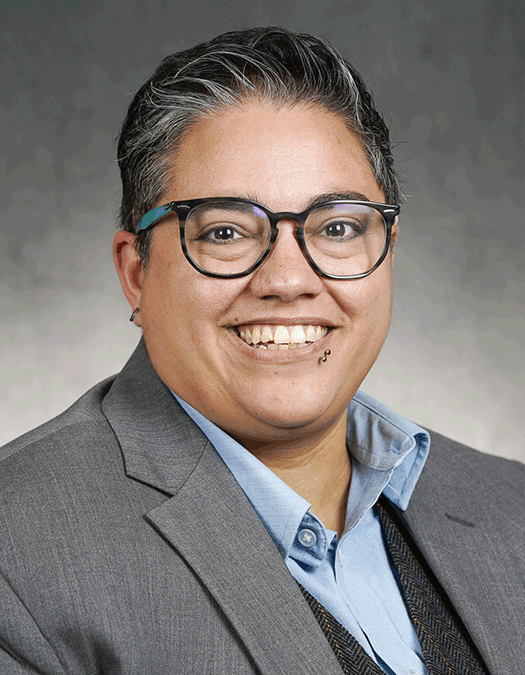
Rep. Brion Curran
Sponsored bills
Maddy summaryThis bill, which has been signed into law, updates Minnesota's human services regulations to improve safety and operational clarity for disability, aging, and substance use disorder programs. It exempts small residential facilities with six or fewer residents from certain local rental licensing rules while maintaining zoning allowances for these programs. Additionally, the bill mandates that providers complete specific health and safety assessments within 45 days of a client's service start date to better address individual needs. These changes aim to modernize existing statutes and remove outdated language to better support service delivery across the state.
Maddy summaryThis bill prohibits state agencies, public universities, charter schools, and local municipalities from banning or removing rainbow flags and other rainbow displays from their property. While it protects these symbols, it includes an exception for public meeting rooms or spaces where general rules already restrict the display of any banners or posters. The law applies immediately upon enactment and ensures that government entities cannot enforce policies that specifically target rainbow imagery.
Maddy summaryThis bill updates Minnesota laws to protect the privacy of judges and other judicial officials by classifying their personal information as private data. It specifically safeguards details such as residential addresses, contact information, and the names of their children or the schools they attend from being posted online by businesses, government entities, or individuals. While the law generally prohibits making this information available on the internet, it includes exceptions for news reporting, information voluntarily shared by the officials themselves, or data requested by the officials. Additionally, the legislation establishes a process allowing judicial officials to request the removal of their personal information if it has already been posted online.
Maddy summaryThis bill establishes a new program in Minnesota to collect and recycle electronic waste from households and small businesses. It defines specific items that must be recycled, such as computers, monitors, and gaming consoles, while excluding devices like cameras, telephones, and household appliances. The legislation creates a system where an approved organization, known as a clearinghouse, will manage the collection, transport, and recycling of these covered devices. Additionally, the bill sets up new state accounts to fund the program and requires the state agency to submit a report on its progress.
Maddy summaryThis bill modifies Minnesota's unemployment insurance rules to clarify eligibility for workers who stop working due to a labor dispute at their workplace. It states that applicants involved in such disputes are not considered to have quit or been fired, nor are they on leave, which preserves their potential claim for benefits. The law specifies that eligibility depends on whether the worker is directly participating in the dispute or if the dispute involves a conflict between different labor organizations. Additionally, the bill clarifies that quitting or being fired while a dispute is active does not end the worker's participation in the dispute for benefit purposes.
Maddy summaryThis bill prohibits individuals from using force against another person based on the victim's actual or perceived sexual orientation, gender identity, or expression. It specifically removes the ability to claim self-defense or use of force authorization if the victim made an unwanted nonforcible romantic or sexual advance or if the two people had previously dated. The law applies to crimes committed on or after August 1, 2024, and does not alter existing rules regarding the use of force in other situations like arrests or property disputes.