

Maddy summaryHF 186 requires Minnesota's transportation department to conduct cumulative impacts analyses and alternative design studies for highway projects, incorporating community input through a new policy advisory committee. It creates a dedicated environmental justice ombudsperson position to address equity concerns and restricts highway funds from covering non-transportation uses like tourist kiosks, parades, or electric vehicle infrastructure. The bill directly affects highway planning decisions, funding allocations for the Minnesota Department of Transportation, and communities near proposed projects. Key provisions include mandating community input for project designs and clarifying eligible uses of highway funds under Minnesota Statutes.
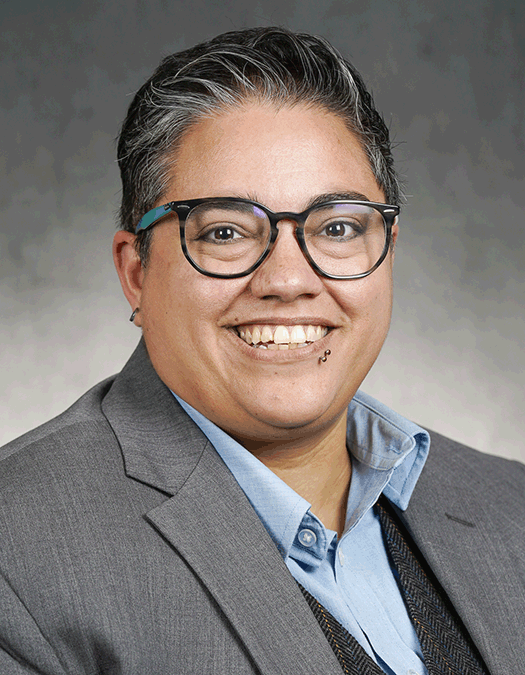
Rep. Brion Curran
Sponsored bills
Maddy summaryHF 1611 appropriates $1 million from the general fund for the 2026 fiscal year to fund a "Lawns to Lunch" pilot program. The program provides financial and technical assistance to help residents and communities convert lawns into food gardens featuring vegetables, fruits, pollinator plants, and other edibles. It prohibits using funds for commercial food sales, greenhouses, or buildings, and the money must be spent by June 30, 2030. This one-time funding supports local food gardening efforts without creating new regulations.
Maddy summaryHF 1756 increases property tax exclusions for Minnesota veterans with service-connected disabilities and modifies benefits for surviving spouses. Veterans with a 70% or higher disability rating receive a $150,000 exclusion (doubling to $300,000 for 100% disability), with the base amount adjusted annually for inflation using a federal economic index. Surviving spouses of qualifying veterans or service members who died in active duty can continue the full $300,000 exclusion until they remarry or sell the home. The bill directly affects veterans, their spouses, and primary family caregivers who qualify under the existing program.
Maddy summaryHF 669 modifies Minnesota's children's mental health grant programs to expand services for students. It allows schools and providers to use funds for telehealth services, family support, school staff training, and student transportation to mental health appointments when school isn't in session. The bill requires grantees to seek third-party reimbursement (excluding public schools) but ensures services are available regardless of a student's insurance or ability to pay. It also clarifies rules for nonemergency medical transportation providers under Minnesota health care programs. The legislation appropriates state funds to support these expanded services for children and families.
Maddy summaryThis Minnesota House resolution (H.R. No. 1) condemns President Trump's January 20, 2025, pardon of individuals convicted of violent crimes related to the January 6, 2021, Capitol insurrection. It specifically targets the pardon of 400 people, including members of extremist groups like the Oath Keepers and Proud Boys, who had been found guilty of assaulting law enforcement with weapons. The resolution expresses the Minnesota House's disapproval of erasing these convictions, arguing the pardon undermines justice and devalues law enforcement sacrifices. As a non-binding resolution, it has no legal effect but formally rejects politicizing public safety.
Maddy summaryHF 1401 expands Minnesota's definition of "endangered" for the missing and endangered persons program. The bill adds specific circumstances that classify a missing person as endangered, including needing urgent medical care, having cognitive impairments like dementia, or being lost in dangerous wilderness areas. This change allows law enforcement to activate immediate search and rescue resources when these new criteria are met. The bill directly affects local police departments and individuals who go missing under these expanded circumstances, ensuring faster response for vulnerable cases.
Maddy summaryHF 775 requires Minnesota school districts to create written policies ensuring parents of children with disabilities can fully participate in their child's education. Specifically, districts must establish processes for providing free language assistance (like interpreters or translated documents) for non-English-speaking parents and reasonable accommodations (such as sign language interpreters or modified meeting formats) for parents with disabilities, without requiring health information disclosure. These policies must be posted in multiple languages on district websites, shared annually with parents, and kept confidential. The bill directly affects school districts and parents interacting with special education programs, effective July 1, 2025.
Maddy summaryHF 2040 directs Minnesota's Commissioner of Human Services to provide regular updates and seek federal approval for children's mental health programs. It funds gaps in children's residential facilities, establishes crisis stabilization facilities, and creates a legislative task force to address issues in residential care. The bill also requires licensing for facilities serving youth with sexual behavior concerns and mandates a financial study on residential facility funding. These changes aim to improve access to mental health services for children, particularly those in foster care, juvenile justice, or under protective services, with specific funding appropriations included.
Maddy summaryHF 2010 raises Minnesota's age of consent for criminal sexual conduct from 16 to 18 years old in cases where the offender is 22 or older. The bill amends Minnesota Statutes 609.344 and 609.345 to remove consent as a defense and criminalize sexual contact between minors aged 16-17 and partners 22+ years old. It specifically targets situations where the age gap exceeds 36 months (3 years) and the offender holds authority over the minor. The law takes effect August 1, 2025, imposing criminal penalties for violations that previously might have been treated as consensual.
Maddy summaryHF 701 appropriates funds from Minnesota's renewable development account to construct an anaerobic digestor energy system in Louisville Township. The bill specifically provides money for Recycling and Energy, in partnership with Dem-Con HZI Bioenergy, LLC, to build a facility that converts food and organic waste into renewable natural gas and biochar. This funding applies to fiscal years 2025 and 2026, with the system designed to process local organic waste streams. The bill directly affects Louisville Township residents and the designated companies by enabling this specific renewable energy project. The funding mechanism is a grant from the renewable development account to support the construction of the facility.