

Maddy summaryHF 3190 would impose a 2% gross receipts tax on businesses providing specific professional services to other businesses within Minnesota. It directly affects companies offering services like legal, accounting, architectural, engineering, management consulting, and computer services to other trade or business entities. The tax applies to the total revenue from these business-to-business service sales, with businesses optionally collecting it from customers (if separately stated) or paying it directly to the state. Businesses that paid similar taxes to other states may claim a credit against this tax. The bill does not apply to services sold directly to end consumers or to personal services.
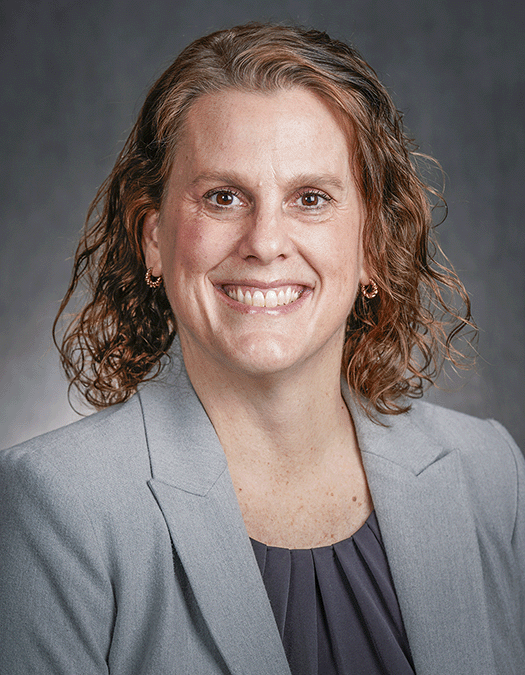
Rep. Kari Rehrauer
Sponsored bills
Maddy summaryHF 3189 imposes a 5-cent tax per kilowatt-hour on electricity used for charging electric vehicles at public charging stations in Minnesota, effective October 1, 2025. This tax applies to charging station operators who charge customers for public use (e.g., at businesses or public locations), but excludes home charging, small chargers under 50 kilowatts, and legacy stations (operating before October 2023) until 2032. Revenue from the tax is split equally: 50% goes to the highway user tax fund and 50% to the transportation advancement account. The bill also repeals a prior $75 annual surcharge on electric vehicle registrations.
Maddy summaryHF 2152 increases state funding for Minnesota's adult basic education programs. It raises the annual state total aid from $52.76 million to $65.17 million for fiscal year 2026, raises the per-contact-hour aid limit from $30 to $36, and fully covers (100%) the cost of commissioner-selected high school equivalency tests (like the GED) for eligible individuals, up to $40 per test. The bill appropriates $375,000 annually for test costs through 2027. These changes directly affect adult education programs statewide and individuals seeking high school equivalency credentials.
Maddy summaryHF 2994 appropriates $1 million from the workforce development fund to create a child care pilot program for Hennepin County law enforcement and first responders. The funding, available until June 2027, will help the Sheriff's Office partner with WomenVenture to recruit child care providers who can accommodate irregular work shifts, covering costs like business planning, training, and family scholarships. The program aims to improve retention by addressing a key challenge for these workers. By December 2027, the Sheriff's Office must submit a report detailing how the funds were used and recommending future child care solutions for public safety staff.
Maddy summaryHF 3179 requires large government-owned and private buildings (50,000+ square feet) to meet increasingly strict energy efficiency standards, aiming to cut greenhouse gas emissions from these buildings by 90% by 2045 compared to 2005 levels. Buildings are classified into four tiers based on ownership and size, with deadlines ranging from 2042 for government buildings (Class 1) to 2045 for large private buildings (Class 4). Owners must submit annual progress reports starting in 2028 and demonstrate steady improvement toward interim targets every five years. The law includes limited exemptions for buildings facing financial distress and specifically addresses multifamily affordable housing properties meeting certain eligibility criteria.
Maddy summaryHF 2469 requires Minnesota public high schools to provide free administration of nationally recognized college entrance exams (like the ACT or SAT) to all students in grades 11 or 12 starting in the 2026-2027 school year. It mandates school districts to contract with approved providers for these exams, using them to meet federal accountability requirements in English, math, and science. Students eligible for free or reduced-price meals receive full fee coverage, while others may be charged but must be offered fee waivers. The bill also requires districts to provide parental access to exam details and preparation resources. This directly affects Minnesota high school students, school districts, and state education officials managing testing compliance.
Maddy summaryThis bill modifies Minnesota law to clarify and restrict optometrists' authority to prescribe or administer certain medications for eye conditions. It specifically prohibits optometrists from administering drugs via IV, IM, or injection (except for anaphylaxis treatment or specific eye injections), performing invasive surgery (including laser procedures), or prescribing Schedule II/III oral drugs. The bill also sets strict time limits: oral antivirals cannot exceed 10 days, steroids require physician consultation after 14 days, and oral carbonic anhydrase inhibitors are limited to 7 days. These changes directly affect licensed optometrists in Minnesota who provide medical eye care.
Maddy summaryHF 2764 requires Minnesota public schools (including charter schools participating in the National School Lunch Program) to offer at least one plant-based meal option daily starting with the 2026-2027 school year. A "plant-based meal" is defined as one without any animal products (meat, dairy, eggs, fish), and schools must provide this option within four weeks of a student's written request. Schools must also make the request process clear to students and parents, comply with federal nutrition standards, and report annually on implementation to the Department of Education. The bill applies to all public schools serving lunches through the National School Lunch Program.
Maddy summaryHF 2489 modifies Minnesota school policies for epinephrine access, directly affecting students with severe allergies and school staff. The bill requires annual written authorization from parents and prescribing doctors for students to possess epinephrine auto-injectors or for schools to store them for immediate use. It mandates individualized health plans developed by parents, school staff, and medical professionals at the start of each school year, specifying whether a student can carry the device or needs it kept nearby during the instructional day. Schools must also keep additional epinephrine in first aid kits and define "instructional day" for implementation, while providing liability protection for good-faith actions.
Maddy summaryThis bill lowers the age threshold for early retirement reductions in Minnesota's Teachers Retirement Association from 62 to 60. It directly affects teachers who retire before normal retirement age but want to avoid reduced benefits. Specifically, members retiring before age 60 will now face the early retirement reduction, whereas previously the reduction applied only for retirement before age 62. The bill also clarifies procedures for delaying postretirement adjustments, though the exact mechanism isn't detailed in the provided text.